#Industry News
How the World's Safest Hospitals Use UV-C: An International Benchmark
Globally, 1 in 10 hospitalized patients develops at least one HAI, amounting to over 90 million cases annually, with several million resulting in severe complications or death—a major burden on healthcare systems and a constant driver for innovation.
Globally, one in ten hospitalized patients acquires an infection — over 90 million cases a year. The leading health systems pair manual cleaning with UV-C disinfection, digital traceability and adapted infrastructure. This benchmark shows how they do it.
Hospital-acquired infections (HAIs) affect roughly one in ten inpatients worldwide, more than 90 million cases annually, with several million severe or fatal. The burden is national-scale: the United States records about 1.7 million HAIs and 99,000 deaths a year at a cost above $30 billion; Germany about 580,000 HAIs, 35,000 linked to multidrug-resistant organisms and over 2,100 attributable deaths; Australia more than 170,000 HAIs and around 7,600 deaths. UV-C disinfection has become a common response, always as an adjunct to manual cleaning.
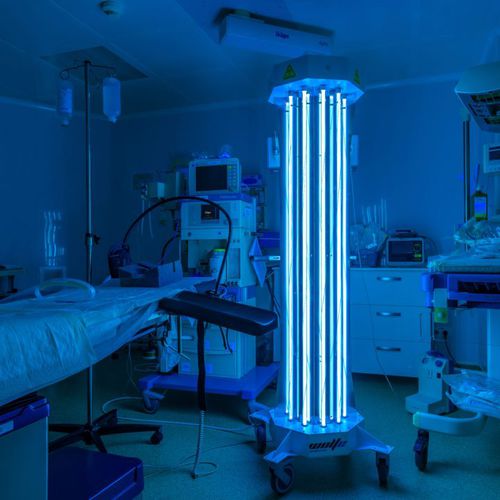
The benchmarks are instructive. Scandinavian hospitals keep HAIs under 4% (versus an EU average of 6%); Denmark's Odense University Hospital co-developed an autonomous UV robot (2016–2018), and 200 units were deployed across ten European countries in 2020. Germany's Freiburg University Hospital reported that a 15-minute post-discharge UV-C cycle cut Clostridioides difficile recurrence by about 25%. The Netherlands' "Search and Destroy" programme holds MRSA carriage at 0.11%, and Wilhelmina Hospital Assen halved orthopaedic-ward MRSA after routine post-discharge UV-C. In the US, Duke Health integrated UV-C into operational standards through the BETR and FELICIA studies, and an APIC no-touch whitepaper cited one hospital saving $30,000 a month. Singapore's smart hospitals achieve lethal UV-C doses on over 90% of surfaces and keep MRSA and CDI under 3%, while Seoul National University Hospital logs every cycle on a hospital blockchain. The UK's BS 8628:2022 standard formalises door interlocks, sensors and signage.
Across all of them, four success factors recur: digital traceability of every cycle, staff training that treats UV-C as a complement to cleaning, infrastructure adapted to robotics, and integration with HEPA filtration. Wolf-e Robotics — Romanian-born, globally oriented — is built around exactly these capabilities.
See how Wolf-e Robotics' traceable, autonomous UV-C systems align with international best practice on the company's MedicalExpo profile!
***
/UV-C hospital disinfection benchmark, HAI reduction, no-touch disinfection, infection control best practice, disinfection traceability/