#Industry News
Fractional CO₂ Laser Resurfacing: How It Works, Applications, and How to Choose a Professional System
Fractional CO₂ Laser From PZLASER
Fractional CO₂ laser resurfacing is a widely used laser technology in aesthetic dermatology for improving skin texture, acne scars, wrinkles, and selected forms of photodamage. By delivering laser energy in controlled microscopic treatment zones, fractional CO₂ lasers stimulate the skin's natural healing response while leaving surrounding tissue untreated.
For aesthetic clinics, dermatology practices, and medical aesthetic equipment distributors, understanding the technology, treatment applications, and key equipment specifications helps support informed purchasing decisions.
1. What Is Fractional CO₂ Laser Resurfacing?
A fractional CO₂ laser is a skin resurfacing system that delivers laser energy in multiple microscopic treatment zones rather than treating the entire skin surface uniformly.
Traditional ablative resurfacing removes tissue across a continuous treatment area. In contrast, fractional technology creates small, separated zones of controlled thermal injury while preserving surrounding skin. These untreated areas support the healing process and can help reduce recovery time compared with fully ablative resurfacing, although downtime still depends on treatment intensity and individual skin characteristics.
Fractional CO₂ lasers commonly operate at a wavelength of 10,600 nm (10.6 μm). Water absorbs this wavelength efficiently, allowing the laser to heat and ablate water-containing tissue with precision.
The resulting controlled tissue response can stimulate collagen remodeling and improve the appearance of selected scars, wrinkles, and uneven skin texture over time.
2. How Does a Fractional CO₂ Laser Work?
Fractional CO₂ laser resurfacing involves three main processes:
①. Controlled tissue ablation
The laser delivers energy to targeted microscopic areas of the skin. Depending on the selected settings and treatment mode, the energy can vaporize tissue and create controlled thermal effects.
②. Activation of the skin's repair response
The treatment initiates a wound-healing response. Fibroblast activity and collagen remodeling contribute to gradual changes in skin texture and the appearance of selected scars and wrinkles.
③. Recovery and tissue remodeling
The surrounding untreated tissue helps support recovery. Redness, swelling, crusting, and temporary changes in pigmentation may occur, and the skin can continue remodeling after the initial healing period.
Treatment parameters must match the indication, skin type, anatomical area, and desired treatment intensity. Appropriate patient assessment and aftercare remain essential.
3. What Skin Concerns Can Fractional CO₂ Lasers Address?
Fractional CO₂ laser systems can support several professional skin resurfacing applications.
① Acne Scars and Selected Traumatic Scars
Atrophic acne scars can create depressions and uneven skin texture. Fractional CO₂ treatment may improve the appearance of selected scars by resurfacing the skin and stimulating collagen remodeling. Certain traumatic scars may also benefit from appropriately selected laser treatment.
Results vary according to scar type, depth, skin characteristics, and treatment protocol. Deep or tethered scars may require a combination of treatment approaches.
② Fine Lines and Wrinkles
Fractional CO₂ resurfacing can improve the appearance of selected fine lines and photoaging-related skin changes. Collagen remodeling may contribute to gradual improvements in skin texture and firmness.
③ Uneven Skin Texture and Photodamage
Sun exposure and aging can contribute to rough skin texture, surface irregularities, and other visible signs of photodamage. Fractional resurfacing can help improve selected concerns through controlled tissue removal and subsequent healing.
④ Selected Pigmented Lesions
CO₂ lasers may be used for certain superficial lesions or tissue irregularities when clinically appropriate. However, not every pigmented lesion is suitable for CO₂ laser treatment. Suspicious lesions require appropriate medical assessment before any cosmetic procedure.
The treatment plan should reflect the diagnosis rather than treating all pigmentation concerns as the same condition.
4. How to Choose a Professional Fractional CO₂ Laser Machine
When comparing fractional CO₂ laser machines for a clinic or aesthetic practice, buyers should evaluate more than the wavelength or advertised power. The following technical factors can help determine whether a system suits the intended applications.
①. Laser Source and Energy Stability
The laser source influences energy delivery, spot characteristics, maintenance requirements, and long-term operating consistency.
Some professional systems use RF-excited CO₂ laser tubes. Buyers should evaluate the manufacturer's specifications, output stability, expected service life, maintenance requirements, and available technical support rather than relying on the laser source type alone.
②. Fractional Scanning Patterns
Adjustable scanning patterns allow practitioners to adapt treatment geometry to different areas and treatment objectives.
Useful considerations include the available pattern shapes, spot distribution, treatment area, spacing adjustments, and control over treatment parameters. These features can support more flexible treatment planning when used within the manufacturer's instructions.
③. Treatment Modes and Applicators
A system may offer fractional resurfacing alongside a conventional or normal mode for different tissue applications. Applicator options should correspond to the clinic's intended procedures.
Before purchasing, buyers should confirm which handpieces or applicators come with the machine, which options require additional purchase, and which treatment indications the manufacturer supports.
④. User Interface and Treatment Control
An intelligent control system can help practitioners select treatment parameters and manage scanning configurations. Clear controls, reproducible settings, and appropriate safety features are important for daily clinical operation.
Training, documentation, maintenance access, and after-sales support should also form part of the purchasing evaluation.
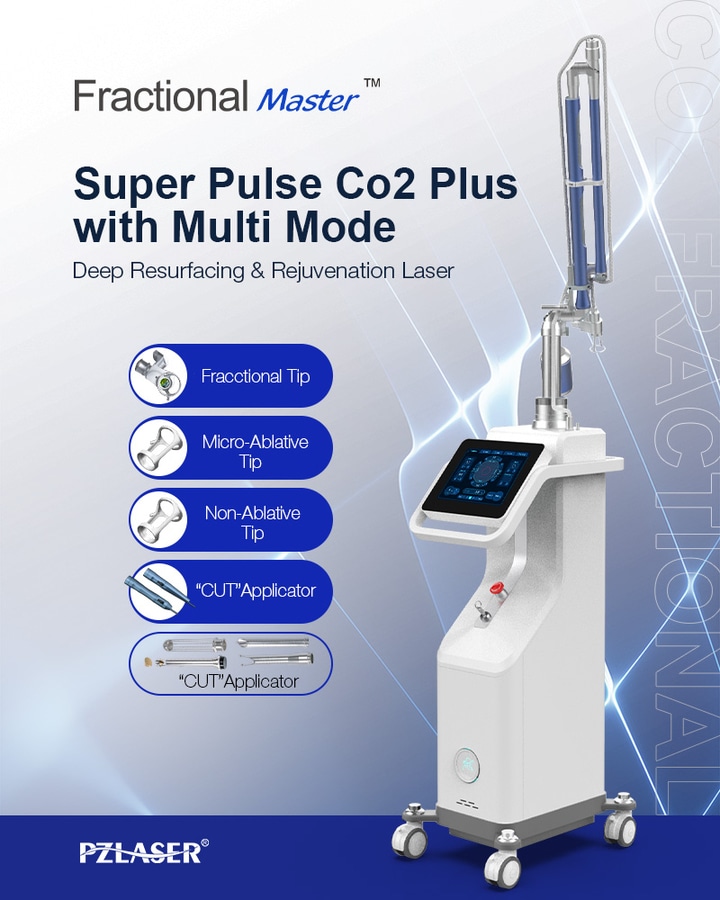
5. PZLASER Fractional CO₂ Laser: Features and Configuration
For clinics and distributors evaluating professional resurfacing equipment, the PZLASER Fractional CO₂ Laser offers a configuration built around 10,600 nm CO₂ laser technology.
According to the manufacturer's product specifications, the system includes the following features:
- 10,600 nm wavelength: Uses the strong absorption of CO₂ laser energy by water-containing tissue for resurfacing applications.
- RF-excited laser source: The brochure specifies a metal RF tube and describes stable energy delivery as a design feature.
- Two working modes: Normal mode and fractional mode support different treatment approaches.
- Multiple applicator options: The manufacturer describes a configuration with five applicators for different target areas.
- Adjustable scanning patterns: Multiple shapes, sizes, and spacing options support flexible treatment-area configuration.
- Articulated light-guiding arm: The system features a seven-joint light-guiding arm, according to the product brochure.
These features may be relevant to clinics seeking a versatile CO₂ laser platform for professional skin resurfacing and selected tissue applications.
Actual configurations, included applicators, operating parameters, and market-specific documentation should be confirmed directly with the manufacturer before purchase.
6. Fractional CO₂ Laser vs. Other Skin Resurfacing Technologies
Fractional CO₂ lasers are not the only option for improving skin texture and signs of aging. The appropriate technology depends on the treatment objective, acceptable downtime, patient characteristics, and clinical expertise.
- Fractional CO₂ laser: An ablative resurfacing approach that can address selected acne scars, wrinkles, and textural irregularities. It generally involves more recovery than non-ablative options.
- Non-ablative fractional lasers: Heat targeted tissue without the same degree of surface ablation. They may offer less downtime, depending on the device and treatment protocol.
- RF microneedling: Delivers radiofrequency energy through needles to create controlled thermal effects in the skin. Its mechanism and treatment considerations differ from those of CO₂ laser resurfacing.
- Superficial chemical peels: Use chemical agents to improve selected surface-level concerns and may suit patients seeking less intensive resurfacing.
No single technology is best for every patient or clinic. Treatment selection should consider the indication, expected benefits, risks, recovery requirements, and practitioner experience.
7. Frequently Asked Questions
① Is fractional CO₂ laser treatment ablative?
Yes. Fractional CO₂ resurfacing is an ablative laser technique because it can remove microscopic columns of tissue. The fractional delivery pattern leaves surrounding areas untreated, which supports recovery compared with treating the entire surface uniformly.
② How long does recovery take after fractional CO₂ laser treatment?
Recovery varies according to treatment intensity, anatomical area, individual skin response, and aftercare. Redness, swelling, crusting, and temporary pigment changes may occur. More intensive treatments generally require longer recovery, so practitioners should provide individualized aftercare instructions.
③ Is fractional CO₂ laser suitable for every skin type?
No. The risk of post-inflammatory hyperpigmentation and other complications can vary with skin type, treatment parameters, and individual risk factors. Practitioners should assess each patient carefully and follow appropriate treatment protocols.
④ What should buyers check before purchasing a fractional CO₂ laser machine?
Buyers should review the laser source, energy specifications, scanning patterns, applicator configuration, safety features, training, maintenance requirements, warranty, technical support, and applicable regulatory documentation for their intended market.
⑤ What is the difference between fractional and normal CO₂ laser modes?
Fractional mode distributes laser energy across separated microscopic treatment zones, preserving surrounding untreated tissue. Normal mode may deliver energy differently, depending on the system and applicator. Buyers should verify the precise functions and intended uses of each mode in the manufacturer's documentation.
8. Conclusion
Fractional CO₂ laser resurfacing combines controlled tissue ablation with the skin's natural repair response to improve selected scars, wrinkles, and textural irregularities. For professional buyers, understanding wavelength, laser source, scanning flexibility, applicator configuration, and clinical requirements is essential when evaluating equipment.
The PZLASER Fractional CO₂ Laser features a 10,600 nm laser source, normal and fractional working modes, multiple applicator options, and adjustable scanning patterns. Clinics and distributors can evaluate its configuration against their treatment needs, local regulatory requirements, and service expectations.
Manufacturer: Zhengzhou PZ Laser Slim Technology Co., Ltd.
Website: https://www.pzlaser.com/
Email: [email protected]