#Industry News
Нow Q-Switched Nd:YAG Laser Aesthetic Treatment Options
QBeam Q-Switched Nd:YAG Laser
Understanding Q-Switched Nd:YAG Laser Technology
Q-Switched Nd:YAG laser technology plays an important role in modern dermatology and aesthetic medicine. It uses short, high-energy laser pulses to target specific pigments in the skin, making it widely used for tattoo removal and the treatment of selected pigmented lesions.
Unlike conventional laser systems that rely primarily on prolonged thermal exposure, Q-switched lasers deliver energy within nanoseconds. This generates a photoacoustic effect that breaks pigment particles into smaller fragments, which can then be gradually cleared through the body's natural processes.
For aesthetic clinics and medical spas, understanding wavelength selection, pulse duration, and energy delivery is essential when evaluating a Q-switched laser system. Different wavelengths interact with different skin targets, allowing practitioners to address a wider range of treatment needs.
How Do Different Nd:YAG Laser Wavelengths Work?
One of the main advantages of Nd:YAG laser technology is its ability to operate at different wavelengths. Each wavelength has distinct absorption and penetration characteristics, making it suitable for different aesthetic applications.
1. 1064nm: Deep Pigmentation and Dark Tattoo Removal
The 1064nm wavelength penetrates relatively deeply into the skin and has lower melanin absorption compared with shorter wavelengths.
Its common applications include:
- Removal of dark tattoos, including black, blue, and brown pigments.
- Treatment of selected deep dermal pigmented lesions.
- Management of certain conditions involving deeper pigmentation, such as nevus of Ota and Mongolian spots.
Because of its relatively lower melanin absorption, 1064nm is often considered when treating patients with darker skin phototypes (Fitzpatrick IV–VI). However, appropriate parameter selection and professional assessment remain essential.
2. 532nm: Superficial Pigmentation and Colored Tattoos
The 532nm wavelength is generated through frequency doubling of the 1064nm Nd:YAG laser.
It is more strongly absorbed by melanin and primarily targets superficial skin pigmentation. Its applications include:
- Removal of selected red, orange, and yellow tattoo pigments.
- Treatment of freckles and sun spots.
- Management of certain epidermal pigmented lesions, including age spots and café-au-lait spots.
Since 532nm has stronger melanin absorption, practitioners should carefully adjust treatment parameters, particularly when treating darker skin types.
3. 1320nm: Skin Rejuvenation and Collagen Remodeling
Unlike 1064nm and 532nm, which are commonly associated with pigment targeting, the 1320nm wavelength primarily interacts with water in skin tissue.
It delivers non-ablative thermal energy to the dermis, supporting collagen stimulation and remodeling. This approach can help improve skin texture and the appearance of skin laxity without intentionally removing the epidermis.
For clinics looking to expand beyond pigmentation and tattoo-related services, 1320nm technology provides another treatment option within a multi-functional laser platform.
Why Are Pulse Duration and Energy Delivery Important?
Wavelength is only one factor affecting laser performance. Pulse duration and energy distribution also influence how laser energy interacts with target tissue.
A shorter pulse duration allows energy to be delivered within a shorter period, generating a stronger photoacoustic effect. This helps fragment pigment particles while limiting unnecessary thermal diffusion into surrounding tissues.
Energy uniformity is equally important. High homogeneous spot delivery helps distribute laser energy more consistently across the treatment area, supporting predictable energy delivery and treatment safety.
Some advanced systems also incorporate PTP (Photoacoustic Twin Pulse) technology. Instead of delivering the original energy as a single pulse, PTP divides it into two consecutive sub-pulses separated by an extremely short interval.
This approach is designed to distribute energy more evenly and provide a gentler treatment experience. It can be particularly relevant for skin rejuvenation applications where patient comfort is an important consideration.
What Should Clinics Consider When Choosing a Q-Switched Nd:YAG Laser?
For clinic owners, dermatology practices, and aesthetic equipment distributors, selecting a Q-switched laser involves more than comparing output power.
Several factors deserve attention:
1. Wavelength versatility
A system offering multiple wavelengths can support different treatment categories, including tattoo removal, pigmentation management, and skin rejuvenation. This may help clinics expand their service portfolios without purchasing separate devices for every application.
2. Pulse duration and energy output
Evaluate pulse width, single-pulse energy, and maximum energy output together. These specifications help buyers understand the system's technical capabilities.
3. Spot uniformity
Consistent energy distribution is an important consideration when assessing treatment precision and operational reliability.
4. Treatment flexibility
Selectable treatment tips and operating modes can help practitioners adapt the system to different clinical requirements.
5. Equipment design and workflow
For clinics with limited treatment room space, a compact and portable system may offer practical advantages. Ease of operation and maintenance support should also be considered when evaluating long-term equipment investment.
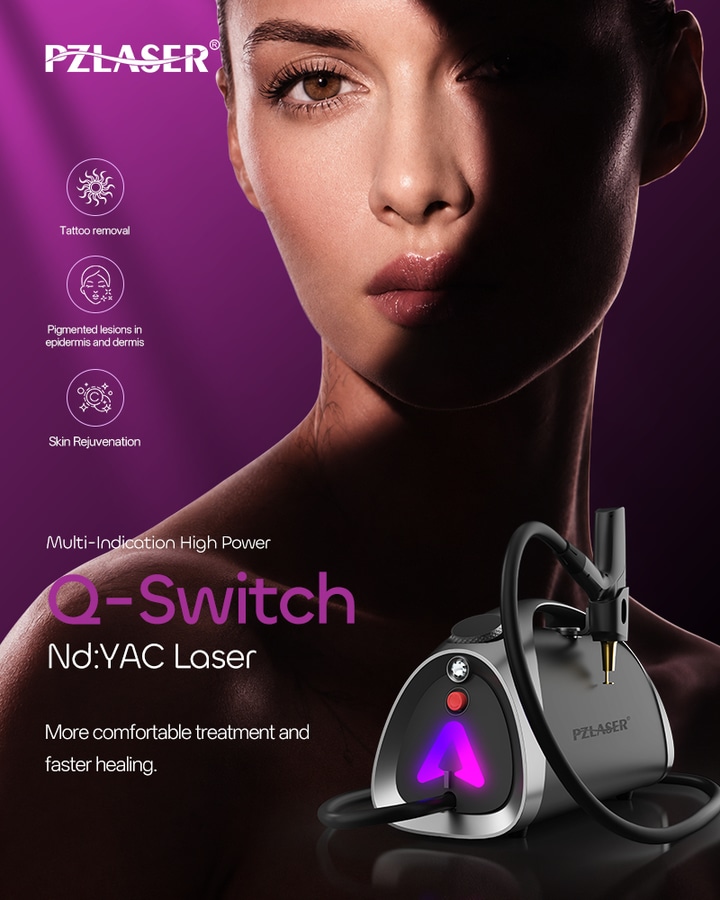
Q-Beam Plus: A Multi-Indication Q-Switched Nd:YAG Laser Solution
For clinics and distributors looking for a versatile Q-switched laser platform, PZLASER's Q-Beam Plus combines 1064nm, 532nm, and 1320nm wavelengths in one system.
Its key technical features include:
- One Lamp, Two Rods Design: A dual-rod Q-switched Nd:YAG configuration designed to maximize energy output.
- High Energy Output: Single-pulse energy of at least 450mJ, with maximum energy reaching 1500mJ.
- 6 ns Pulse Duration: Ultra-short pulse delivery designed to generate a strong photoacoustic effect.
- Three Treatment Options: Interchangeable 1064nm, 532nm, and carbon-assisted treatment tips for different applications.
- PTP Technology: Photoacoustic Twin Pulse mode designed to improve energy distribution and treatment comfort.
- Uniform Spot Delivery: High Homogeneous Spot Delivery technology for more consistent energy distribution.
- Portable Design: A compact system designed for aesthetic and dermatology institutions.
By combining multiple wavelength options with high-energy Q-switched technology and PTP functionality, Q-Beam Plus supports clinics seeking to develop pigmentation, tattoo removal, and skin rejuvenation services within one equipment platform.
Conclusion
Q-Switched Nd:YAG laser technology continues to offer versatile applications in aesthetic medicine. Understanding the differences between 1064nm, 532nm, and 1320nm wavelengths helps clinic owners and equipment buyers make more informed investment decisions.
When evaluating a system, buyers should consider not only wavelength options but also pulse duration, energy output, spot uniformity, treatment modes, and equipment design.
For professional clinics and distributors seeking a multi-indication solution, Q-Beam Plus provides a combination of three wavelength options, high-energy output, and PTP technology to support a broader range of aesthetic treatment services.