
#Trade Shows & Events
Micare at DenTech China 2026: Surgical Headlights & Dental Loupes on Show (Oct 22–25, Hall 4, Booth V69)
Nanchang Micare Medical Equipment will present its cordless surgical headlight and dental loupe lines at the 29th China International Dental Equipment Exhibition & Academic Symposium, held at the Shanghai World Expo Exhibition & Convention Center fro
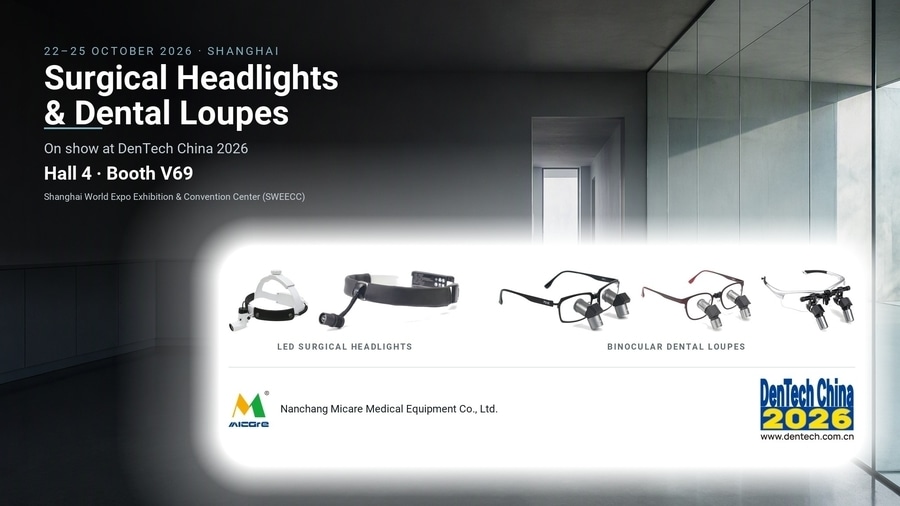
Nanchang / Shanghai — Nanchang Micare Medical Equipment Co., Ltd. will exhibit at DenTech China 2026, the 29th China International Dental Equipment Exhibition & Academic Symposium, taking place at the Shanghai World Expo Exhibition & Convention Center (SWEECC) from 22 to 25 October 2026. Micare's stand is in Hall 4, Booth V69, where the company will present two product lines aimed specifically at the working conditions of dental and oral surgery practice: cordless LED surgical headlights and binocular loupe systems. Visitors to the stand will be able to assemble and wear both configurations and judge the combined weight on the head rather than reading it from a brochure, and the loupe options most often specified for dentistry will be shown fitted to both headlight platforms.
"It is the same problem in every dental practice we visit," said the Micare engineering team. "You need magnification to see the detail, and you need light delivered from the same direction you are looking. Buying those two things separately is where most clinicians end up with a rig that is heavy, badly balanced or simply does not get used."
The reference levels that decide this comparison
Anyone walking a dental exhibition will compare equipment from several suppliers in a single afternoon, so it helps to have the category reference levels in mind before reaching the first stand.
In cordless surgical headlights and loupe systems, four published figures decide most of the decision: maximum illuminance at a stated working distance, the weight of the assembly worn on the head, colour temperature, and runtime at the intensity actually used. The bands we benchmark against when assessing equipment in this class are:
Illuminance. Cordless designs span a wide range — from the region of 85,000 lx at the lighter-duty end up to roughly 200,000 lx where a unit is intended for narrow, deep, high-detail fields. The figure means nothing without the working distance it was measured at, which is why quoted values differ so much between suppliers.
Weight of the head assembly. Published figures run from about 185 g for lightweight units to around 400 g for systems that carry the optics, the light and a battery on the same frame.
Colour temperature. Most of the category sits between roughly 4,500 K and 6,500 K: the warmer end reads closer to the halogen output many clinicians trained on, the cooler end reads as daylight.
Colour rendering. Ra 90 is the practical floor for magnified clinical work and Ra 95 or above is where the useful difference lives. Ask for R9 as well — it measures deep saturated red, and it can be weak even on a unit quoting a high Ra.
Runtime and charging. Five to twelve hours depending on the intensity used is the normal published band, with a full charge in about four hours and roughly half charge in two — the figure that decides whether one unit covers back-to-back sessions.
Spot adjustment. An adjustable spot spanning roughly 10 mm to 90 mm at a working distance in the region of 420 mm is what allows a single unit to cover both pinpoint and wide-field work without changing optics.
Two points are worth carrying into any comparison. First, these are category reference levels used for evaluating equipment — not the specification of any individual model, and not a substitute for the current datasheet of the unit you intend to order. Second, weight and runtime are the two figures most often published at their most favourable setting; ask for both at the intensity and magnification you actually work at.
The two headlight configurations on the stand
Micare brings one unit in each of those two classes.
The MB-JD2000 sits at the lightweight end: a cordless LED surgical headlight designed around the load carried on the head, with an adjustable spot that lets the same unit cover pinpoint and wider fields without a change of optics. Clinics that work mostly under loupes, on surface and shallow-cavity procedures, generally find that this is the class of headlight that gets worn all day without being taken off.
The JD2500 sits at the other end: a heavier, magnification-integrated system that carries both the light and the optics on one frame, intended for clinicians who work magnified throughout the day. It removes the second frame and the alignment problem between light and optics — and, as with any integrated system, it trades weight for that convenience.
The difference between the two is a genuine trade-off rather than a hierarchy, and it is decided by specialty and case mix rather than by a specification sheet. A lighter head is easier on the neck across a long list; an integrated system keeps the light coaxial with the magnification and removes a separate frame. Micare's stand staff will be asking about magnification and working distance before discussing brightness for exactly that reason.
Both units are cordless, which is a deliberate choice rather than a detail. Cable-driven headlight systems deliver light through a fibre-optic cable from a separate box, and the hazards of that arrangement are documented — see below. Battery workflow is the trade-off for removing the cable, so visitors should look at runtime, charging time and spare-battery options as a single system, not three separate line items.
The loupe lines
Alongside the headlights, Micare will show its binocular loupe ranges for dental and oral surgery use.
The AENF and AEFF magnetic-change systems let the clinician swap magnification on the same frame, so a single frame serves procedures that call for different working distances — which is usually the reason a clinician ends up owning two pairs of loupes instead. The 27NM series covers the lower-magnification end of the range, and the 27NM-350X is the configuration most often specified for general dentistry, where a wider field of view matters as much as resolution.
Both loupe families are shown with the headlight mounting interfaces on the stand, because compatibility — clip-on against headband-integrated, and the declination angle of the optics — is decided by the frame, not by the light.
Why the pairing matters, and what the literature says about it
For a dental audience, the headlight-and-loupe decision has a documented downside that product pages rarely mention: both are worn on the head for hours in a fixed, forward-leaning working posture.
The surgical lighting review by Curlin and Herman (Surg J, 2020) summarises the evidence on this directly. In a single-site study by Sahni et al, 68% of high-frequency surgical headlight users reported aggravated neck symptoms, compared with 38% of non- or low-frequency users, and 34% of high-frequency users had a confirmed clinical diagnosis of degenerative cervical disorder against 7% of low-frequency users. A separate retrospective analysis in the same review associated symptom onset with wearing headlights combined with loupes, with cases severe enough to require surgery.
The practical conclusion is not to avoid magnification, but to decide the rig as one system and to treat combined weight and balance as clinical parameters. A headlight is worn for hours a day, several days a week, for a career, and a difference of two hundred grams between two assemblies is not a specification detail — particularly when the same frame also has to hold the optics at the correct declination angle.
What visitors can do at Booth V69
Wear both headlight platforms with the loupe options fitted, and judge the combined weight and balance directly rather than from a figure.
Have a working distance measured and matched to a magnification, instead of selecting a magnification from a catalogue.
Check the spot adjustment across its full range at their own working distance.
Review the battery and charging workflow, including spares, as it would run across a full clinical day.
Compare cordless against cable-powered configurations. Cable-driven headlight systems deliver light through a fibre-optic cable from a separate box; the same review records those cables reaching as high as 437 °F (approximately 225 °C) within ten minutes, with case reports of patient burns from cable contact, and identifies them as a leading cause of surgical fires. For a clinic where the practice owner is also the safety officer, removing that hazard class from the room is a stronger argument than any illuminance figure.
Ask for the published data in writing. For tender and comparison purposes, Micare's engineering and compliance team can supply the current datasheet, the applicable test documentation and the compliance pack for a specific configuration on request.
Micare's engineering team will be available on the stand throughout the four days for working-distance fitting and specification discussions, including OEM and ODM enquiries from distributors and clinic chains. Meetings can be arranged in advance for visitors who want a specific configuration prepared before the show.
About Nanchang Micare Medical Equipment Co., Ltd.
Nanchang Micare Medical Equipment Co., Ltd. designs, manufactures and exports surgical lighting and medical illumination equipment, including surgical lights, examination lights, surgical headlights, binocular loupes, X-ray film viewers and operating table accessories, with OEM and ODM capability. The company's manufacturing facility holds ISO 13485:2016 certification, and its products carry CE marking under EU MDR 2017/745. The facility is an FDA-registered establishment (facility registration no. 3023808059) — establishment registration, which is a statement about the manufacturing facility and not a clearance or approval of any individual device.
Micare's product range, including the headlight and loupe configurations exhibited at DenTech China 2026, can be reviewed at the company's MedicalExpo profile: https://www.medicalexpo.com/soc/nanchang-micare-medical-equipment-123592.html
Exhibition details
Event: DenTech China 2026 — the 29th China International Dental Equipment Exhibition & Academic Symposium
Dates: 22–25 October 2026
Venue: Shanghai World Expo Exhibition & Convention Center (SWEECC), Shanghai, China — Halls 1, 2 and 4
Micare stand: Hall 4, Booth V69
Organiser's official website: www.dentech.com.cn
Specification figures quoted in this article are category reference levels used for comparing equipment of this type. They are not the specification of any individual model exhibited, and they do not constitute a product warranty or commitment. For the model you intend to order, the current datasheet and the applicable test documentation are the only documents to rely on. Exhibition dates, venue and hall allocation are as published by the organiser; check the official exhibition website for any updates before travelling.
Micare Medical Engineering Team