
#Product Trends
Why a Distributor Went From 850 to 3,000 MB-JD2900 Headlights
Two months, 3,850 units: what the second order actually tests.
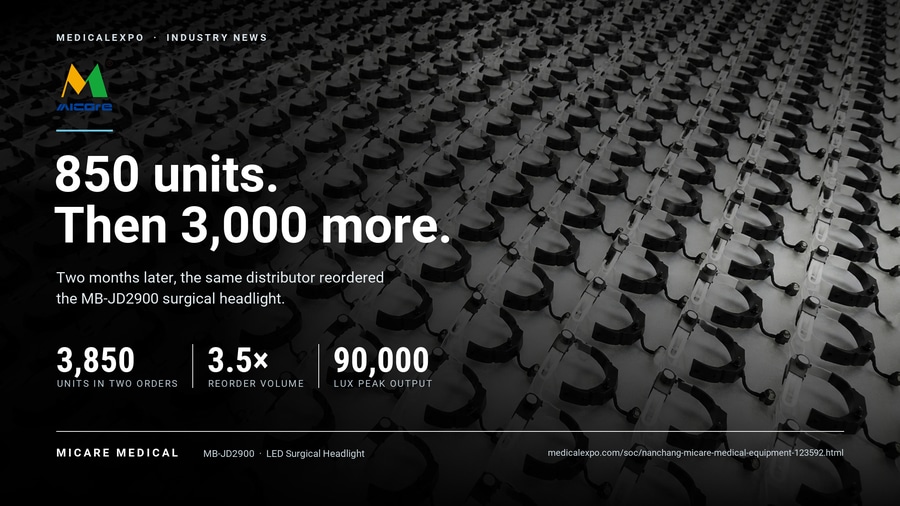
Nanchang, China — Micare Medical has received a follow-up order for 3,000 units of the MB-JD2900 LED surgical headlight from an existing distribution customer. The same customer placed an initial order for 850 units approximately two months earlier. The two orders together total 3,850 headlights.
The second order is roughly 3.5 times the size of the first, and it arrived after the first batch had been in the customer's hands long enough to be sold and used.
The order record
First order: 850 units of the MB-JD2900.
Interval: approximately two months.
Follow-up order: 3,000 units of the same model.
Cumulative volume: 3,850 units.
Customer identity, destination market and contract value are not disclosed.
Why the second order carries more information than the first
A first order records an intention. A buyer compares catalogues, requests samples, checks paperwork and commits — but the decision rests on what the supplier said.
A second order records an outcome. By the time this one was placed, 850 headlights had cleared customs, been unpacked, checked, priced, demonstrated and handed to clinicians who used them on patients. A customer who repeats at 3.5 times the original volume has had the opportunity to find faults and has not built the next order around them.
What the record does — and does not — establish
It is worth being precise, because overstatement is easy here. The order establishes that a customer with direct experience of the first 850 units chose to commit to 3,000 more of the same model within two months. The product cleared that customer's own commercial test at volume.
It does not establish a market-wide verdict, and it is not a clinical comparison against other brands. One customer's repeat purchase says nothing about how the headlight performs against a competing unit in a controlled trial. Buyers should read this as purchasing evidence, not performance evidence.
What 3,000 units changes on the production side
Volume does not simply multiply a small order. It changes which problems become visible, and a supplier that cannot absorb those changes will show it at unit 1,800 rather than unit 80.
Component consistency. A headlight is judged on a beam that looks the same on every unit, which depends on the LED being binned to a narrow colour-temperature window and the optic assembled to the same tolerance every time. At 850 units a supplier can hand-select; at 3,000 the process has to hold without it.
Traceability. ISO 13485:2016 — the quality management standard Micare's facility is certified to — requires device history records and component traceability through production. On a 3,000-unit run that stops being paperwork and becomes the only way to answer a question about a specific batch eighteen months later.
Freight and packing. Each unit ships as one headlight and one battery in a cloth box of 0.5 kg gross and 23 × 21 × 12 cm. On 3,000 units that is roughly 1.5 tonnes before outer cartons — a logistics question as much as a production one.
The product being reordered: MB-JD2900
The MB-JD2900 is a 7 W LED surgical headlight built on LED refractive optics rather than a fibre-optic cable and remote light source. Specifications below are from the manufacturer's current model sheet.
Light output. Up to 90,000 lux at maximum intensity, with adjustable brightness across low, medium and high settings — which is also how the longer end of the runtime figure is reached.
Colour. Colour temperature 4,300–5,300 K, the cool-neutral range used for clinical illumination.
A rotating lamp head. The lamp head sits on a rotating joint rather than being fixed to the front of the headband. The surgeon aims the beam by turning the head — angled down for close work, lifted for a cavity viewed from above — without resetting the headband or repositioning the patient. On a light worn for a full list rather than lifted into place for one procedure, this is what decides whether it is actually worn.
A fixed spot size. The illuminated spot is 100 mm at a 420 mm working distance, and it does not adjust. This is the specification a buyer should weigh most carefully, because it defines who the product is for. A fixed spot at a fixed distance suits work where the field is roughly that size — examination, a quadrant of the mouth, a lesion, a defined surgical site. It is the wrong choice for a surgeon who needs to move between a narrow pinpoint and a wide field within the same case; for that, a model with an adjustable spot is the correct purchase.
Weight. The lamp head weighs 175 g — the figure that decides whether the unit is tolerated over a long list.
Runtime and charging. A rechargeable lithium-ion battery provides 5 to 12 hours depending on the brightness setting used, and recharges in 4 hours. One battery is supplied as standard; a second in rotation covers a full day.
Service life. The LED is rated at 50,000 hours, a lifetime-of-the-device figure in ordinary clinical use rather than a maintenance interval.
The intended applications are surgery, dentistry, medical examination, aesthetics and veterinary work — fields where the working distance changes little during a case, so a light that is aimed rather than re-focused is the right tool.
Where the MB-JD2900 sits in the headlight range
Micare builds the JD2900 headlight on a shared platform. The MA-JD2900 is the highest-output version at 15 W and up to 150,000 lux. The ME-JD2900 runs 10 W and up to 100,000 lux. The MB-JD2900 — the model in this order — runs 7 W and up to 90,000 lux. The MF-JD2900 is the low-output, warm-light version at 3 W and up to 45,000 lux.
A 150,000-lux unit makes sense where a surgeon works at depth in a narrow cavity and needs the intensity. A 7 W, 90,000-lux unit weighing 175 g and running 5–12 hours makes sense where the light is worn for hours across ENT, dental or examination work, and where tolerable weight and battery life matter more than the last 60,000 lux. The MB configuration sits where weight, runtime and cost balance against output — a plausible reason this is the model a distribution customer standardised on at 3,000 units.
FAQ
Q: What exactly was ordered, and in what quantities? A: 850 units of the MB-JD2900, followed approximately two months later by a further 3,000 units of the same model from the same customer — 3,850 units in total.
Q: Why is a repeat order more significant than the first one? A: The first reflects a buyer's assessment of what was presented to them. The second reflects what happened after 850 units were sold and used. A 3.5× increase within two months means the customer found no problem large enough to change supplier.
Q: Does this order prove the headlight outperforms other brands? A: No, and it should not be presented that way. It is evidence that one customer accepted the product at volume and reordered. Comparative clinical performance would require a controlled comparison, which this record does not provide.
Q: Can the spot size be adjusted, and is 90,000 lux enough? A: The spot is fixed at 100 mm at a 420 mm working distance; brightness, not spot size, is what varies. 90,000 lux is sufficient for the work this model targets — ENT, dental, examination, aesthetics and veterinary procedures at short working distances. For deep-cavity work at greater distance, the higher-output models on the same platform (10 W and 15 W) are the appropriate choice.
Q: What is in the box? A: One headlight and one rechargeable lithium-ion battery, in a cloth box measuring 23 × 21 × 12 cm at 0.5 kg gross. A second battery is normally ordered alongside for full-day use.
This article records a commercial order. It is provided for reference only, is not clinical or regulatory advice, and makes no comparative performance claim for any product. Specifications quoted are those on the manufacturer's current model sheet; verify the datasheet for the exact configuration you intend to purchase.
References
MB-JD2900 LED surgical headlight on MedicalExpo: https://www.medicalexpo.com/prod/nanchang-micare-medical-equipment/product-123592-1109061.html
Catalog of Medical LED Headlight: https://pdf.medicalexpo.com/pdf/nanchang-micare-medical-equipment/catalog-medical-led-headlight/123592-271482.html
Nanchang Micare Medical Equipment — company profile: https://www.medicalexpo.com/soc/nanchang-micare-medical-equipment-123592.html
ISO 13485:2016: https://www.iso.org/standard/59752.html
About Micare Medical
Nanchang Micare Medical Equipment Co., Ltd. manufactures surgical lighting and medical illumination equipment — surgical lights, operating tables, examination lights, surgical headlights, binocular loupes and X-ray film viewers — with OEM and ODM capability. Our manufacturing facility holds ISO 13485:2016 certification, and our products carry CE marking under EU MDR 2017/745. Our facility is an FDA-registered establishment (facility registration no. 3023808059) — establishment registration, a statement about the manufacturing facility and not a clearance or approval of any individual device.
View the model in this order: MB-JD2900 LED surgical headlight | Full company profile and product range
Micare Medical Engineering Team