
#Product Trends
Three Mobile Light and Table Sets for a Serbian Hospital: What the Delivery Record Shows
Why a Serbian hospital ordered three mobile light-and-table sets instead of one fixed theatre
Why a Serbian hospital ordered three mobile light-and-table sets instead of one fixed theatre.
Nanchang, China — A hospital in Serbia has taken delivery of three complete sets of JD1800L mobile surgical lights and ET300C electric operating tables. All three sets were commissioned and are now in active use across the hospital's departments.
The order is worth examining for a reason that has nothing to do with specifications: it is a mobile, multi-room purchase, not a single fixed theatre. That shape of order answers a different set of constraints from a ceiling-mounted installation, and the constraints are the ones most hospitals in Europe are working under right now — rooms that were built for a different procedure mix, capital budgets that arrive in stages, and departments that share equipment rather than own it.
The short version
Three identical sets were supplied, each pairing a mobile LED surgical light with a three-section electric operating table. The light is a compact unit on a wheeled stand with a 30 W LED source and a three-joint arm; the table is a three-section electric model with a micro-touch controller, independent head, back and leg adjustment, a built-in kidney bridge and horizontal sliding for C-arm work.
Delivery, installation and commissioning were completed as one package, and the hospital's feedback after handover centred on two things: the design parameters matched the procedures the departments actually perform, and the equipment adapted across more than one clinical setting.
Why a mobile order looks different from a fixed installation
A ceiling-mounted light is the better answer when a room is dedicated to one procedure type and will stay that way. A mobile light is the better answer when the room changes.
That difference drives everything else in the specification. A mobile unit has to pass through doors, park against a wall without blocking a gas panel, and hold its position once placed. The JD1800L addresses this with a three-joint articulated arm on a wheeled base with lockable castors: the head can be positioned over the patient and then locked, and the whole unit can be moved to the next room without a service technician.
For a hospital running minor surgery, dentistry and routine examinations through the same building — often through the same corridor — three mobile sets can cover more clinical ground than one fixed light in one theatre. That is the trade: you give up the reach and stability of a ceiling suspension, and you gain the ability to move the light to where the list is.
The light: JD1800L
The JD1800L is a compact mobile surgical light built around a 30 W LED light source. Two properties matter in daily use.
The first is colour reproduction. The unit is designed to reproduce the true colours of the surgical field rather than to maximise brightness alone — which is the difference between a light that makes a wound look bright and a light that lets a clinician distinguish tissue, blood and suture material.
The second is positioning. The three-joint arm lets the head be brought in from above, from the side, or angled into a cavity, and the castors lock so the head stays where it was placed. The stand is quiet in movement, which matters in a room where an examination is already underway.
The light is specified for minor surgery, dentistry and routine medical examinations — a deliberately broad brief. It is not a replacement for a high-output double-dome theatre light, and it should not be sold as one. Its value is that it can serve several of those rooms competently, which is exactly what a three-set order implies.
The table: ET300C
The ET300C is a three-section electric operating table. Three sections — head, back and leg — adjust independently, which allows the table to be configured for general surgery, gynaecological and urological positioning, and the reclining positions used in minor procedures, without swapping table tops.
Three features are worth pointing out to a buyer.
The controller. Adjustment runs through a micro-touch controller, which allows precise positioning rather than the up-down-only movement of a hydraulic table. For procedures where a few degrees of back section matter, that precision is the difference between a workable position and a compromise.
The kidney bridge. A built-in kidney bridge raises the renal area without adding a separate accessory — useful in urology and in upper abdominal work, and one less item to store and lose.
Horizontal sliding. The tabletop slides horizontally, which is what makes it compatible with C-arm imaging: the patient can be moved relative to the fixed imaging arc rather than the other way round. In a room without a dedicated imaging table, this is often the single feature that decides the purchase.
The table is built with key components sourced from international suppliers, runs quietly, and is specified for stability across positions — a point that matters more on a mobile-capable table than on a fixed one, because the table may be moved between rooms and re-levelled.
The room in the photograph
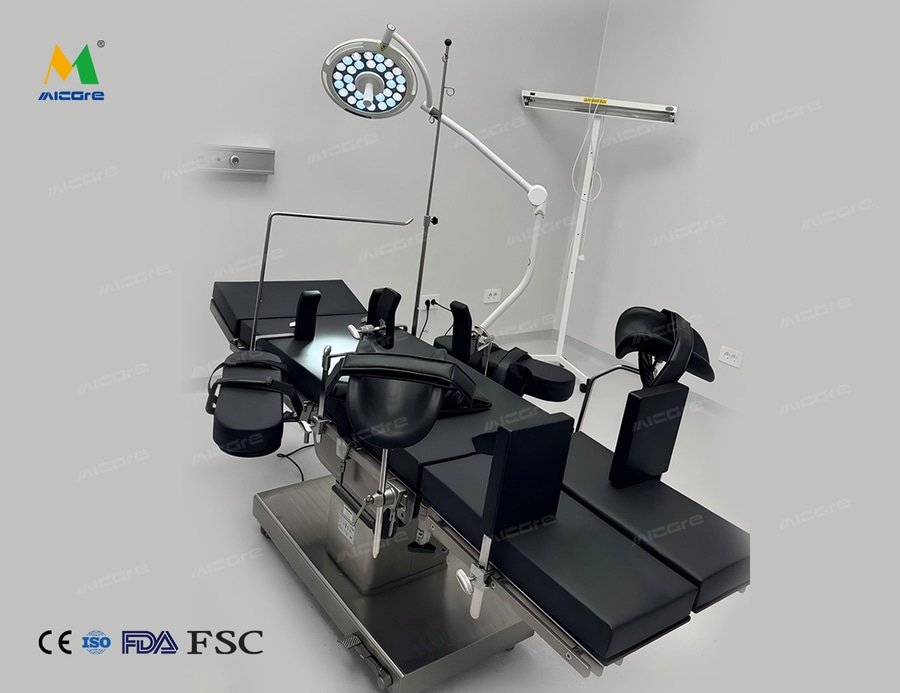
The installation photograph shows a compact treatment room rather than a full theatre: white walls, a single table, and the mobile light standing at the head end of the table with its arm extended over the tabletop.
Several details in the image are the ones a project team should look at when planning a similar room. The table is fitted with leg supports and arm rests, which tells you the room is set up for positioned procedures rather than only supine work — and that the accessories were supplied as part of the package. A wall-mounted fixture and a power socket sit on the far wall, clear of the light's stand, which is what allows the unit to be parked without blocking services. The floor is bare and continuous around the table — the practical condition that makes a mobile light mobile.
None of that appears on a datasheet. All of it decides whether the equipment is actually used.
Commissioning and handover
The three sets were delivered as complete units, installed and commissioned, then handed over for clinical use. Commissioning of a mobile set is shorter than a ceiling installation but not trivial, and the items that matter are consistent:
the arm balanced so the head holds position when released, at the working distance the room uses;
the castors checked for lock and release on the actual floor surface, not a showroom floor;
the table's section travel and controller verified across the full range, including the kidney bridge and the horizontal slide;
the accessories — leg supports, arm rests — fitted and demonstrated in the positions the department will use;
a handover walkthrough with the clinical team, so that adjustment is demonstrated rather than left to the manual.
A three-set order adds one more item: consistency. All three units should be set up identically, so that staff moving between rooms do not have to relearn the controls.
What the hospital's feedback focused on
The feedback after handover was positive, and it was specific in a way that is useful to other buyers: the hospital attributed the result to clinically relevant design parameters and to operational adaptability — the equipment's ability to serve more than one department without modification.
That is a meaningful distinction. Hospitals rarely complain that a light was not bright enough; they complain that it does not fit the room, cannot be moved, or requires an accessory that was not supplied. The two things this hospital named are the two things that determine whether equipment gets used daily or sits in a corner.
It is also worth being precise about what a single delivery record can and cannot tell you. Three commissioned sets in active use establish that the supplier can deliver, install and hand over this configuration. They do not establish comparative clinical performance, and no such claim is made here.
What to check before ordering mobile sets
Five questions decide most of the risk in a mobile, multi-room order.
Which rooms, and what is on the floor? A mobile light needs a continuous floor surface and a parking position that does not block a socket, a gas outlet or a doorway. Ask for the parking plan, not just the product.
How many rooms per set? Three sets shared across departments is a scheduling decision as much as a purchase. Map the weekly list against the number of units before fixing the quantity.
Does the table need to slide? Horizontal travel for C-arm access is the feature that most often separates a usable table from an expensive one. If the department does any imaging-guided work, specify it explicitly.
What accessories are in the package? Leg supports, arm rests, straps and headrests are frequently quoted separately. Ask for the accessory list in the quotation, itemised.
Who commissions, and what is demonstrated? Ask for a commissioning checklist and a handover session with the clinical team. On a three-set order, ask for all three to be set up identically.
FAQ
Q: What was delivered in this case?
A: Three complete sets, each pairing a JD1800L mobile surgical light with an ET300C electric operating table, for a hospital in Serbia. All three were commissioned and are in active use.
Q: Why choose a mobile light instead of a ceiling-mounted one?
A: A ceiling light suits a room dedicated to one procedure type. A mobile light suits rooms that change, or departments that share equipment. The trade is reach and stability against mobility and coverage across rooms.
Q: Is the JD1800L suitable for major surgery?
A: It is specified for minor surgery, dentistry and routine medical examinations. It is not a substitute for a high-output double-dome theatre light, and a supplier who presents it as one is overstating the product.
Q: What does the ET300C's horizontal slide do?
A: It moves the tabletop relative to a fixed imaging arc, which is what allows C-arm access without repositioning the patient. In rooms without a dedicated imaging table, it is often the deciding feature.
Q: Should all three sets be identical?
A: Yes, unless the departments genuinely need different configurations. Identical units let staff move between rooms without retraining, and simplify spare parts and servicing.
Q: What documentation should come with the order?
A: The type-test report to IEC 60601-2-41, the Declaration of Conformity under EU MDR 2017/745 where CE marking is claimed, the ISO 13485:2016 certificate with its scope, the commissioning checklist, the accessory list as supplied, and the warranty and spare-parts terms.
This article records one completed delivery and the commercial questions it raises. It is provided for reference only, is not clinical or regulatory advice, and makes no comparative performance claim for any product. Specifications quoted are those published for the models named; verify the current datasheet for the exact configuration you intend to purchase.
References
IEC 60601-2-41:2021 — Particular requirements for surgical luminaires and luminaires for diagnosis: https://webstore.iec.ch/en/publication/62677
Regulation (EU) 2017/745 (MDR), consolidated text: https://eur-lex.europa.eu/legal-content/EN/TXT/?uri=CELEX%3A02017R0745-20250110
JD1800L mobile surgical light on MedicalExpo: https://www.medicalexpo.com/prod/nanchang-micare-medical-equipment/product-123592-1139593.html
ET300C universal operating table on MedicalExpo: https://www.medicalexpo.com/prod/nanchang-micare-medical-equipment/product-123592-1140221.html
Related reading
How to Read a Surgical Light Datasheet Without Getting Misled — the measurement conventions behind the figures quoted above: working distance, light-field definitions, colour rendering indices and the L and B lifetime designation.
About Micare Medical
Nanchang Micare Medical Equipment Co., Ltd. manufactures surgical lighting and medical illumination equipment — surgical lights, operating tables, examination lights, surgical headlights, binocular loupes and X-ray film viewers — with OEM and ODM capability. Our manufacturing facility holds ISO 13485:2016 certification, and our products carry CE marking under EU MDR 2017/745. Our facility is an FDA-registered establishment (facility registration no. 3023808059) — establishment registration, a statement about the manufacturing facility and not a clearance or approval of any individual device.
For a multi-room or staged purchase, our engineering team can map the room list against mobile and fixed options and return a configuration with the accessory list itemised before a quotation is issued.
View the models in this delivery: JD1800L mobile surgical light | ET300C operating table
Full company profile and product range: Nanchang Micare Medical Equipment on MedicalExpo
Micare Medical Engineering Team