


#Product Trends
Ceiling-Mounted or Mobile Surgical Light? What Actually Decides It in an Existing OR
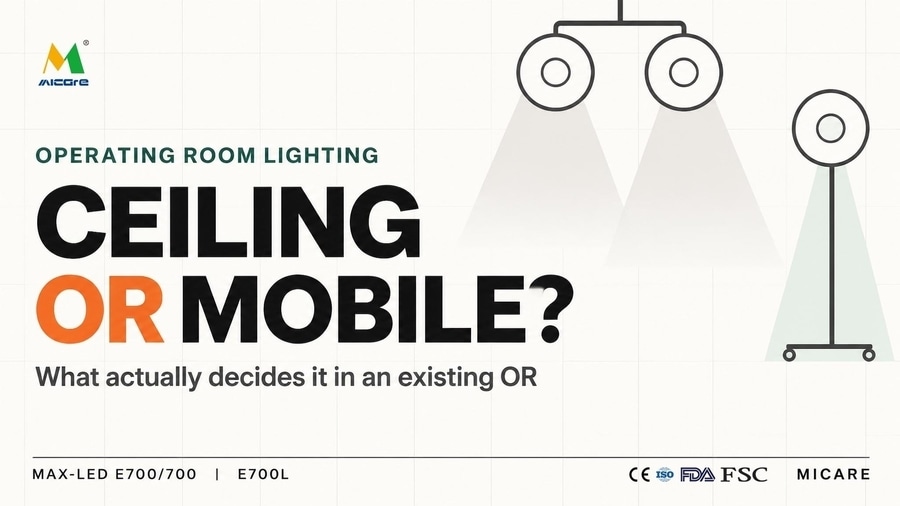
The illumination figures are closer than most buyers expect. What separates the two is the ceiling, the floor, and how many different lists the room has to run.
The illumination figures are closer than most buyers expect. What separates the two is the ceiling, the floor, and how many different lists the room has to run.
Consider a hospital with four ceiling-mounted general theatres and a fifth room handling endoscopy overflow and minor procedures. Nothing structural sits above that fifth room, so the request that arrives is not for a fifth ceiling light but for a mobile unit. Nobody finds that surprising. What deserves a second look is the assumption underneath — that the mobile light is the lesser product, chosen because the room is lesser too.
Two questions are being answered at once there. Which mounting type suits a room is an engineering and workflow decision; which product is better has no single answer, because the two types are not competing for the same job.
The figures are closer than the assumption
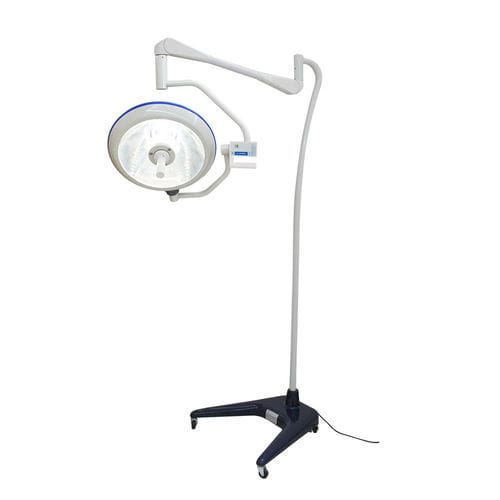
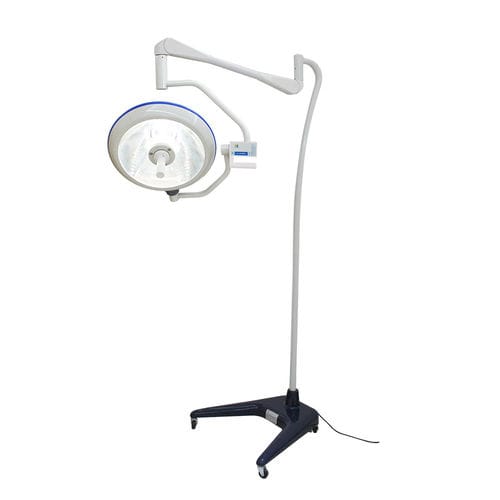
A 700 mm mobile dome in the MAX-LED range — the E700L — is specified at 60,000–180,000 lux at one metre, produced by 112 LEDs at a rated 110 W. The ceiling-mounted E700/700 delivers 40,000–160,000 lux at one metre from two 700 mm domes of 112 LEDs each, at a rated 220 W.
Both are specified at Ra 96. Both publish 1,400 mm depth of illumination, measured as L1 plus L2 at 20% of maximum output. Both adjust colour temperature from 3,000 K to 5,800 K with continuous dimming to zero.
The ceiling unit draws twice the power because it drives two heads, not because each head is more capable. On published output, the single mobile head carries the higher upper bound. "Mobile means weaker" is a defensible assumption to arrive with, and the data does not support it.
What these figures are not is a promise about your theatre. They are luminaire measurements at one metre; delivered illuminance falls with mounting distance and with anything passing between head and wound. Ask for the photometric test report for the exact arrangement quoted rather than comparing two headline ranges.
So if light output does not decide it, what does?
What a ceiling installation actually buys
Geometry that stays put. A ceiling-mounted head is aimed once for a procedure and holds that aim; between cases it is repositioned over the table, not carried across the room.
A floor that stays clear. A working theatre is crowded: anaesthesia machine, trolleys, the diathermy stack, staff moving around the table. A floor-standing column occupies a fixed patch of that floor for the whole case and cannot be pushed aside mid-procedure.
A second head over the same table. In this range, the dual-head configuration is a ceiling arrangement only. If the room routinely has two surgeons working opposite sides of the field, the mobile single-dome unit is not a substitute, however good its output figures are.
Imaging that lives in the light. On the E700/700, a Sony 1080p camera can be fixed in the centre of the head, controlled from a keyboard or remote, with a sterile handle that can later be exchanged for a camera handle. Teaching lists and remote consultation get the surgeon's view without a separate camera arm competing for the same ceiling.
The ceiling plane is where surgical lighting belongs in a room built for surgery: nothing on the floor, nothing in the sterile field, nothing to clean around.
But the ceiling is a construction project
A ceiling-mounted light is not a purchase that happens on a delivery date. It is a building intervention, and it starts with a survey of what is above the room: the load path available, the drop height, the clearance under a laminar-flow canopy, and the position of everything else already hanging from that ceiling.
We do not publish installation load figures in a datasheet, and no responsible supplier should let a brochure settle the question. The structure either takes the assembly or it does not, which is answered by looking at the drawings and, where necessary, at the slab. Where the answer is no, the honest options are a different room, a different mounting type, or a structural project with the theatre out of service.
That last consequence is underestimated in renovation programmes: a ceiling installation closes a room, while a mobile unit gets wheeled in.
Where a mobile unit is the correct answer, not the compromise
The room's use is variable. An endoscopy overflow room, a minor-procedure room, an emergency department bay — these run a mixed, unpredictable list. They need good light some of the time, and the floor space back the rest of the time.
The structure will not take it. Suspended ceilings in converted or leased buildings, upper floors with no suitable load path, heritage interiors where nobody wants to see an anchor plate. A mobile unit sidesteps the survey entirely.
The room has to stay open. During a staged refurbishment, a mobile unit keeps a list running in a room that is not yet finished, or covers for a theatre that is temporarily closed. That continuity is usually worth more than the equipment cost difference.
One unit, two rooms, sequenced lists. Where a site runs short procedures in two rooms on different days, a single mobile light can serve both — provided the transport path is clear and the turnaround is real.
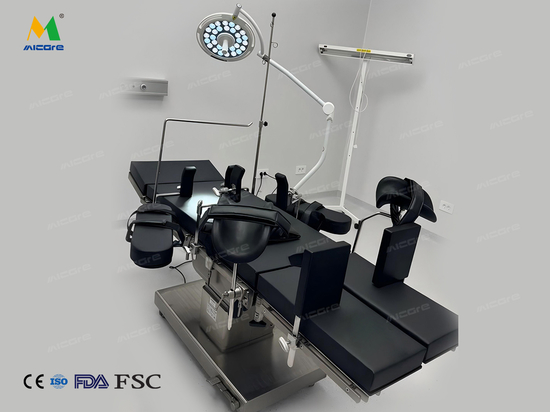
The E700L is built for this role rather than adapted to it: a slimline housing specified as suitable for laminar air flow systems, a 4.3-inch touch panel, stored settings, an endo mode for cavity work, an optional infrared remote, and an optional sync mode for two lamps working together.
The costs that never appear on the quotation
A mobile light is cheap to install because its costs are operational instead. They should be named before the purchase order.
Where it parks. A floor-standing unit needs a designated position when not in use. In practice it ends up in the corridor, where it is a fire-route problem, or in the corner of the room, where it is in the way of the cleaning round.
What it rolls through. Castors travel the same floor as trolleys, beds and staff shoes, so the cleaning protocol for that column and those wheels belongs in the theatre's routine.
Where it plugs in. These units run on 95–245 V mains, so socket position matters more than buyers expect: a lead across a working floor is a trip hazard and a contamination path.
Whether it reaches. The head has to clear the table, the patient's chest and the surgeon's shoulders at the working height the team actually uses. Check that with the room's own table.
When it moves. In major surgery, repositioning the light mid-case is not acceptable; the unit is set before incision. A team expecting to re-aim freely through a long procedure is describing a ceiling light, whether they say so or not.
How we would decide, in one paragraph
If the room runs a predictable list of major cases and the ceiling will take the assembly, mount it on the ceiling — you are buying stability, floor space and the option of a second head. If the room's use is mixed, the structure is doubtful, or the room must stay open while work happens elsewhere, a mobile unit is the right instrument rather than the cheaper one. A mixed fleet is normal: ceiling lights in the main theatres, one mobile light for the room that is not quite a theatre.
The question that settles it is not "which is better" but "who moves this light, and when". Send the room drawing, the ceiling type and the weekly list mix, and we will say which arrangement the survey supports — before the budget line is committed.
Micare Medical Engineering Team
Frequently asked questions
Is a mobile surgical light dimmer than a ceiling-mounted one? Not on published figures. The single-dome E700L is specified at 60,000–180,000 lux at one metre; the dual-dome E700/700 at 40,000–160,000 lux at one metre. Per head, output and power are comparable. The ceiling unit's advantage is a second head and fixed geometry, not a stronger single beam.
Can a mobile unit be used in a laminar-flow theatre? The E700L housing is specified as suitable for laminar air flow systems. Position it outside the sterile field and clear of the canopy's working zone, and follow your own infection-control policy on floor-standing equipment in a theatre.
Do I need structural work for a ceiling-mounted light? Yes, in the sense that the ceiling assembly must be surveyed before the order is confirmed: available load path, drop height and clearance under the canopy. We do not publish installation load figures, because the answer depends on the building rather than the luminaire.
Can one mobile light serve two rooms? It can, where the case mix is short procedures, the transport path between rooms is clear, and the turnaround is realistic. It cannot serve two rooms running simultaneously, and it should not be moved during a case.
What should we ask a supplier before choosing a mounting type? For the photometric test report covering the exact configuration quoted, the installation requirements in writing, and a straight answer on which of your rooms the arrangement suits. A supplier who will only quote the configuration they prefer has not done the survey.

 鄂公网安备42018502009510号