


#Product Trends
MAX-LED in Practice: What a Dual-Head Configuration Actually Changes in a Busy OR
A working account of what the second head changes between cases — and the three things it does not fix.
At 07:40 the first patient of the day is draped and the scrub nurse is swinging the arm over a laparoscopic field. By 11:20 two surgeons are standing on opposite sides of the table, each wanting the light angled to their own eyeline. By 19:00 the last case is an open procedure in a deep cavity, and the light that behaved perfectly at breakfast is now throwing a shadow exactly where the surgeon needs to see.
A single-head surgical light can be excellent and still lose one of those three moments. That is the honest case for a dual-head configuration: not brightness, but angle. What follows is what changes once a dual head is installed and running, rather than why you should buy one — the choice between configurations belongs earlier in the process. Here we assume the decision is made.
The second head buys redundancy of angle, not of lux
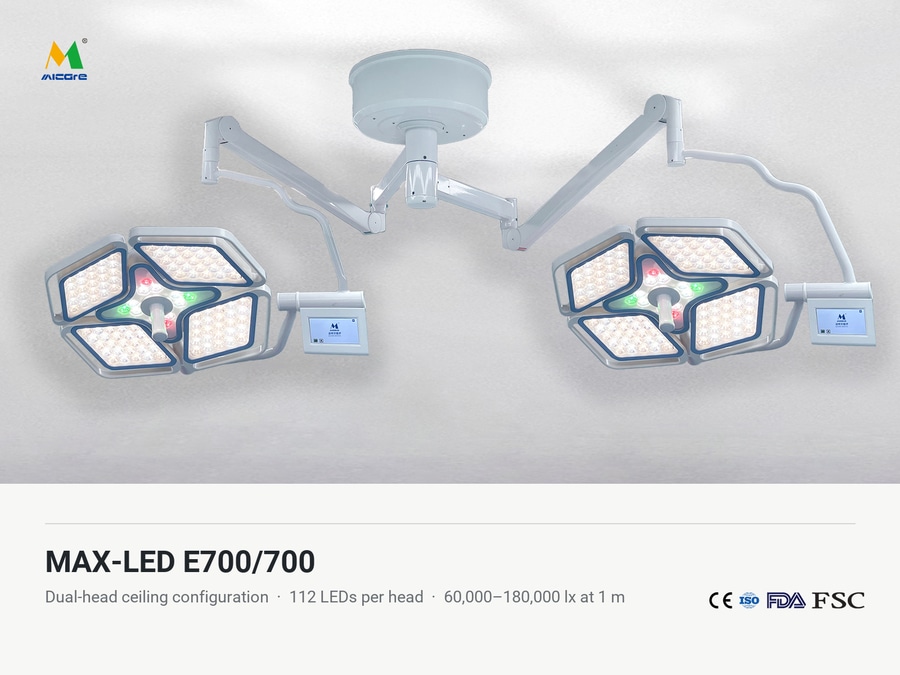
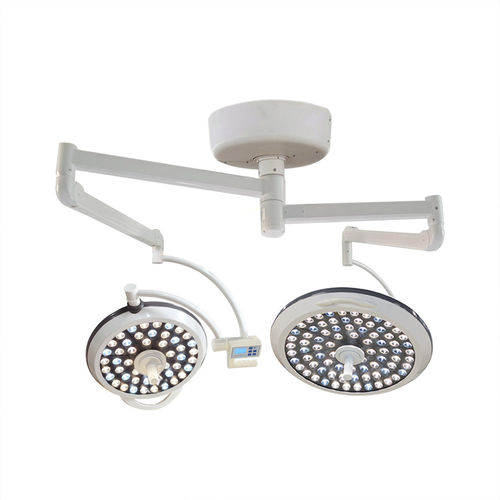
The MAX-LED E700/700 is a two-dome ceiling assembly with a 700 mm head and 112 LEDs per head. It is specified at 60,000–180,000 lux at one metre, adjustable across a 10–100% range, with a 400 W input.
That is one head's output, and it is already generous. Adding a second dome does not double the light reaching the wound: the luminaire is managed so the field stays at a comfortable working level, and no patient benefits from a brighter wound.
What the second head changes is geometry. When a surgeon leans in, a shoulder or a head casts a shadow into the field, and the correction is a second beam from a different angle — not a stronger beam from the same one. In a room where the team rotates around the table through the day, that redundancy keeps the field readable without anyone stopping to re-aim mid-procedure.
Spot size, not headline lux, is what the room feels
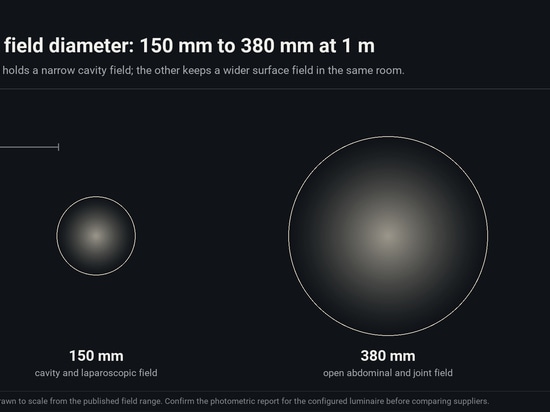
The E700/700 adjusts its light field from 150 mm to 380 mm. On a laparoscopic case the narrow setting keeps the periphery from washing out the monitor view; on an open abdominal or joint case the wide setting covers a full incision without moving the head.
Two heads matter here for a practical reason rather than a photometric one. Each head can be set to its own field size and angle, so a deep narrow field and a broader surface field can coexist in one room. A single head can only be in one configuration at a time.
We do not publish a depth-of-illumination figure for this model, and we would rather say so than quote a number a competitor can pick apart. What the specification does give you is the field range, the illuminance at one metre and the LED count; the photometric report for the exact arrangement quoted is the document to compare, and it is available on request.
One room, several specialities: colour temperature and dimming in daily use
The E700/700 adjusts colour temperature from 3,800 K to 5,500 K and dims from 10% to 100%. In a single-specialty unit that is a convenience. In a district hospital running endoscopy in the morning and reconstruction in the afternoon, it is the difference between one room serving several lists and a team working around a light they dislike.
Two practical notes from installations. Set both heads to the same colour temperature before the list begins — mismatched heads produce a colour split that is more distracting than one slightly warm light. And keep presets at values the team actually chose; a 5,500 K setting nobody uses is just a number on a panel.
The camera is an option, and should be bought as one
The MAX-LED can be supplied with a Sony camera fixed in the centre of the head, controlled from a keyboard or a remote, with a sterile handle that can later be exchanged for a camera handle. For a teaching hospital that is a genuine capability: the surgeon's view becomes the room's view, without a separate camera arm competing for ceiling space.
For a purely clinical unit it is a cost with no return, and we would rather say so than put it in every quotation. The retrofit path exists so the decision can be deferred: specify the standard sterile handle now, add imaging when a teaching or remote-consultation requirement appears.
Three things a dual head does not fix
Two domes solve fewer problems than the brochure implies. Three survive the purchase intact.
Ceiling structure. A twin-head assembly with two 700 mm domes carries more mass on a longer arm than a single head. The load path, the drop height, and the clearance available under a laminar-flow ceiling all have to be surveyed before the order is confirmed — not after the unit arrives on site. If the structure will not take it, no configuration debate matters.
The second head nobody moves. The most common waste we see is a second dome parked at an angle nobody uses, because nobody showed the team how to position it for the procedures that room performs. A dual head pays back only when staff are trained on their own list mix.
Spares and service windows. Each head carries 112 LEDs, and the assembly draws 400 W. Consumables are modest, but the plan should name who inspects the domes, how the endoscopy mode is checked, and which parts are held locally — particularly where this is the only theatre in the building and cannot go offline for a week.
What a procurement team can actually hold us to
Beyond the optical figures, the E700/700 is documented the way an EU tender expects: an IEC 60601-2-41:2021 test report for the luminaire, CE marking under EU MDR 2017/745 with a Declaration of Conformity, and ISO 13485 certification. Colour rendering is published as Ra 96 with R9 98 — the R9 figure matters more than peak lux for tissue discrimination, and it is the one we would ask a competitor to publish alongside it.
So the short answer to "should we have bought two heads?" is a workload question, not a technical one. A dual-head light is the right purchase when "who is standing where?" is genuinely uncertain across the week: major surgery, trauma-capable rooms, teaching lists, or a single-theatre facility that cannot afford a head failure mid-case. It is an expensive answer when the honest reply is one surgeon, one assistant, predictable angles.
Photometric data, ceiling requirements and configuration options are available through our product page on this platform. Send the room drawing and your list mix, and our engineers will tell you which arrangement the survey supports — before you commit the budget line.
Micare Medical Engineering Team
Frequently asked questions
Does a dual-head surgical light deliver twice the illuminance at the wound? No. Both domes are normally aimed at the same field, and output is managed to a working level between 10% and 100%. The second head adds an alternative angle and a degree of redundancy, not raw brightness.
What has to be checked before ordering the E700/700? The ceiling load path for a twin-head assembly, the available drop height, the arm reach against your table positions, and the clearance under any laminar-flow canopy. These are survey items, not catalogue items, and they should be settled before the order rather than at installation.
Can the camera be added after the light is installed? Yes. The standard sterile handle can be exchanged for a camera handle, which is why the retrofit path is specified at the outset. The camera is a Sony unit mounted at the centre of the head and operated from a keyboard or remote.
Is adjustable colour temperature worth paying for in a single-specialty OR? Usually not. If every list in the room is the same procedure type, a fixed setting chosen once is sufficient. The value appears in multi-specialty rooms, and in hospitals that reallocate theatres between departments seasonally.
What should be kept as spares? Sterile handles are the realistic consumable, and the endoscopy mode should be included in the routine check. LED arrays are not a routine replacement item, but the service plan should still name who inspects the domes and on what interval.
 鄂公网安备42018502009510号