#Product Trends
Title (English): What Is a Knotless Anchor and When Should It Be Used?
Subtitle (English): A comprehensive guide to knotless anchor technology, its advantages, surgical applications, and role in modern arthroscopic soft tissue repair.
Knotless anchors have become an increasingly popular fixation option in modern arthroscopic surgery. Designed to eliminate the need for arthroscopic knot tying, these advanced fixation systems simplify surgical procedures while providing strong and reliable soft tissue fixation.
Knotless anchor technology is widely used in shoulder, knee, and sports medicine procedures, particularly in rotator cuff repair, labral repair, instability surgery, and ligament reconstruction.
Understanding how knotless anchors work and when they should be used can help surgeons optimize efficiency, fixation quality, and clinical outcomes.
What Is a Knotless Anchor?
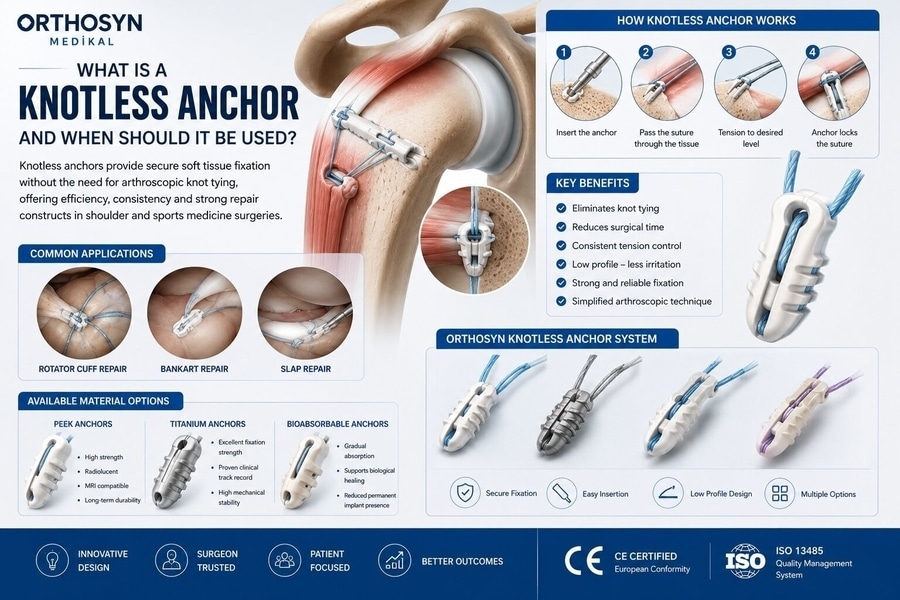
A knotless anchor is a type of suture anchor designed to secure soft tissue to bone without requiring surgical knot tying.
Unlike traditional anchors that require arthroscopic knots to maintain tissue fixation, knotless systems use integrated locking mechanisms that secure the suture directly within the anchor body.
This design allows surgeons to tension and fixate tissue while eliminating the need for knot management.
How Knotless Anchors Work
The basic principle of a knotless anchor involves:
Anchor insertion into bone
Suture passage through soft tissue
Tension adjustment of the repair construct
Suture locking within the anchor mechanism
Once the desired tension is achieved, the anchor locks the suture in place, creating stable fixation without the need for arthroscopic knots.
Common Materials Used in Knotless Anchors
Modern knotless anchors are available in several materials, including:
Titanium
PEEK (Polyether Ether Ketone)
Bioabsorbable materials
Biocomposite materials
All-suture anchor systems
The choice of material depends on surgical preference, imaging requirements, bone quality, and fixation strategy.
Advantages of Knotless Anchors
Simplified Surgical Technique
One of the biggest advantages of knotless systems is the elimination of arthroscopic knot tying.
Benefits include:
Reduced technical complexity
Shorter learning curve
Improved procedural efficiency
Consistent fixation quality
Reduced Operative Time
Knot tying can be one of the most time-consuming steps in arthroscopic procedures.
Knotless systems may help:
Reduce overall surgical time
Improve workflow efficiency
Simplify multi-anchor repairs
Consistent Tension Control
Knotless anchors allow surgeons to precisely adjust tissue tension before final fixation.
This may improve:
Tissue compression
Footprint restoration
Repair consistency
Reduced Knot-Related Complications
Traditional knots may occasionally cause:
Soft tissue irritation
Subacromial impingement
Knot migration
Prominent repair constructs
Knotless systems eliminate these potential knot-related issues.
Common Clinical Applications
Knotless anchors are frequently used in:
Rotator cuff repair
Bankart repair
SLAP repair
Shoulder instability surgery
Biceps tenodesis
Capsular repair
Meniscus root repair
Certain ligament reconstruction procedures
They are particularly useful when multiple fixation points are required.
Knotless Anchors in Rotator Cuff Repair
Rotator cuff repair is one of the most common applications of knotless anchor technology.
Benefits include:
Improved tendon compression
Efficient double-row repairs
Simplified suture bridge constructs
Reduced surgical complexity
Many modern double-row repair techniques rely heavily on knotless lateral-row fixation.
Knotless Anchors in Labral Repair
During Bankart and labral repairs, knotless anchors may provide:
Reliable soft tissue fixation
Reduced implant prominence
Consistent capsulolabral tensioning
Simplified arthroscopic workflow
These advantages make them popular in shoulder instability procedures.
Biomechanical Considerations
The performance of a knotless anchor depends on:
Anchor design
Bone quality
Suture material
Fixation mechanism
Surgical technique
Modern biomechanical studies have demonstrated that many knotless systems provide fixation strength comparable to traditional knotted repairs.
Potential Limitations
Although knotless anchors offer many advantages, they are not appropriate for every situation.
Potential limitations include:
Dependence on proper tensioning before fixation
Limited ability to retension after deployment
Technique-specific considerations
Higher implant cost in certain systems
Proper implant selection remains important.
Revision Surgery Considerations
Revision procedures may require careful evaluation of:
Existing anchor placement
Bone stock quality
Tunnel position
Remaining soft tissue quality
Anchor material and fixation strategy may influence revision planning.
Future Developments
Advances in arthroscopic implant technology continue to improve knotless anchor systems through:
Smaller implant profiles
Enhanced fixation mechanisms
Improved suture materials
Biocomposite technologies
All-suture fixation designs
These developments aim to improve both surgical efficiency and clinical outcomes.
Conclusion
Knotless anchors represent an important advancement in modern arthroscopic surgery by simplifying fixation techniques, reducing operative time, and minimizing knot-related complications.
When used appropriately, knotless anchor systems provide reliable soft tissue fixation and support successful outcomes in shoulder, knee, and sports medicine procedures.
Orthosyn Medikal provides advanced knotless anchor solutions designed to support modern arthroscopic and orthopedic repair techniques.