#Product Trends
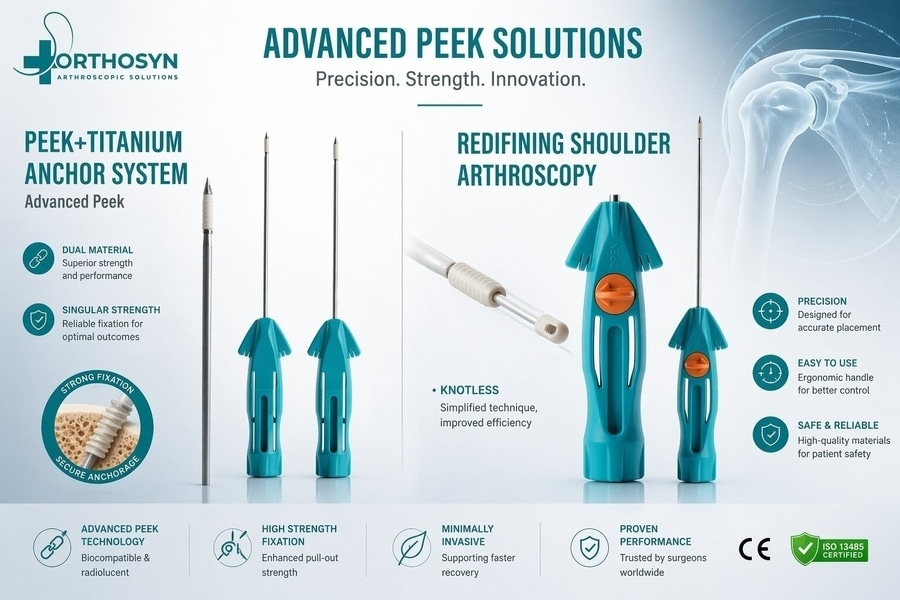
How Knotless Anchors Are Changing Modern Shoulder Arthroscopy
An in-depth look at knotless suture anchor technology, its surgical advantages, biomechanical principles, and its growing role in modern shoulder arthroscopy.
Shoulder arthroscopy has undergone significant technological evolution over the past two decades. Improvements in arthroscopic visualization, surgical instrumentation, implant materials, and fixation techniques have transformed the way surgeons treat shoulder instability, rotator cuff tears, and labral injuries.
Among these innovations, knotless suture anchors have become one of the most important advancements in shoulder arthroscopy. By eliminating the need for arthroscopic knot tying, these implants simplify surgical procedures while maintaining secure tissue fixation and reliable biomechanical performance.
Today, knotless anchor systems are widely used in procedures such as Bankart repair, rotator cuff repair, SLAP lesion repair, biceps tenodesis, and capsulolabral reconstruction.
Understanding Knotless Anchor Technology
Traditional suture anchor systems require surgeons to tie arthroscopic knots after passing sutures through soft tissue.
Although highly effective, arthroscopic knot tying is technically demanding and requires significant surgical experience.
Knotless anchors eliminate this step by securing the suture directly within the anchor mechanism.
Instead of relying on knots for fixation, the implant locks the suture under controlled tension, providing stable fixation without knot stacks.
This design simplifies the procedure while maintaining excellent fixation strength.
Evolution from Traditional Anchors
Conventional suture anchors have long been considered the gold standard for soft tissue fixation.
However, knotless technology addresses several limitations associated with traditional knot-tying techniques.
These improvements include:
Reduced surgical complexity
Consistent suture tension
Lower risk of knot-related complications
Improved procedural efficiency
As implant designs have evolved, knotless systems have become increasingly reliable and versatile.
Advantages of Knotless Anchors
One of the primary reasons for the growing popularity of knotless anchors is their ability to simplify arthroscopic procedures.
Key advantages include:
Elimination of arthroscopic knot tying
Reduced operative time
Consistent fixation quality
Simplified surgical workflow
Improved reproducibility
By reducing technical complexity, knotless systems may shorten the learning curve for many arthroscopic procedures.
Improved Surgical Efficiency
Arthroscopic knot tying often represents one of the most time-consuming portions of shoulder arthroscopy.
Each knot requires careful tensioning and secure placement.
Knotless fixation allows surgeons to:
Pass the suture
Adjust tissue tension
Lock the implant
This streamlined sequence significantly improves surgical efficiency without compromising repair quality.
Shorter procedures may also reduce operating room time and improve workflow.
Consistent Suture Tension
Achieving appropriate suture tension is critical for successful soft tissue healing.
Excessive tension may compromise tissue vascularity.
Insufficient tension may result in repair instability.
Modern knotless anchors allow surgeons to fine-tune tissue compression before final fixation.
This controlled tensioning may contribute to improved repair consistency.
Elimination of Knot Stacks
Traditional repairs create knot stacks that remain on the repaired tissue.
Although usually well tolerated, prominent knots may occasionally contribute to:
Soft tissue irritation
Mechanical impingement
Abrasion of surrounding structures
Knotless fixation eliminates bulky knot stacks, producing a lower-profile repair construct.
This may reduce irritation in selected patients.
Biomechanical Performance
Modern knotless anchors are engineered to provide excellent biomechanical stability.
Laboratory studies have demonstrated favorable characteristics including:
High pullout strength
Secure suture locking
Stable tendon compression
Resistance to cyclic loading
Many contemporary knotless systems demonstrate biomechanical performance comparable to conventional knotted repairs.
Implant design continues to improve with ongoing technological innovation.
Common Clinical Applications
Knotless anchors are widely used in numerous shoulder arthroscopy procedures.
Common indications include:
Rotator cuff repair
Bankart repair
SLAP lesion repair
Capsulolabral reconstruction
Biceps tenodesis
Revision shoulder stabilization procedures
Their versatility has contributed significantly to their widespread adoption.
Implant Materials
Modern knotless anchors are available in several materials, including:
PEEK (Polyether Ether Ketone)
Titanium
Bioabsorbable materials
Composite biomaterials
Material selection depends on surgeon preference, bone quality, imaging considerations, and revision planning.
Each material offers unique clinical advantages.
Role in Rotator Cuff Repair
Rotator cuff repair is one of the most common indications for knotless fixation.
In double-row and suture bridge techniques, knotless lateral-row anchors provide:
Excellent tendon compression
Uniform load distribution
Simplified construct assembly
Reduced operative complexity
These characteristics have made knotless systems particularly valuable in contemporary rotator cuff reconstruction.
Role in Shoulder Instability Surgery
Bankart lesions remain one of the leading indications for shoulder stabilization surgery.
Knotless anchors facilitate:
Labral fixation
Capsular tensioning
Anatomic restoration
Efficient suture management
The ability to adjust tissue tension before final fixation allows surgeons to optimize repair quality.
Reduced Learning Curve
Arthroscopic knot tying is often considered one of the most technically challenging skills in shoulder arthroscopy.
By eliminating complex knot tying, knotless anchors may help:
Simplify training
Improve procedural consistency
Reduce technical errors
This may benefit both experienced surgeons and those early in their arthroscopic practice.
Clinical Outcomes
Clinical studies have demonstrated excellent outcomes following procedures performed with knotless anchor systems.
Reported benefits include:
Reliable fixation
High patient satisfaction
Improved shoulder stability
Successful tendon healing
Excellent functional recovery
Long-term outcomes continue to support the use of knotless technology in appropriately selected patients.
Future Developments
The evolution of knotless anchor technology continues.
Future innovations may include:
Smaller implant profiles
Advanced biomaterials
Enhanced fixation mechanisms
Biologic augmentation strategies
Improved suture technologies
These developments aim to further improve surgical efficiency and biological healing.
Conclusion
Knotless suture anchors have transformed modern shoulder arthroscopy by simplifying surgical techniques while maintaining secure fixation and excellent biomechanical performance. Their ability to eliminate arthroscopic knot tying, reduce operative time, improve workflow, and provide consistent tissue tension has made them an increasingly preferred solution for many shoulder procedures.
As implant technology continues to evolve, knotless anchor systems are expected to play an even greater role in the future of minimally invasive shoulder surgery.
Orthosyn Medikal provides advanced knotless anchor systems, arthroscopy instruments, and shoulder fixation solutions designed to support modern orthopedic and sports medicine procedures.