#Product Trends
The Role of Knot Pushers in Successful Arthroscopic Knot Tying
How precision knot pushers improve suture management, knot security, and surgical efficiency during arthroscopic procedures.
Arthroscopic surgery relies on precise soft tissue fixation to achieve durable repairs of tendons, ligaments, and labral structures. While suture anchors and high-strength sutures receive considerable attention, the importance of the knot pusher is often underestimated. This specialized arthroscopic instrument enables surgeons to deliver and tighten knots accurately within confined joint spaces, contributing significantly to repair quality and procedural efficiency.
Proper knot management is essential for maintaining tissue tension, ensuring fixation stability, and minimizing the risk of repair failure. A well-designed knot pusher allows surgeons to transfer knots smoothly through cannulas while maintaining consistent control throughout the procedure.
What Is an Arthroscopic Knot Pusher?
A knot pusher is a surgical instrument specifically designed to advance pre-tied arthroscopic knots from outside the joint to the repair site.
Its primary functions include:
Advancing sliding and non-sliding knots
Maintaining suture tension during knot advancement
Improving knot placement accuracy
Allowing secure tightening in confined spaces
Facilitating reproducible knot tying
Knot pushers are routinely used in shoulder, knee, hip, elbow, and ankle arthroscopy.
Why Is Secure Knot Tying Important?
The quality of an arthroscopic repair depends not only on implant selection but also on knot integrity.
Secure knot tying helps achieve:
Stable tendon fixation
Reliable labral repair
Appropriate tissue compression
Reduced gap formation
Long-term repair durability
Poorly seated knots may compromise fixation strength and increase the risk of repair failure.
Challenges of Arthroscopic Knot Tying
Unlike open surgery, arthroscopy is performed through small portals with limited visualization and working space.
Common challenges include:
Limited instrument maneuverability
Long suture pathways
Restricted joint access
Maintaining constant suture tension
Precise knot positioning
A high-quality knot pusher helps surgeons overcome these technical difficulties.
How Knot Pushers Improve Surgical Precision
Modern knot pushers are engineered to provide excellent control throughout knot advancement.
Their advantages include:
Smooth knot delivery
Controlled knot seating
Reduced friction during advancement
Improved tactile feedback
Enhanced accuracy in confined anatomical spaces
These features help surgeons reproduce consistent knot quality during every procedure.
Design Features of Modern Knot Pushers
Contemporary arthroscopic knot pushers are designed for both performance and ergonomics.
Important characteristics include:
Slim shaft profile
Rounded atraumatic tip
High-strength stainless steel construction
Comfortable ergonomic handle
Compatibility with multiple suture types
Easy cleaning and sterilization
Proper instrument design contributes to efficient workflow and user comfort.
Applications in Arthroscopic Procedures
Knot pushers are used in a wide variety of sports medicine procedures, including:
Rotator Cuff Repair
Secure advancement of mattress and simple knots for tendon fixation.
Bankart Repair
Precise labral knot placement around the glenoid rim.
SLAP Repair
Controlled knot positioning within the superior labrum.
Meniscal Repair
Assistance with secure fixation in selected repair techniques.
Ligament Reconstruction
Supplementary soft tissue fixation during reconstructive procedures.
Improving Surgical Efficiency
Reliable knot management helps reduce unnecessary instrument exchanges and repeated knot adjustments.
Potential benefits include:
Faster knot delivery
Improved procedural consistency
Reduced operative time
Greater confidence during complex repairs
More predictable surgical workflow
Efficient instrumentation supports both surgeons and operating room teams.
Selecting the Right Knot Pusher
Several factors should be considered when choosing a knot pusher.
These include:
Instrument diameter
Shaft length
Tip configuration
Handle ergonomics
Compatibility with surgical techniques
Reusability and sterilization requirements
Selecting the appropriate instrument depends on surgeon preference and procedural requirements.
Future Developments
Advances in arthroscopic instrumentation continue to improve knot management technologies.
Current innovations include:
Enhanced ergonomic designs
Low-friction surface treatments
Improved tip geometries
Greater compatibility with high-strength sutures
Integration with next-generation arthroscopic systems
These developments aim to increase precision while simplifying surgical techniques.
Conclusion
Although often considered a simple surgical instrument, the arthroscopic knot pusher plays a critical role in achieving secure and reproducible soft tissue fixation. By enabling accurate knot advancement, maintaining appropriate tissue tension, and improving surgical control, knot pushers contribute directly to successful arthroscopic repairs across a wide range of orthopedic procedures.
As arthroscopic techniques continue to evolve, high-quality knot pushers remain an essential component of modern sports medicine instrumentation.
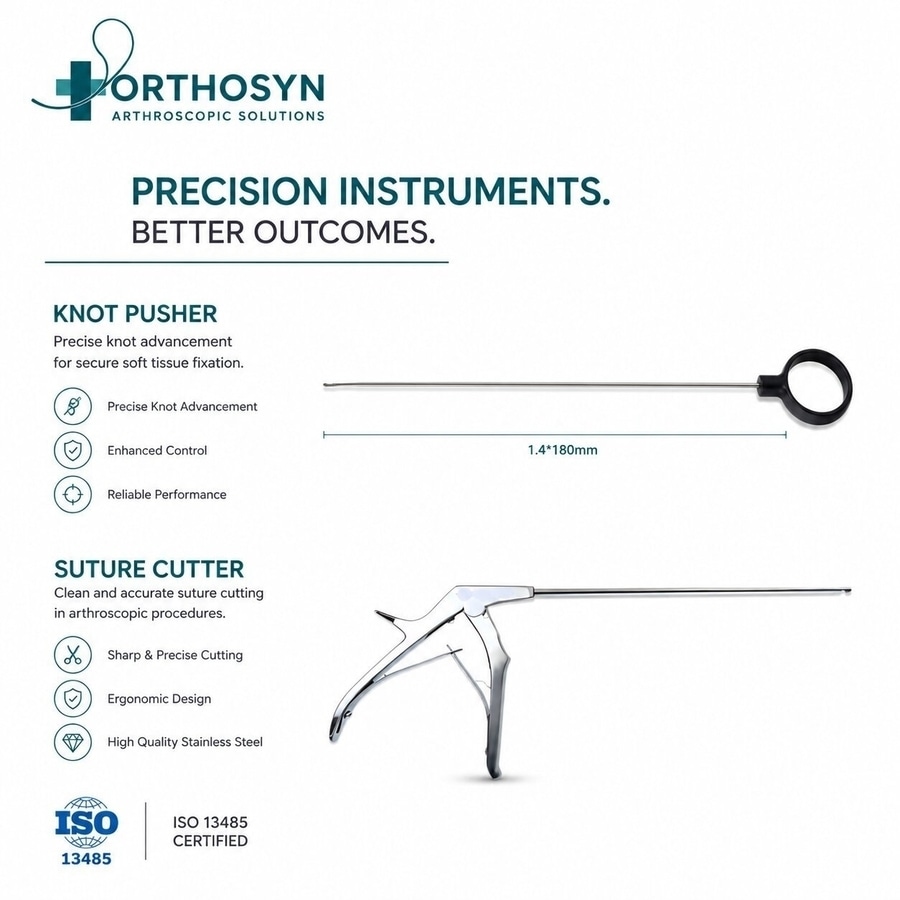
Orthosyn Medikal manufactures precision arthroscopic surgical instruments, including ergonomic knot pushers designed to facilitate accurate knot advancement, improve suture management, and support reliable soft tissue fixation during minimally invasive orthopedic procedures.