#Product Trends
Sodium Hyaluronate vs Hyaluronic Acid: What’s the Difference? | AlkaFlex
Understand the relationship between hyaluronic acid and sodium hyaluronate, why the terms are sometimes used interchangeably, how their chemical forms differ, and what this means when evaluating intra-articular hyaluronic acid injections.
When researching hyaluronic acid injections for joints, two closely related terms frequently appear: hyaluronic acid and sodium hyaluronate.
They are sometimes treated as if they were completely different substances. In other contexts, the terms are used almost interchangeably. This can create confusion for patients, healthcare professionals, distributors, and anyone comparing viscosupplementation products.
The distinction is primarily chemical.
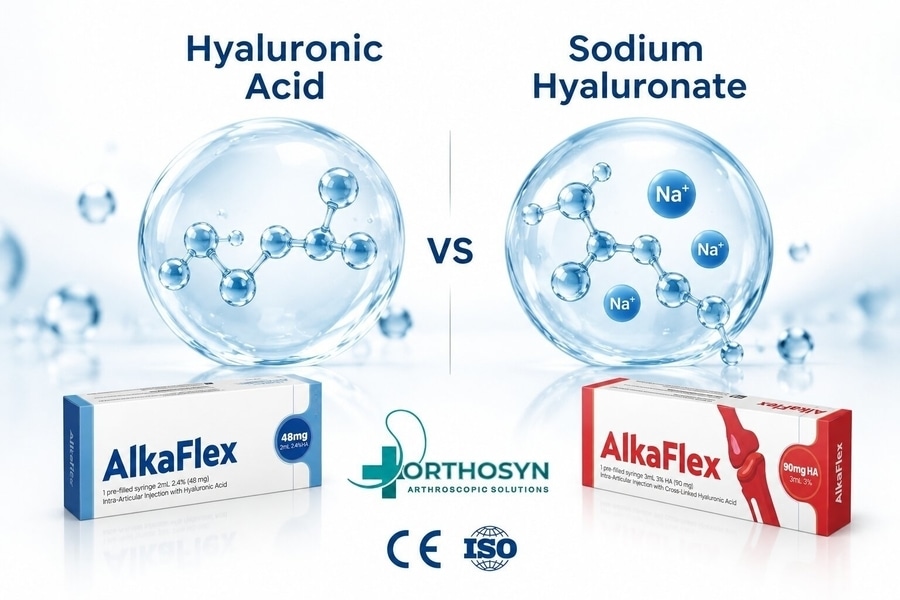
Hyaluronic acid refers to the acid form of hyaluronan, while sodium hyaluronate is the sodium salt of hyaluronic acid. In aqueous physiological environments, hyaluronic acid is largely present in its ionized form, which helps explain why terminology can overlap in medical and scientific discussions.
The basic relationship can be represented as:
Hyaluronic Acid → Sodium Salt Formation → Sodium Hyaluronate
For intra-articular products, understanding this terminology is useful, but the name alone does not determine the complete performance of a formulation. Other characteristics—including molecular weight, concentration, total HA dose, molecular structure, cross-linking, injection volume, rheological properties, and administration protocol—also need to be considered.
What Is Hyaluronic Acid?
Hyaluronic acid, commonly abbreviated as HA, is a naturally occurring glycosaminoglycan found throughout the human body.
It is present in tissues and biological fluids including:
- Synovial fluid
- Articular cartilage
- Skin
- Connective tissues
- Vitreous humor of the eye
Within synovial joints, HA is an important component of synovial fluid.
It contributes to properties associated with:
- Lubrication
- Viscoelasticity
- Load distribution
- Joint cushioning
- Mechanical behavior of synovial fluid
Because of these characteristics, HA is widely associated with intra-articular viscosupplementation.
What Is Sodium Hyaluronate?
Sodium hyaluronate is the sodium salt of hyaluronic acid.
Chemically, the carboxylic acid groups associated with hyaluronic acid can exist in ionized form and interact with positively charged ions such as sodium.
When sodium is the associated counterion, the material is referred to as sodium hyaluronate.
A simplified relationship is:
Hyaluronic Acid + Sodium Ion → Sodium Hyaluronate
This does not mean that sodium hyaluronate represents an unrelated active material.
It is a salt form of the same hyaluronan molecular backbone.
Are Hyaluronic Acid and Sodium Hyaluronate the Same Thing?
They are closely related, but chemically they are not exactly the same form.
The distinction can be summarized as follows:
Term Basic Meaning
Hyaluronic Acid Acid form of hyaluronan
Sodium Hyaluronate Sodium salt of hyaluronic acid
Hyaluronan Broader scientific term commonly used for the molecule regardless of protonation/counterion terminology
In practical medical discussions, however, “hyaluronic acid” is often used as a general term for HA-based materials, including formulations that contain sodium hyaluronate.
This is why a product may be described broadly as a “hyaluronic acid injection” while its composition or technical documentation identifies the material more specifically as sodium hyaluronate.
What Is Hyaluronan?
Hyaluronan is another term commonly encountered in scientific literature.
It is often preferred as a general name because the molecule exists predominantly in an ionized state under physiological conditions rather than as a fully protonated acid.
Therefore, three terms may appear:
Hyaluronic Acid — Hyaluronan — Sodium Hyaluronate
They are related to the same fundamental polysaccharide structure but describe it from somewhat different chemical or naming perspectives.
For general clinical communication, “hyaluronic acid” remains widely recognized.
Why Is Sodium Hyaluronate Commonly Used in Medical Formulations?
Salt forms are commonly used in pharmaceutical and medical-device formulations because their physicochemical characteristics can be suitable for preparation in aqueous solutions.
Sodium hyaluronate can be formulated in water-based preparations used in different medical fields.
Depending on the specific product, sodium hyaluronate can be found in applications involving:
- Intra-articular injections
- Ophthalmic preparations
- Wound-related products
- Medical gels
- Other medical formulations
For joint injections, however, the clinically relevant question is not simply whether the label says “hyaluronic acid” or “sodium hyaluronate.”
The properties of the complete formulation are more informative.
What Happens to Hyaluronic Acid at Physiological pH?
This helps explain much of the terminology confusion.
At physiological pH, the carboxylic acid groups within HA are largely deprotonated.
As a result, the molecule carries negative charges and interacts with positively charged ions present in the surrounding environment.
Therefore, the simple idea that there are two completely separate substances—one called hyaluronic acid and another called sodium hyaluronate—can be misleading in a biological context.
The chemical naming distinction is real, but the two forms are closely related.
Is Sodium Hyaluronate a Type of Hyaluronic Acid?
In general medical and commercial terminology, sodium hyaluronate is frequently discussed under the broader category of hyaluronic acid.
More precisely:
Sodium Hyaluronate = Sodium Salt of Hyaluronic Acid
Therefore, when comparing joint injection products, it is important not to interpret the presence of the words “sodium hyaluronate” as evidence that the product belongs to a completely different therapeutic category from HA-based viscosupplementation.
Does Sodium Hyaluronate Have a Smaller Molecular Size Than Hyaluronic Acid?
Not necessarily.
This is an important distinction.
The terms hyaluronic acid and sodium hyaluronate describe chemical form, whereas molecular weight describes the size of the polymer chains.
These are different parameters.
For example, sodium hyaluronate can theoretically be produced with different molecular-weight ranges.
Therefore:
Sodium Hyaluronate ≠ Automatically Low Molecular Weight
and:
Hyaluronic Acid ≠ Automatically High Molecular Weight
When comparing products, the molecular-weight specification should be evaluated separately.
What Does Molecular Weight Mean?
HA is a polymer composed of repeating molecular units.
The length of these polymer chains influences molecular weight.
In general terms:
Longer Polymer Chain → Higher Molecular Weight
Shorter Polymer Chain → Lower Molecular Weight
Molecular weight can influence characteristics such as:
- Solution behavior
- Viscosity
- Polymer interactions
- Rheological properties
- Formulation characteristics
However, molecular weight should not be evaluated in isolation when comparing intra-articular HA formulations.
Is Molecular Weight the Same as HA Concentration?
No.
These are completely different parameters.
Molecular weight describes the approximate size of the HA polymer chains.
Concentration describes how much HA is present within a given volume of formulation.
For example, concentration may be expressed as:
mg/mL
Therefore, two products can have the same HA concentration but different molecular weights.
Likewise, two formulations can have similar molecular-weight characteristics but different concentrations.
What Is the Difference Between Concentration and Total HA Dose?
This is another important distinction when comparing joint injections.
Concentration tells you how much HA is present per unit volume.
Total dose tells you how much HA is delivered in the entire injection.
The relationship is:
HA Concentration × Injection Volume = Total HA Amount
For example, evaluating only the percentage or mg/mL value without considering syringe volume can lead to an incomplete comparison.
Therefore, product comparisons should consider both:
- HA concentration
- Injection volume
- Total HA dose
Does Sodium Hyaluronate Mean the Product Is Linear?
No.
The term sodium hyaluronate does not by itself determine whether a formulation is linear or cross-linked.
These describe different characteristics.
A linear HA formulation contains polymer chains without an intentionally created cross-linked network.
A cross-linked formulation modifies the molecular architecture by creating connections between polymer chains.
Therefore:
Sodium Hyaluronate vs Hyaluronic Acid = Chemical/Naming Distinction
while:
Linear vs Cross-Linked HA = Structural/Formulation Distinction
These comparisons should not be confused.
What Is Linear Hyaluronic Acid?
Linear or non-cross-linked HA consists of polymer chains that have not been intentionally connected into a cross-linked network.
Its properties depend on factors such as:
- Molecular weight
- Concentration
- Polymer distribution
- Formulation environment
- Injection volume
Linear HA formulations can be used in intra-articular viscosupplementation depending on the specific product and its intended indication.
What Is Cross-Linked Hyaluronic Acid?
Cross-linked HA contains molecular connections introduced between HA polymer chains.
Cross-linking can modify characteristics such as:
- Rheological behavior
- Viscoelastic characteristics
- Resistance to degradation
- Residence characteristics
- Mechanical properties of the formulation
However:
Cross-Linked HA ≠ Automatically Clinically Superior
Clinical performance cannot be determined from cross-linking alone.
The complete formulation, product indication, clinical evidence, injection protocol, and patient characteristics must also be considered.
Is Sodium Hyaluronate Naturally Present in the Joint?
The body's native HA exists in a physiological ionic environment.
Rather than thinking of synovial HA as a bottle of chemically isolated “hyaluronic acid” or “sodium hyaluronate,” it is more accurate to understand it as hyaluronan existing within a complex biological fluid containing water, electrolytes, proteins, and other molecules.
In synovial fluid, hyaluronan contributes substantially to the fluid's viscoelastic properties.
What Role Does HA Play in Synovial Fluid?
Synovial fluid is not simply water inside the joint.
It is a specialized biological fluid that supports joint mechanics.
HA contributes to several important properties of synovial fluid:
Lubrication
HA contributes to an environment that allows articular surfaces to move smoothly relative to one another.
Viscoelasticity
Synovial fluid demonstrates both viscous and elastic behavior.
HA contributes to this rate-dependent mechanical response.
Load Distribution
The synovial environment participates in managing mechanical forces across joint structures.
Cushioning
The viscoelastic characteristics of synovial fluid contribute to the overall mechanical environment of the joint.
However, HA is only one component of joint mechanics. Articular cartilage, subchondral bone, menisci, ligaments, muscles, tendons, and joint geometry also contribute to load management.
What Happens to HA in Osteoarthritis?
Osteoarthritis involves changes throughout the joint environment.
These can involve:
- Articular cartilage
- Subchondral bone
- Synovium
- Synovial fluid
- Menisci in the knee
- Ligaments and surrounding tissues
The concentration, molecular characteristics, and functional behavior of endogenous HA within synovial fluid may also change in the osteoarthritic joint.
This provides part of the scientific basis for the concept of viscosupplementation.
What Is Viscosupplementation?
Viscosupplementation refers to the intra-articular administration of HA-based formulations into a synovial joint.
The concept is related to supplementing the rheological and viscoelastic environment of synovial fluid.
Simplified:
Intra-Articular HA Administration → Interaction with Synovial Environment → Viscosupplementation
It should not be interpreted as physically resurfacing the joint or replacing damaged cartilage.
Does Sodium Hyaluronate Replace Cartilage?
No.
Sodium hyaluronate or HA injection should not be described as a replacement for articular cartilage.
HA Injection ≠ Cartilage Replacement
Articular cartilage is a specialized tissue with a complex extracellular matrix and mechanical architecture.
An injectable HA formulation does not reproduce this structure.
Does Hyaluronic Acid Regenerate Lost Cartilage?
An intra-articular HA injection should not automatically be described as regenerating lost articular cartilage.
The primary rationale for viscosupplementation relates to the synovial environment and the properties of HA-based formulations.
Claims regarding cartilage regeneration would require specific evidence and should not be assumed simply because a product contains HA or sodium hyaluronate.
Does the Word “Sodium” Mean the Injection Contains a Large Amount of Salt?
No.
“Sodium hyaluronate” describes the sodium salt form of the HA polymer.
It should not be interpreted as meaning that the product is simply a high-salt solution.
The overall ionic composition and excipients of an injectable formulation depend on the specific product.
Is Sodium Hyaluronate Made from Rooster Combs?
Not necessarily.
The term sodium hyaluronate does not identify the biological source or manufacturing method.
HA can be obtained using different production methods.
Historically, animal-derived sources have been used for some HA products. Modern HA can also be produced using microbial or bacterial fermentation.
Therefore:
Sodium Hyaluronate ≠ Animal-Derived by Definition
The manufacturing source should be evaluated separately from the chemical name.
What Is Bacterial Fermentation?
Bacterial fermentation is a manufacturing approach used to produce HA without relying on animal tissue as the original HA source.
After fermentation, the material undergoes purification and further manufacturing processes according to the specifications of the particular product.
This distinction can be important when evaluating:
- Manufacturing origin
- Product documentation
- Raw-material specifications
- Formulation characteristics
AlkaFlex hyaluronic acid formulations use HA produced through bacterial fermentation.
Sodium Hyaluronate vs Hyaluronic Acid: Key Differences
Parameter Hyaluronic Acid Sodium Hyaluronate
Basic identity Acid form of hyaluronan Sodium salt of hyaluronic acid
Molecular backbone Hyaluronan polymer Hyaluronan polymer
Sodium counterion Not specified by the term Sodium is the associated counterion
Common medical terminology Often used as broad/general term More chemically specific salt terminology
Molecular weight Can vary Can vary
Concentration Can vary Can vary
Linear or cross-linked Can be either depending on formulation Can be either depending on formulation
Manufacturing source Must be evaluated separately Must be evaluated separately
Clinical performance Cannot be determined from name alone Cannot be determined from name alone
The most important point is that the terminology alone is not enough to compare two intra-articular HA products.
What Should Be Compared in HA Joint Injections?
When evaluating two viscosupplementation products, a more complete comparison can include:
Parameter Why It Matters
HA form Identifies how the material is chemically described
Molecular weight Influences polymer and rheological characteristics
HA concentration Indicates HA amount per unit volume
Total HA dose Indicates total amount delivered
Injection volume Influences total formulation delivered
Linear vs cross-linked Describes molecular architecture
Viscoelastic properties Relevant to mechanical fluid behavior
Manufacturing source Describes production origin
Injection protocol Defines product-specific administration
Applicable indication Defines intended clinical use
This provides considerably more useful information than simply comparing the words “hyaluronic acid” and “sodium hyaluronate.”
Is One Better Than the Other?
The terms alone do not provide a meaningful basis for saying that one is clinically better than the other.
A product labeled sodium hyaluronate is not automatically superior or inferior to a product described as hyaluronic acid.
Likewise, the chemical naming terminology alone does not determine:
- Clinical outcome
- Duration of effect
- Mechanical performance
- Appropriate number of injections
- Suitability for a particular patient
Those questions require evaluation of the complete formulation and the applicable clinical information.
Why Can Product Labels Use Different Terminology?
Medical-device labeling, technical documentation, scientific publications, commercial descriptions, and general patient information may use terminology at different levels of chemical specificity.
For example, one document may use:
Hyaluronic Acid Injection
while a composition section may specify:
Sodium Hyaluronate
This is not necessarily contradictory.
The first can describe the broader HA product category, while the second identifies the chemical salt form more specifically.
AlkaFlex Hyaluronic Acid Injections
AlkaFlex by Orthosyn Medikal includes intra-articular HA formulations developed for viscosupplementation, with different formulation strategies including linear and cross-linked hyaluronic acid options.
The AlkaFlex portfolio can be evaluated according to parameters including:
- Molecular weight
- HA concentration
- Total HA dose
- Injection volume
- Linear or cross-linked structure
- Viscoelastic characteristics
- Injection protocol
- Applicable product indication
AlkaFlex HA is produced using bacterial fermentation, providing a non-animal-source manufacturing approach.
AlkaFlex Hyaluronic Acid Injections
The specific formulation should always be evaluated according to its applicable product documentation, instructions for use, intended indication, and clinical assessment.
Conclusion
Hyaluronic acid and sodium hyaluronate are closely related forms of the same fundamental hyaluronan polymer, but the terms are not chemically identical.
The simplest distinction is:
Hyaluronic Acid = Acid Form
Sodium Hyaluronate = Sodium Salt of Hyaluronic Acid
In medical communication, however, “hyaluronic acid” is frequently used as a broader term for HA-based formulations, including products whose composition may more specifically identify sodium hyaluronate.
For intra-articular injections, this naming difference should not be mistaken for a direct indicator of product performance.
More meaningful parameters include molecular weight, HA concentration, total dose, injection volume, linear or cross-linked molecular structure, viscoelastic properties, manufacturing source, injection protocol, and applicable indication.
AlkaFlex by Orthosyn Medikal includes linear and cross-linked intra-articular hyaluronic acid formulations produced using bacterial fermentation, with different molecular, concentration, dose, volume, and viscoelastic characteristics for viscosupplementation where the specific product indication and clinical assessment are appropriate.