#Product Trends
How Soft Suture Anchors Preserve Bone During Arthroscopic Repair
Discover how soft suture anchors provide secure soft tissue fixation while minimizing bone removal in modern arthroscopic surgery.
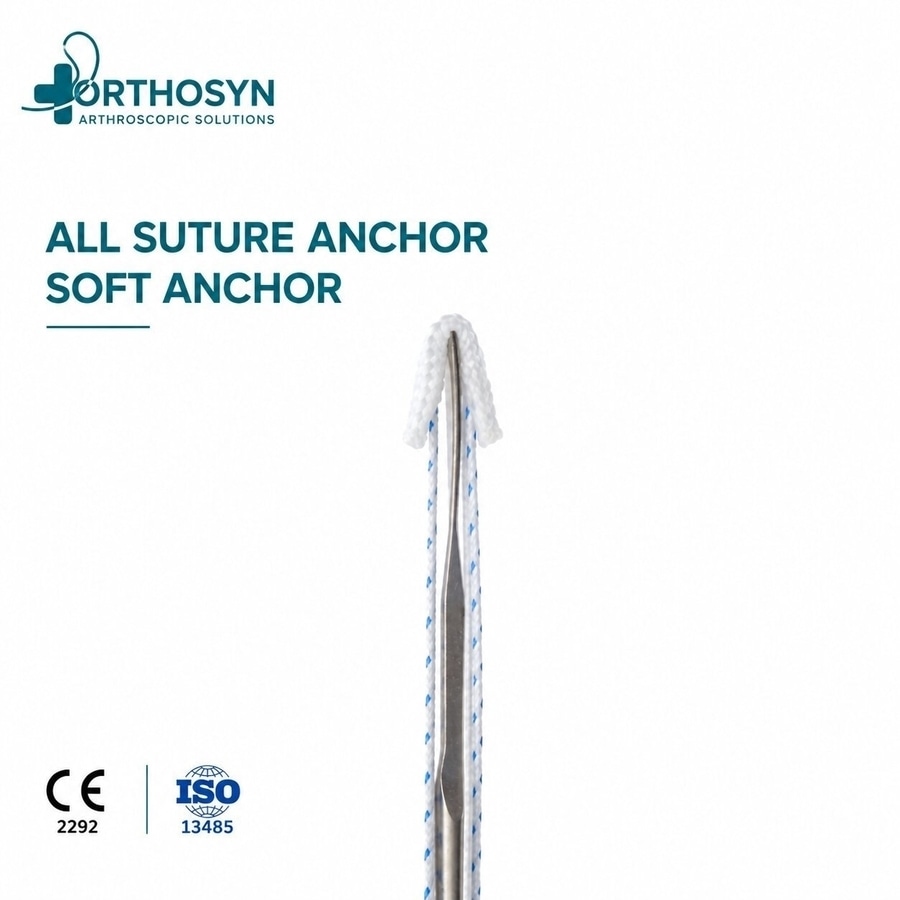
Advances in arthroscopic surgery continue to improve both surgical techniques and implant technology. Among these innovations, soft suture anchors have become an increasingly popular option for repairing tendons, ligaments, and labral tissue. Unlike traditional rigid anchors made from metal or PEEK, soft suture anchors are composed primarily of high-strength suture material and require significantly smaller bone tunnels for implantation.
By minimizing bone removal while maintaining reliable fixation, soft suture anchors have become an important tool in modern sports medicine and minimally invasive orthopedic surgery.
What Are Soft Suture Anchors?
Soft suture anchors are all-suture fixation devices designed to secure soft tissue directly to bone.
Instead of relying on a solid implant body, these anchors expand within the bone after insertion, creating stable fixation while preserving surrounding bone tissue.
Their primary characteristics include:
Small insertion diameter
High-strength suture construction
Bone-preserving fixation
Minimal implant footprint
Compatibility with arthroscopic techniques
These features make them suitable for a wide variety of orthopedic procedures.
Why Is Bone Preservation Important?
Maintaining healthy bone stock is an important objective during orthopedic surgery.
Preserving bone may provide several potential advantages:
Reduced removal of native bone
Improved options for future revision surgery
Less disruption of bone architecture
Greater flexibility when placing multiple anchors
Preservation of anatomical integrity
Bone conservation is particularly valuable in younger, active patients and in revision procedures.
How Soft Anchors Minimize Bone Loss
Traditional rigid anchors generally require larger drill holes to accommodate the implant body.
Soft suture anchors typically require considerably smaller bone tunnels.
This allows surgeons to:
Remove less bone during implantation
Preserve cortical bone
Reduce overall bone trauma
Maintain stronger surrounding bone
Optimize anchor spacing in limited anatomical areas
Smaller drill holes may contribute to improved preservation of native bone.
Clinical Applications
Soft suture anchors are widely used in numerous arthroscopic procedures.
Rotator Cuff Repair
Providing secure tendon fixation while preserving the greater tuberosity.
Bankart Repair
Allowing multiple anchor placement around the glenoid with minimal bone removal.
SLAP Repair
Supporting stable superior labral fixation while conserving glenoid bone.
Hip Arthroscopy
Facilitating labral repair in areas with limited available bone.
Elbow and Ankle Procedures
Offering reliable soft tissue fixation in smaller anatomical structures.
Advantages Beyond Bone Preservation
In addition to conserving bone, soft anchors offer several other potential benefits.
These include:
Smaller implant profile
Reduced implant volume
Flexible fixation
Excellent arthroscopic compatibility
Easier placement in confined spaces
Broad compatibility with modern high-strength sutures
These characteristics contribute to procedural versatility.
Surgical Considerations
Successful use of soft suture anchors depends on several technical factors.
Surgeons should consider:
Bone quality
Appropriate insertion angle
Correct drill size
Proper anchor deployment
Tissue quality
Repair configuration
Careful surgical technique remains essential for achieving optimal fixation.
Are Soft Anchors Suitable for Every Patient?
Soft suture anchors offer many advantages but are not necessarily the ideal solution in every clinical situation.
Implant selection depends on multiple factors, including:
Patient age
Bone density
Tissue quality
Anatomical location
Surgeon preference
Specific repair requirements
Treatment decisions should always be individualized according to the patient's clinical condition.
Future Developments
Innovation continues to improve all-suture anchor technology.
Current developments include:
Higher-strength suture materials
Improved deployment mechanisms
Enhanced fixation performance
Smaller insertion diameters
Next-generation anchor designs
These advances aim to further improve both fixation reliability and bone preservation.
Conclusion
Soft suture anchors have significantly expanded the options available for arthroscopic soft tissue repair. By requiring smaller bone tunnels, preserving native bone, and providing reliable fixation, they support modern minimally invasive surgical techniques across a wide range of orthopedic procedures. Although implant selection should always be tailored to the individual patient and surgical indication, soft suture anchors represent an important advancement for surgeons seeking effective fixation while maximizing bone preservation.
As arthroscopic technology continues to evolve, bone-preserving implant designs such as soft suture anchors will remain an integral part of contemporary sports medicine.
Orthosyn Medikal manufactures advanced soft suture anchor systems designed to provide secure soft tissue fixation, preserve native bone, and support reliable arthroscopic repair across a wide range of minimally invasive orthopedic procedures.