#Product Trends
What Does Molecular Weight Mean in Hyaluronic Acid Injections? | AlkaFlex
Learn what molecular weight means in intra-articular hyaluronic acid injections, how HA polymer chain length influences molecular size and viscoelastic properties, and why molecular weight should be evaluated together with concentration, total dose,
Molecular weight is one of the most frequently discussed characteristics of hyaluronic acid (HA) used in intra-articular injections. Product descriptions may refer to low-, medium-, or high-molecular-weight HA, while some formulations provide a specific value expressed in Daltons (Da) or MegaDaltons (MDa).
But what does molecular weight actually mean?
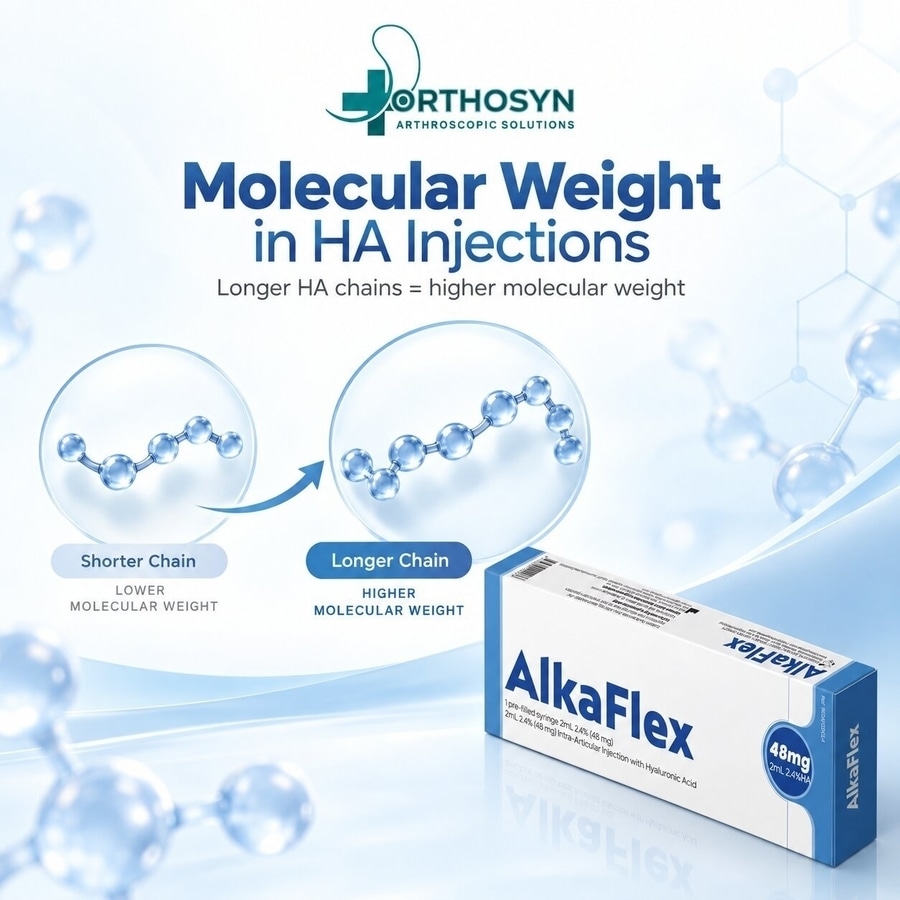
Hyaluronic acid is a long-chain molecule composed of repeating sugar units. In simple terms, molecular weight reflects the size of these HA polymer chains. Longer chains generally have a higher molecular weight, while shorter chains have a lower molecular weight.
The basic relationship can be summarized as:
Longer HA Polymer Chain → Higher Molecular Weight
Shorter HA Polymer Chain → Lower Molecular Weight
Molecular weight can influence the physical and rheological behavior of an HA solution, including viscosity and viscoelastic characteristics. However, it should not be evaluated in isolation.
When comparing intra-articular HA formulations such as those within the AlkaFlex portfolio, molecular weight should be considered together with factors including HA concentration, total HA amount, injection volume, linear or cross-linked structure, rheological properties, and intended administration protocol.
What Is Hyaluronic Acid?
Hyaluronic acid, also called hyaluronan, is a naturally occurring glycosaminoglycan found throughout the human body.
It is present in tissues including:
- Synovial fluid
- Articular cartilage
- Connective tissues
- Skin
- Vitreous humor of the eye
Within synovial joints such as the knee, HA is an important component of synovial fluid.
It contributes to:
- Lubrication
- Viscoelastic behavior
- Load distribution
- Joint movement
- Mechanical cushioning
These functions are closely related to the molecular structure and physical behavior of HA.
What Does “Molecular Weight” Mean?
Molecular weight describes the approximate mass of a molecule.
For hyaluronic acid, however, it is useful to think about molecular weight primarily in terms of polymer chain size.
HA consists of repeating disaccharide units linked together to create long polymer chains.
Conceptually:
Repeating Sugar Units → HA Polymer Chain → Molecular Weight
As the number of repeating units increases, the polymer chain becomes longer and its molecular weight increases.
Therefore:
More Repeating Units → Longer HA Chain → Higher Molecular Weight
How Is HA Molecular Weight Measured?
Molecular weight is generally expressed in Daltons (Da).
Because HA molecules can be very large, their molecular weight is often expressed in millions of Daltons, or MegaDaltons (MDa).
For example:
1 MDa = 1,000,000 Da
Therefore, an HA polymer described as 2.0 MDa has an approximate molecular weight of two million Daltons.
However, HA preparations typically contain a distribution of polymer chain sizes rather than every molecule having exactly the same molecular weight.
For this reason, molecular-weight specifications may represent an average or a defined molecular-weight range depending on the analytical method and product specification.
Why Does Polymer Chain Length Matter?
The length of an HA polymer chain can influence how the molecules interact with each other in solution.
Longer chains can form more extensive molecular interactions and entanglements.
This can affect properties such as:
- Solution viscosity
- Viscoelasticity
- Flow characteristics
- Molecular interactions
- Mechanical behavior under different loading conditions
A simplified relationship is:
Longer HA Chains → Greater Molecular Interaction → Different Rheological Behavior
However, molecular weight is only one factor determining the final properties of an injectable HA formulation.
What Is High-Molecular-Weight Hyaluronic Acid?
High-molecular-weight HA refers to HA composed of relatively long polymer chains.
There is not always one universally applied numerical boundary separating low-, medium-, and high-molecular-weight HA across every scientific or commercial context.
Therefore, the actual molecular-weight specification is generally more informative than simply seeing the phrase “high molecular weight.”
When evaluating a product, it may be useful to ask:
- What is the specified molecular weight?
- Is it an average or a range?
- Is the HA linear or cross-linked?
- What is the HA concentration?
- What is the injection volume?
- What is the total amount of HA delivered?
These parameters provide considerably more information than a general marketing description alone.
What Is Low-Molecular-Weight Hyaluronic Acid?
Low-molecular-weight HA consists of shorter HA polymer chains compared with higher-molecular-weight preparations.
Again, the exact definition can vary depending on the scientific context.
The important distinction is the underlying polymer concept:
Shorter Polymer Chains → Lower Molecular Weight
Longer Polymer Chains → Higher Molecular Weight
This difference can influence solution behavior, but it does not mean that molecular weight alone determines the clinical performance of an intra-articular injection.
Does Higher Molecular Weight Mean Higher Viscosity?
Molecular weight can strongly influence viscosity, but the relationship is not as simple as:
Higher Molecular Weight = Always Higher Final Product Viscosity
The rheological behavior of an HA formulation can also depend on:
- HA concentration
- Polymer distribution
- Cross-linking
- Molecular architecture
- Temperature
- Solvent environment
- Manufacturing process
- Formulation design
Therefore, two HA products with similar molecular-weight specifications may still exhibit different rheological properties.
Likewise, two products with different molecular weights may be formulated to produce different but clinically relevant physical characteristics.
What Is Viscoelasticity?
Synovial fluid does not behave exactly like water.
Its behavior is partly viscoelastic, meaning it demonstrates both viscous and elastic characteristics.
This allows the joint fluid to respond differently depending on movement and mechanical loading.
Conceptually:
Slow Movement → Greater Contribution of Viscous Behavior → Lubrication
Faster Mechanical Loading → Viscoelastic Response → Load Management and Cushioning
Hyaluronic acid is one of the important molecules contributing to these characteristics of synovial fluid.
The molecular weight, concentration, structure, and interactions between HA chains can all influence this behavior.
Why Is Molecular Weight Relevant to Joint Injections?
Intra-articular HA injections are used in viscosupplementation.
The concept is to introduce an HA formulation into the joint environment to supplement the rheological and mechanical properties associated with synovial fluid.
The general concept can be represented as:
Intra-Articular HA Administration → Interaction with Synovial Environment → Viscosupplementation → Support of Joint Lubrication and Mechanical Function
Because molecular weight influences polymer behavior, it is one of the formulation parameters considered when developing and evaluating viscosupplement products.
However:
Molecular Weight ≠ Complete Product Profile
It is one component of a larger formulation.
Does Higher Molecular Weight Mean a Better HA Injection?
Not automatically.
A higher molecular-weight number should not by itself be interpreted as proof of superior clinical performance.
The final characteristics of an intra-articular HA formulation depend on multiple interacting parameters.
These include:
- Molecular weight
- HA concentration
- Total HA dose
- Injection volume
- Linear or cross-linked structure
- Rheological characteristics
- Manufacturing process
- Administration protocol
- Applicable product indication
Therefore:
Higher Molecular Weight ≠ Automatically Better Clinical Outcome
A meaningful comparison requires evaluation of the complete formulation.
Molecular Weight vs HA Concentration: What Is the Difference?
Molecular weight and concentration describe two completely different characteristics.
Molecular Weight
Molecular weight describes the approximate size or mass of the HA polymer chains.
Concentration
Concentration describes how much HA is present within a given volume of solution.
For example:
20 mg / 2 mL = 10 mg/mL
This describes concentration.
It does not describe molecular weight.
Therefore:
Molecular Weight ≠ HA Concentration
A product can contain high-molecular-weight HA at a relatively low concentration, or a different formulation may contain HA at a higher concentration.
These characteristics must be evaluated separately.
Molecular Weight vs Total HA Dose
Total HA dose describes the amount of hyaluronic acid delivered in the injection.
The relationship is:
HA Concentration × Injection Volume = Total HA Amount
For example, a formulation containing:
30 mg/mL × 3 mL = 90 mg HA
provides a total HA amount of 90 mg.
This does not mean that the molecular weight is 90 mg.
Molecular weight and total HA dose are fundamentally different measurements.
Therefore:
Molecular Weight ≠ Total HA Dose
This distinction is particularly important when comparing viscosupplement products.
Molecular Weight vs Injection Volume
Injection volume describes the physical amount of solution delivered into the joint.
Examples may include:
- 2 mL
- 3 mL
- Other formulation-specific volumes
Injection volume does not determine molecular weight.
Similarly, a larger syringe does not automatically contain higher-molecular-weight HA.
Therefore:
Injection Volume ≠ Molecular Weight
The product specification must be evaluated directly.
Molecular Weight vs Cross-Linking
This is another important distinction.
Molecular weight describes polymer chain size.
Cross-linking describes structural connections created between polymer chains.
Linear HA consists primarily of individual polymer chains.
Cross-linked HA contains additional connections between those chains, creating a more complex molecular network.
Conceptually:
Linear HA → Individual Polymer Chains
Cross-Linked HA → Interconnected Polymer Network
Therefore:
High Molecular Weight ≠ Cross-Linked HA
and
Cross-Linked HA ≠ Automatically Higher Native Polymer Molecular Weight
These are separate formulation characteristics.
Can Linear HA Have a High Molecular Weight?
Yes.
A linear HA formulation can contain high-molecular-weight polymer chains without being cross-linked.
This distinction is important because “linear” does not mean “low molecular weight.”
Therefore:
Linear HA ≠ Low Molecular Weight
Likewise, cross-linking should not automatically be interpreted as evidence that the original HA polymer chains have a higher molecular weight.
Why Is Cross-Linking Used?
Cross-linking changes the molecular architecture of HA.
Instead of relying only on individual linear polymer chains, chemical connections are introduced between chains to create a network.
This can modify physical properties such as:
- Rheological behavior
- Resistance to degradation
- Residence characteristics
- Gel structure
- Mechanical behavior
However:
Cross-Linking ≠ Automatic Clinical Superiority
Clinical performance depends on the complete formulation, applicable indication, patient characteristics, administration protocol, and other factors.
What Is the Difference Between Native Molecular Weight and Cross-Linked Structure?
This distinction can become important when reading technical product information.
A manufacturer may specify the molecular weight of the HA polymer used before cross-linking.
After cross-linking, the material forms a larger interconnected network.
Therefore, describing a cross-linked gel using a single conventional molecular-weight number may not provide the same information as describing the molecular weight of a linear HA polymer.
For this reason, technical comparisons should clearly identify what the molecular-weight specification actually refers to.
Does Molecular Weight Affect How Long HA Remains in the Joint?
Molecular size and structure can influence degradation and residence characteristics, but molecular weight alone does not determine how long an injectable HA formulation remains in the joint.
Residence characteristics can also be influenced by:
- Cross-linking
- Formulation structure
- Enzymatic degradation
- Mechanical environment
- Concentration
- Molecular architecture
- Patient-related factors
Therefore:
Higher Molecular Weight ≠ Guaranteed Longer Clinical Duration
Similarly:
Cross-Linked HA ≠ Guaranteed Longer Clinical Benefit in Every Patient
Physical residence characteristics and duration of clinical effect should not be treated as identical concepts.
Does Molecular Weight Affect Lubrication?
Molecular weight can influence the rheological behavior of HA solutions and therefore can contribute to their lubrication-related properties.
However, joint lubrication is complex.
It involves:
- Synovial fluid
- Hyaluronic acid
- Lubricin
- Articular cartilage surfaces
- Phospholipids
- Joint geometry
- Mechanical loading
Therefore, HA molecular weight is relevant but represents only one component of the complete joint lubrication system.
Does Molecular Weight Affect Shock Absorption?
HA contributes to the viscoelastic properties of synovial fluid, which are involved in mechanical load management.
However, HA should not be described as a standalone shock absorber.
Joint cushioning depends on multiple structures, including:
- Articular cartilage
- Menisci
- Subchondral bone
- Synovial fluid
- Ligaments
- Muscles
- Tendons
- Joint geometry
A more accurate concept is:
HA Molecular Characteristics → Synovial Fluid Rheology → Contribution to Lubrication and Load Management
rather than:
HA = Complete Shock Absorber
Does Molecular Weight Tell Us How Much HA Is in the Syringe?
No.
Molecular weight describes polymer size.
It does not tell you how many milligrams of HA are contained in the syringe.
To determine the amount of HA delivered, you need:
- HA concentration
- Injection volume
Then:
Concentration × Volume = Total HA Dose
This is independent of the molecular-weight specification.
Why Can Two HA Products with the Same Dose Be Different?
Two injections can contain the same total number of milligrams of HA while still having substantially different formulation characteristics.
For example, they may differ in:
- Molecular weight
- Concentration
- Injection volume
- Linear or cross-linked structure
- Molecular-weight distribution
- Rheological properties
- Manufacturing method
- Administration protocol
Therefore:
Same HA Dose ≠ Same HA Formulation
This is why comparing products only by milligrams can be misleading.
Why Can Two HA Products with Similar Molecular Weight Still Be Different?
Molecular weight is only one parameter.
Two products with similar molecular-weight specifications may still differ in:
- HA concentration
- Total dose
- Injection volume
- Cross-linking
- Purification
- Molecular-weight distribution
- Rheological characteristics
- Product design
- Administration schedule
Therefore:
Similar Molecular Weight ≠ Identical Product
The complete technical profile should be considered.
What Is Molecular-Weight Distribution?
An HA preparation usually does not consist of polymer chains that are all exactly the same length.
Instead, there can be a distribution of molecular sizes.
A product may therefore be characterized using an average molecular weight or molecular-weight range.
This means that a single molecular-weight value should be interpreted within the context of the manufacturer's analytical method and specification.
For technical product comparison, it can therefore be useful to evaluate not only the stated number but also how that number was determined.
Does the Source of HA Determine Molecular Weight?
Not necessarily.
Hyaluronic acid can be manufactured using different production methods.
Modern medical HA products can use HA produced through microbial or bacterial fermentation, avoiding the need for animal-derived HA sources.
The production source and molecular weight are separate characteristics.
Therefore:
Bacterial Fermentation ≠ Specific Molecular Weight
and:
Molecular Weight ≠ Manufacturing Source
The manufacturing process can influence product quality and specifications, but the terms should not be treated as interchangeable.
What Does Molecular Weight Mean for AlkaFlex?
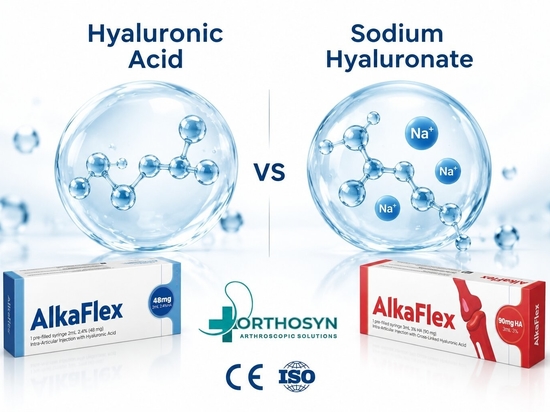
The AlkaFlex intra-articular hyaluronic acid portfolio includes formulations designed around different HA structures, concentrations, total doses, and formulation strategies.
Within the AlkaFlex portfolio, the linear/non-cross-linked HA formulation is based on 2.4 MDa hyaluronic acid, while the cross-linked formulation is associated with a 5.65 MDa molecular-weight specification.
These values should be interpreted together with the complete formulation rather than as isolated indicators of performance.
For AlkaFlex, relevant product characteristics may include:
- Molecular-weight specification
- Linear or cross-linked HA structure
- HA concentration
- Total HA amount
- Injection volume
- Administration protocol
- Applicable product indication
AlkaFlex HA is produced using bacterial fermentation, providing a non-animal-source approach to hyaluronic acid production.
More information about the AlkaFlex intra-articular hyaluronic acid portfolio is available from the Orthosyn Medikal HA category:
AlkaFlex Hyaluronic Acid Injections | Orthosyn Medikal
How Should HA Products Be Compared?
When comparing intra-articular HA injections, evaluating only molecular weight provides an incomplete picture.
A broader comparison can include:
Parameter What It Describes
Molecular weight Approximate size of HA polymer chains
Concentration Amount of HA per unit volume
Total HA dose Total amount of HA administered
Injection volume Volume delivered into the joint
Linear structure Non-cross-linked polymer configuration
Cross-linked structure Interconnected HA network
Rheology Flow and viscoelastic behavior
Source Manufacturing origin of HA
Injection protocol Number and timing of administrations
Product indication Intended clinical use
This approach provides a more meaningful understanding of the formulation than focusing on a single numerical specification.
Does Higher Molecular Weight Mean More HA?
No.
This is one of the most important distinctions.
Consider the following:
Molecular Weight → Size of HA Polymer Chains
Concentration → Amount of HA per Unit Volume
Total Dose → Total Amount of HA in the Injection
These measurements answer different questions.
A higher molecular weight does not automatically mean that the syringe contains more HA.
Does Molecular Weight Determine the Number of Injections?
No.
The number of injections in a viscosupplementation protocol cannot be determined from molecular weight alone.
Administration schedules depend on the specific product formulation and applicable instructions for use.
Depending on the product, HA therapy may involve a single injection or a multiple-injection protocol.
Therefore:
Molecular Weight ≠ Injection Frequency
The applicable product instructions should determine the administration protocol.
Can Molecular Weight Predict Clinical Response?
Molecular weight is an important physicochemical characteristic, but it should not be used as a standalone predictor of individual clinical response.
Clinical outcomes can depend on multiple variables, including:
- Patient characteristics
- Osteoarthritis severity
- Joint condition
- Product formulation
- Injection technique
- Treatment protocol
- Associated therapies
- Individual biological response
Therefore, a molecular-weight number alone cannot determine how an individual patient will respond.
Does HA Molecular Weight Mean Cartilage Regeneration?
No.
Molecular weight describes a physicochemical characteristic of the HA polymer.
It does not mean that the injection replaces lost cartilage or directly regenerates damaged articular cartilage.
Therefore:
High-Molecular-Weight HA ≠ Cartilage Replacement
and:
Viscosupplementation ≠ Structural Resurfacing of the Joint
The role of intra-articular HA should be understood within the context of viscosupplementation and joint management rather than as a replacement for missing cartilage.
Why Is Molecular Weight Important but Not Enough?
Molecular weight provides valuable information about the HA polymer itself.
But an injectable HA product is a complete formulation.
A useful evaluation therefore follows this broader concept:
Molecular Weight + Concentration + Total Dose + Volume + Molecular Structure + Cross-Linking + Rheology + Administration Protocol = More Complete Formulation Profile
This is especially important when comparing different viscosupplement products.
A single large molecular-weight number should not automatically be interpreted as evidence that one product is superior to another.
Conclusion
Molecular weight in hyaluronic acid injections describes the approximate molecular size of the HA polymer chains.
The fundamental relationship is:
Longer Polymer Chain → Higher Molecular Weight
Shorter Polymer Chain → Lower Molecular Weight
Molecular weight can influence how HA molecules interact in solution and can contribute to properties such as viscosity and viscoelastic behavior. However, it represents only one component of an intra-articular HA formulation.
It should not be confused with concentration, total HA dose, injection volume, or cross-linking.
Therefore:
Molecular Weight ≠ Concentration
Molecular Weight ≠ Total HA Dose
Molecular Weight ≠ Cross-Linking
Higher Molecular Weight ≠ Automatically Better Clinical Performance
When evaluating viscosupplementation products, molecular weight should be considered together with the complete formulation profile.
AlkaFlex intra-articular hyaluronic acid injections provide linear and cross-linked formulation options within the Orthosyn Medikal portfolio. The AlkaFlex linear formulation uses a 2.4 MDa molecular-weight specification, while the cross-linked formulation is associated with a 5.65 MDa specification, allowing molecular weight to be evaluated alongside HA concentration, total dose, injection volume, molecular structure, and the applicable administration protocol rather than as an isolated product characteristic.