#Product Trends
How Is a Bucket-Handle Meniscus Tear Repaired? | Orthosyn
Learn what a bucket-handle meniscus tear is, why displaced tears can cause mechanical locking, how arthroscopic meniscus repair is performed, and how all-inside and inside-out fixation techniques can help preserve meniscal tissue.
A bucket-handle meniscus tear is a specific type of longitudinal meniscal tear in which a substantial portion of the meniscus becomes displaced toward the center of the knee joint. The displaced fragment can resemble the handle of a bucket, which gives this tear pattern its name.
Because the torn meniscal fragment may move into the intercondylar region of the knee, bucket-handle tears can produce significant mechanical symptoms, including catching, restricted motion, and a locked knee.
When the meniscal tissue is considered repairable, arthroscopic surgery may be performed with the objective of reducing the displaced fragment back toward its anatomical position and stabilizing the tear with sutures or a meniscal repair system.
The basic concept can be summarized as:
Bucket-Handle Tear → Arthroscopic Assessment → Reduction of Displaced Fragment → Tear Preparation → Meniscal Fixation → Biological Healing
Depending on the location, size, tissue quality, vascularity, associated injuries, and surgeon preference, fixation may be performed using all-inside, inside-out, outside-in, or combined meniscal repair techniques.
What Is a Bucket-Handle Meniscus Tear?
The menisci are fibrocartilaginous structures located between the femur and tibia.
Each knee contains two menisci:
- Medial meniscus
- Lateral meniscus
They contribute to several important functions, including:
- Load distribution
- Shock absorption
- Joint congruity
- Stability
- Lubrication
- Protection of articular cartilage
A bucket-handle tear is generally a vertical longitudinal tear in which the inner portion of the meniscus remains attached at its anterior and posterior ends but becomes separated along a longitudinal tear line.
The separated fragment can then displace toward the center of the knee.
This produces the characteristic “bucket-handle” configuration.
Why Is It Called a Bucket-Handle Tear?
The name describes the shape created by the displaced meniscal fragment.
The remaining peripheral meniscus can be imagined as the body of a bucket, while the centrally displaced longitudinal fragment resembles its handle.
The basic pattern can be represented as:
Longitudinal Meniscal Tear → Mobile Meniscal Fragment → Central Displacement → Bucket-Handle Configuration
The clinical importance comes not from the name itself but from the fact that a relatively large portion of functional meniscal tissue may be displaced.
What Symptoms Can a Bucket-Handle Tear Cause?
Symptoms depend on tear size, displacement, associated injuries, and the condition of the knee.
Possible symptoms include:
- Knee pain
- Swelling
- Catching
- Clicking
- Difficulty fully extending the knee
- Restricted range of motion
- Sensation of something moving inside the joint
- Mechanical locking
A displaced fragment can physically interfere with normal joint movement.
This is one reason bucket-handle tears may require relatively prompt orthopedic evaluation, particularly when the knee remains mechanically locked.
What Does a “Locked Knee” Mean?
A mechanically locked knee occurs when an intra-articular structure physically prevents the knee from moving through its normal range of motion.
In a bucket-handle tear, the displaced meniscal fragment can move into the central part of the joint and interfere with extension.
However, not every patient who reports difficulty moving the knee necessarily has a true mechanical block.
Clinical examination and imaging are therefore important for diagnosis and treatment planning.
How Is a Bucket-Handle Meniscus Tear Diagnosed?
Diagnosis generally combines:
- Patient history
- Physical examination
- Clinical symptoms
- Imaging
- Arthroscopic assessment when surgery is performed
Magnetic resonance imaging (MRI) is commonly used to evaluate the meniscus and identify tear configuration and displacement.
MRI may also provide information about associated injuries, particularly ACL injuries.
However, final assessment of tissue quality, tear mobility, reducibility, and repairability may occur during arthroscopy.
Are Bucket-Handle Tears Associated with ACL Injuries?
Bucket-handle tears can occur as isolated injuries, but they may also occur together with anterior cruciate ligament (ACL) injuries.
This relationship is clinically important because knee instability can increase abnormal mechanical stresses on the meniscus.
When a meniscal tear is identified during ACL reconstruction, the surgeon may evaluate whether meniscal repair should be performed during the same procedure.
The treatment strategy depends on the complete injury pattern rather than the meniscal tear alone.
Does Every Bucket-Handle Tear Require Surgery?
Not every meniscal tear automatically requires surgery.
Treatment depends on factors such as:
- Symptoms
- Mechanical locking
- Tear displacement
- Tear size
- Tear location
- Tissue quality
- Vascularity
- Patient age
- Activity level
- Associated ligament injuries
- Chronicity of the tear
- Clinical examination
However, a displaced bucket-handle tear causing a true mechanical block may present a different clinical situation from a small, stable, non-displaced meniscal tear.
The appropriate treatment should therefore be determined individually.
Why Is Meniscus Preservation Important?
Historically, meniscal tears were often treated by removing damaged meniscal tissue.
Modern knee surgery increasingly emphasizes meniscal preservation whenever repair is clinically appropriate.
This is because the meniscus plays an important role in distributing loads across the knee.
Removing meniscal tissue reduces the amount of functional meniscus available to distribute these forces.
Therefore, when a bucket-handle fragment has sufficient tissue quality and healing potential, repair may be considered instead of removing the displaced segment.
The principle is:
Repairable Meniscal Tissue → Preserve When Clinically Appropriate
Can a Bucket-Handle Tear Be Repaired Instead of Removed?
Yes, selected bucket-handle tears may be repairable.
The decision depends on several factors.
A surgeon may assess:
- Location of the tear
- Peripheral vascularity
- Tissue quality
- Length of the tear
- Chronicity
- Ability to anatomically reduce the fragment
- Stability after reduction
- Associated ACL injury
- Patient characteristics
A young patient with a relatively recent traumatic longitudinal tear in tissue with favorable healing characteristics may represent a different repair situation from a chronic degenerative tear with poor tissue quality.
Therefore:
Bucket-Handle Tear ≠ Automatic Meniscectomy
and:
Bucket-Handle Tear ≠ Automatically Repairable
The decision depends on the individual tear.
What Happens During Arthroscopic Bucket-Handle Meniscus Repair?
Arthroscopic repair generally begins with systematic evaluation of the knee joint.
A simplified sequence is:
Arthroscopic Evaluation → Identification of Displaced Fragment → Reduction → Tear-Site Preparation → Suture Fixation → Stability Assessment
Each stage is important.
Step 1: Arthroscopic Evaluation
The surgeon introduces an arthroscope into the knee through small portals.
The joint is inspected to identify:
- Tear location
- Tear pattern
- Displacement
- Tissue quality
- Cartilage condition
- Associated ligament injuries
- Additional intra-articular pathology
A probe may be used to evaluate the mobility and stability of the meniscal fragment.
Step 2: Reduction of the Displaced Meniscus
Before fixation, the displaced meniscal fragment generally needs to be returned to its anatomical position.
This is known as reduction.
The surgeon may use an arthroscopic probe or other instruments to manipulate the fragment.
The objective is:
Displaced Meniscal Fragment → Anatomical Reduction → Restoration of Meniscal Position
A chronic tear may become deformed or scarred in its displaced position, potentially making reduction more difficult.
Step 3: Preparation of the Tear Site
Once the fragment has been reduced, the tear surfaces may be prepared to support biological healing.
Depending on the technique, this can involve controlled abrasion or refreshing of the tear margins.
The purpose is not to remove large amounts of healthy meniscus.
Instead, preparation aims to create an environment that may support healing after stable fixation.
Step 4: Meniscal Fixation
The reduced meniscus is stabilized using sutures or a dedicated meniscal repair system.
The objective is to maintain contact between the repaired tissue surfaces while biological healing develops.
Several repair techniques are available:
- All-inside repair
- Inside-out repair
- Outside-in repair
- Hybrid or combined repair
The appropriate method depends on tear location, anatomy, surgeon preference, and the specific clinical situation.
What Is All-Inside Meniscus Repair?
In an all-inside repair, fixation is performed primarily from within the joint using an arthroscopic meniscal repair device.
Modern all-inside systems can allow the surgeon to deliver implants or fixation elements across the tear and tension the suture arthroscopically.
A simplified concept is:
Meniscal Tear → All-Inside Device Placement → Fixation Elements Positioned → Suture Tensioning → Tear Stabilization
Potential advantages of all-inside techniques can include reduced need for additional accessory incisions and efficient arthroscopic deployment.
However, safe implant positioning and appropriate penetration depth remain important because neurovascular structures may be located near the posterior knee.
What Is Inside-Out Meniscus Repair?
The inside-out technique is a well-established method of meniscal repair.
Sutures are passed from inside the joint through the meniscus and joint capsule toward the outside of the knee.
The sutures are then retrieved and tied externally, typically through an accessory incision that allows protection of nearby structures.
The principle is:
Inside the Joint → Through Meniscus → Through Capsule → Outside the Joint → Suture Tying
Inside-out repair can provide flexibility in suture placement and is frequently considered for larger longitudinal tears.
However, it requires careful surgical technique because important neurovascular structures are located around the knee.
What Is Outside-In Meniscus Repair?
With the outside-in technique, needles or sutures are introduced from outside the joint and directed through the meniscus under arthroscopic visualization.
This technique can be useful for certain tear locations, particularly more anterior tears.
The repair method should be selected according to the anatomy and tear configuration.
All-Inside vs Inside-Out for Bucket-Handle Tears
Both approaches can be used in meniscal preservation strategies.
Feature All-Inside Repair Inside-Out Repair
Main approach Primarily intra-articular deployment Sutures passed from inside to outside
Accessory incision Often reduced or avoided depending on technique Typically required
Fixation Dedicated repair system Suture-based fixation
Suture positioning Depends on device design Flexible placement
Large longitudinal tears May be used in selected cases Commonly used
Safety consideration Implant depth and trajectory Neurovascular protection during suture retrieval
Technique selection Depends on tear and surgeon Depends on tear and surgeon
Neither technique should be considered universally superior for every bucket-handle tear.
How Many Sutures Are Needed?
There is no universal number of sutures for bucket-handle meniscus repair.
The required number depends on:
- Tear length
- Tear location
- Tissue quality
- Stability
- Suture configuration
- Repair technique
- Distance between fixation points
- Surgeon assessment
A longer tear may require multiple fixation points to create stable tissue approximation along the tear.
The objective is not simply to use more sutures.
The objective is to achieve stable anatomical fixation while preserving viable meniscal tissue.
What Suture Configurations Can Be Used?
Meniscal repair can use different suture orientations and configurations.
Depending on the tear and technique, these may include:
- Vertical mattress sutures
- Horizontal mattress sutures
- Oblique configurations
- Combined configurations
Vertical mattress sutures are frequently discussed for longitudinal tears because of their relationship to the circumferential collagen fiber architecture of the meniscus.
However, configuration should be selected according to tear morphology and surgical technique.
Why Is Tear Location Important?
The meniscus does not have the same vascular supply throughout its entire width.
The peripheral region generally has greater vascularity than the inner region.
This is commonly described using vascular zones.
Red-Red Zone
The peripheral meniscal region with relatively greater vascular supply.
Red-White Zone
The transitional region with intermediate vascularity.
White-White Zone
The more central region with limited vascularity.
Because biological healing depends partly on blood supply, tear location can influence repair potential.
However, vascular zone is only one factor and should not be used as the sole determinant of repairability.
Why Does Tissue Quality Matter?
Sutures can only stabilize tissue effectively when the tissue itself can hold the repair.
Degenerative, fragmented, severely damaged, or chronically deformed meniscal tissue may provide less reliable fixation.
During arthroscopy, the surgeon can directly evaluate whether the tissue can be reduced and securely stabilized.
Therefore, the final repair decision may differ from what was anticipated based on MRI alone.
What Happens If the Tear Cannot Be Repaired?
If the displaced tissue is considered irreparable, the surgeon may remove the unstable portion while attempting to preserve as much functional meniscal tissue as possible.
This is known as partial meniscectomy.
The principle is generally:
Remove Only Irreparable Unstable Tissue → Preserve as Much Functional Meniscus as Possible
Total meniscectomy is generally avoided whenever possible because of the important biomechanical role of the meniscus.
Why Is Stable Reduction Important?
Simply returning the meniscus to its anatomical position is not sufficient if the fragment remains unstable.
After reduction, fixation should maintain tissue approximation during knee movement and throughout the early healing period.
The surgeon therefore evaluates the repaired meniscus with an arthroscopic probe.
The sequence becomes:
Reduction → Fixation → Probe Assessment → Confirmation of Stability
If instability remains, additional fixation may be required depending on the repair strategy.
What Is the Role of Meniscal Repair Devices?
Dedicated meniscal repair systems are designed to help place fixation across meniscal tears arthroscopically.
Depending on device design, a system may include:
- Delivery needle
- Fixation implants
- High-strength suture
- Depth adjustment
- Tensioning mechanism
- Cutting mechanism
Controlled depth is particularly important in posterior meniscal repair because structures outside the joint must be considered during device deployment.
What Is UHMWPE Suture?
Some modern meniscal repair systems use high-strength sutures based on ultra-high-molecular-weight polyethylene (UHMWPE).
This material is widely used in orthopedic sutures because of its mechanical characteristics.
The suture functions as part of the fixation construct, maintaining tissue approximation while biological healing develops.
The suture itself does not heal the meniscus.
Instead:
Fixation Provides Mechanical Stability → Biological Tissue Healing Develops Over Time
How Are Bucket-Handle Tears Managed During ACL Reconstruction?
Bucket-handle meniscal tears may occur together with ACL injuries.
When both require surgery, meniscal repair may sometimes be performed during the same procedure as ACL reconstruction.
The surgeon must evaluate both:
Ligament Stability + Meniscal Preservation
Restoring knee stability can be important because persistent instability may expose the repaired meniscus to abnormal mechanical stresses.
The complete surgical strategy therefore considers the knee as an integrated biomechanical system rather than treating each structure independently.
What Happens After Bucket-Handle Meniscus Repair?
After surgery, the repaired tissue requires time for biological healing.
Rehabilitation protocols vary according to:
- Tear pattern
- Repair technique
- Fixation stability
- Associated ACL reconstruction
- Other procedures
- Surgeon preference
- Patient characteristics
Postoperative management may regulate:
- Weight bearing
- Knee flexion
- Range of motion
- Use of a brace
- Muscle strengthening
- Return to running
- Return to sport
A repaired meniscus should not be considered immediately healed simply because it is mechanically stable at the end of surgery.
How Long Does Meniscal Healing Take?
Meniscal healing is a biological process that occurs over time.
There is no single recovery timeline applicable to every bucket-handle repair.
Recovery depends on factors such as:
- Tear location
- Vascularity
- Tissue quality
- Tear size
- Repair stability
- Patient age
- Associated injuries
- Rehabilitation
- Activity demands
Return to sports is therefore determined by clinical progress and the rehabilitation protocol rather than by a single universal timeframe.
Can a Repaired Bucket-Handle Tear Fail?
Yes.
As with any biological repair, healing is not guaranteed.
Potential reasons for failure can include:
- Poor tissue quality
- Limited biological healing
- Large or complex tear pattern
- Chronic injury
- Recurrent trauma
- Persistent knee instability
- Excessive loading during healing
- Failure of fixation
- Patient-related biological factors
This is another reason why patient selection, surgical technique, fixation stability, and rehabilitation all matter.
Why Is Meniscal Preservation Important for Long-Term Knee Mechanics?
The meniscus distributes loads across the tibiofemoral joint.
When functional meniscal tissue is removed, the remaining contact area can decrease and mechanical stress on the articular surfaces can change.
For this reason, contemporary meniscal surgery generally aims to preserve as much functional meniscal tissue as reasonably possible.
The principle can be summarized as:
Meniscal Preservation → Maintain Functional Meniscal Tissue → Support Load Distribution and Joint Mechanics
This does not mean every tear should be repaired. It means repair should be considered when the tear pattern, tissue quality, biological environment, and clinical circumstances make preservation appropriate.
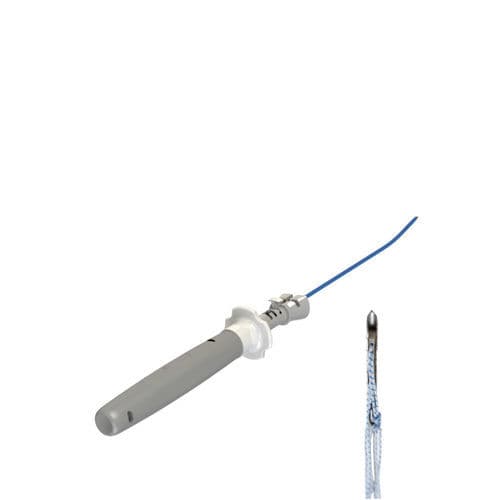
VersaFix All-Inside Meniscal Repair System | Orthosyn
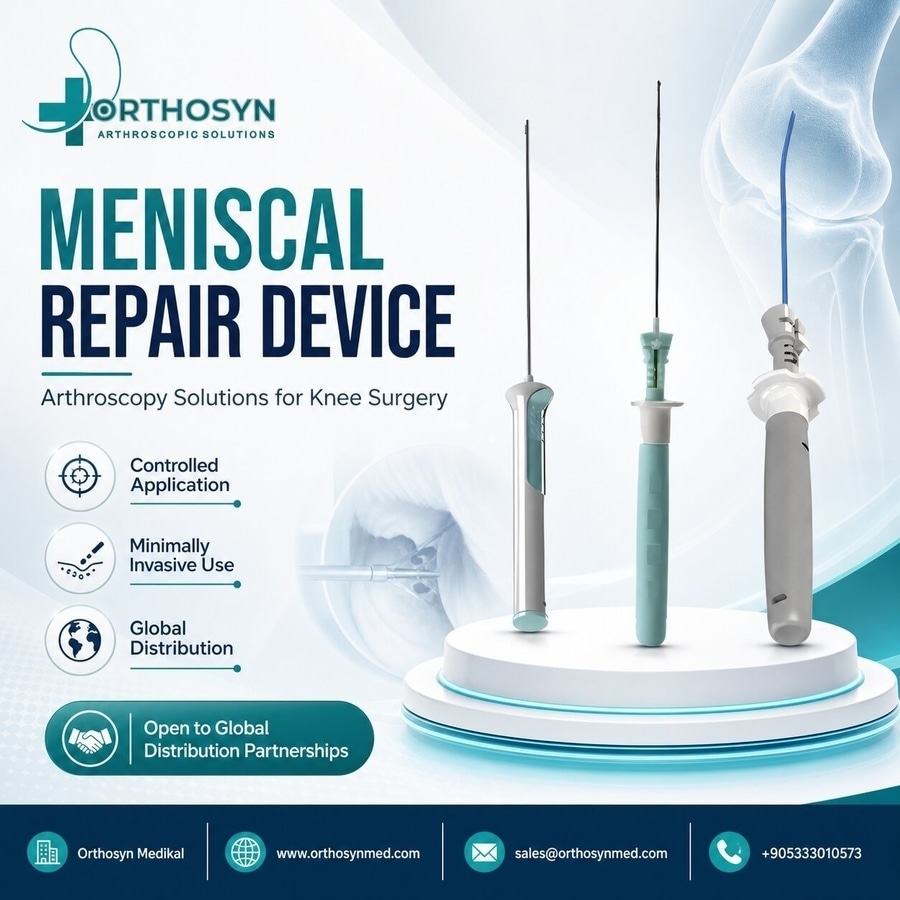
Orthosyn Medikal includes the VersaFix All-Inside Meniscal Repair System within its arthroscopy portfolio for arthroscopic meniscal fixation.
An all-inside system is designed to support arthroscopic placement of fixation elements and suture-based stabilization while minimizing the need for additional external access compared with traditional inside-out techniques.
In bucket-handle tears considered suitable for repair, an all-inside system may form part of a fixation strategy depending on:
- Tear location
- Tear length
- Tissue quality
- Meniscal anatomy
- Required fixation pattern
- Surgical technique
- Surgeon assessment
Orthosyn’s broader arthroscopy portfolio also includes fixation systems and instrumentation for procedures that may accompany meniscal repair, including ACL reconstruction.
The choice of repair technique and device should always follow the applicable product indication, instructions for use, patient anatomy, tear characteristics, and professional surgical assessment.
Conclusion
A bucket-handle meniscus tear is a longitudinal meniscal tear in which a substantial fragment can displace toward the center of the knee, potentially causing catching, restricted motion, or mechanical locking.
When the tissue is considered repairable, arthroscopic treatment generally follows this principle:
Bucket-Handle Tear → Arthroscopic Assessment → Anatomical Reduction → Tear Preparation → Meniscal Fixation → Stability Assessment → Biological Healing
Fixation can be performed using all-inside, inside-out, outside-in, or combined techniques, depending on tear morphology, location, tissue quality, anatomy, associated injuries, and surgeon preference.
The primary objective of repair is not merely to close the tear. It is to restore the displaced meniscal tissue to an appropriate anatomical position, provide sufficient mechanical stability for healing, and preserve as much functional meniscus as clinically appropriate.
Orthosyn Medikal’s VersaFix All-Inside Meniscal Repair System provides an arthroscopic fixation option within the Orthosyn meniscal repair portfolio for cases in which all-inside meniscal fixation is appropriate according to the specific tear characteristics, applicable product indication, and surgical assessment.