#Product Trends
How Arthroscopic Graspers Improve Tissue Handling During Minimally Invasive Surgery
Discover how arthroscopic graspers enhance tissue control, surgical precision, and procedural efficiency in modern minimally invasive orthopedic procedures.
Minimally invasive arthroscopic surgery has transformed orthopedic practice by enabling complex joint procedures through small portals with minimal disruption to surrounding tissues. While arthroscopes and implants often receive the greatest attention, the success of these procedures also relies heavily on specialized surgical instruments. Among them, the arthroscopic grasper is one of the most frequently used tools for tissue manipulation and retrieval.
Designed to securely grasp, mobilize, and position soft tissues inside confined joint spaces, arthroscopic graspers allow surgeons to perform delicate maneuvers with greater precision while minimizing unnecessary tissue trauma. Their versatility makes them indispensable instruments in modern sports medicine and arthroscopic surgery.
What Is an Arthroscopic Grasper?
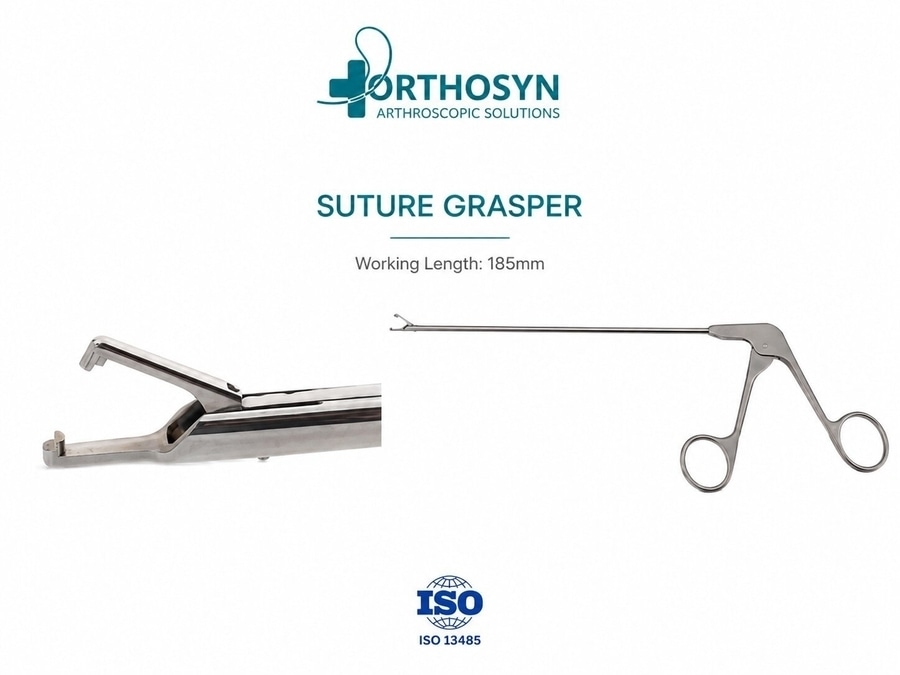
An arthroscopic grasper is a specialized surgical instrument used to grasp, hold, retrieve, or manipulate soft tissues and surgical materials during arthroscopic procedures.
Its primary functions include:
Grasping soft tissues
Retrieving loose bodies
Manipulating tendons and ligaments
Holding sutures during repair
Assisting implant placement
Graspers are available in multiple jaw designs and lengths to accommodate different surgical procedures.
Why Is Tissue Handling Important?
Successful arthroscopic surgery depends on precise control of soft tissues throughout the procedure.
Effective tissue handling helps surgeons:
Improve visualization
Reduce tissue trauma
Position tissues accurately
Facilitate suture passage
Enhance repair quality
Controlled manipulation contributes directly to procedural safety and surgical success.
Improving Surgical Precision
Inside a joint, surgeons work within a very limited operating space.
Arthroscopic graspers provide excellent control by allowing:
Secure tissue capture
Precise tissue positioning
Controlled traction
Stable manipulation
Gentle handling of delicate structures
These capabilities are especially valuable during complex reconstructive procedures.
Applications in Arthroscopic Surgery
Arthroscopic graspers are used in numerous orthopedic procedures.
Rotator Cuff Repair
Holding and mobilizing torn tendon tissue during repair.
Bankart Repair
Positioning the labrum while preparing anchor placement.
SLAP Repair
Manipulating superior labral tissue for accurate fixation.
Meniscal Surgery
Grasping torn meniscal fragments or assisting meniscal repair.
ACL Reconstruction
Handling graft tissue and assisting suture management during ligament reconstruction.
Retrieving Loose Bodies
Loose cartilage or bone fragments inside the joint may cause pain, locking, and mechanical symptoms.
Arthroscopic graspers allow surgeons to:
Securely capture loose bodies
Remove tissue fragments
Maintain visualization
Reduce unnecessary manipulation
Improve procedural efficiency
Reliable retrieval instruments help simplify these procedures.
Supporting Suture Management
Modern arthroscopic repairs often involve multiple sutures and anchors.
Graspers assist by:
Holding suture limbs
Retrieving sutures through portals
Organizing suture management
Preventing suture tangling
Improving workflow
Efficient suture handling becomes increasingly important during advanced soft tissue repairs.
Design Features of Modern Graspers
Today's arthroscopic graspers are engineered for precision and durability.
Common design features include:
Ergonomic handles
Slim shaft profiles
Serrated jaws for secure grip
Various jaw configurations
Stainless steel construction
Smooth opening and closing mechanisms
Different jaw designs allow surgeons to select instruments appropriate for specific tissues and procedures.
Improving Operating Room Efficiency
Well-designed graspers contribute to smoother procedures.
Potential benefits include:
Faster tissue manipulation
Reduced operative time
Better instrument control
Fewer unnecessary instrument exchanges
Greater procedural consistency
Efficient instruments support both surgeon performance and operating room workflow.
Future Developments
Arthroscopic instrumentation continues to evolve.
Current innovations include:
Improved ergonomic designs
Enhanced jaw geometry
Stronger yet lighter materials
Better tactile feedback
Procedure-specific graspers
These advances aim to further improve precision while minimizing tissue trauma.
Conclusion
Arthroscopic graspers are essential instruments in modern minimally invasive orthopedic surgery. By enabling secure tissue handling, precise manipulation, efficient suture management, and reliable retrieval of tissue fragments, they contribute significantly to the safety and success of arthroscopic procedures. Although often considered simple instruments, their design and performance play a critical role in achieving consistent surgical outcomes.