#Product Trends
Why Anchor Diameter Matters in Arthroscopic Soft Tissue Repair | Orthosyn
Understanding how suture anchor diameter can influence bone preservation, fixation strategy, anchor placement, and surgical planning in modern arthroscopic soft tissue repair.
Suture anchors are fundamental components of arthroscopic soft tissue repair. They are used to secure tendons, ligaments, and labral tissue to bone in procedures such as rotator cuff repair, Bankart repair, SLAP repair, and other arthroscopic reconstructions.
When selecting a suture anchor, surgeons consider several factors, including implant material, fixation mechanism, suture configuration, bone quality, and anchor diameter.
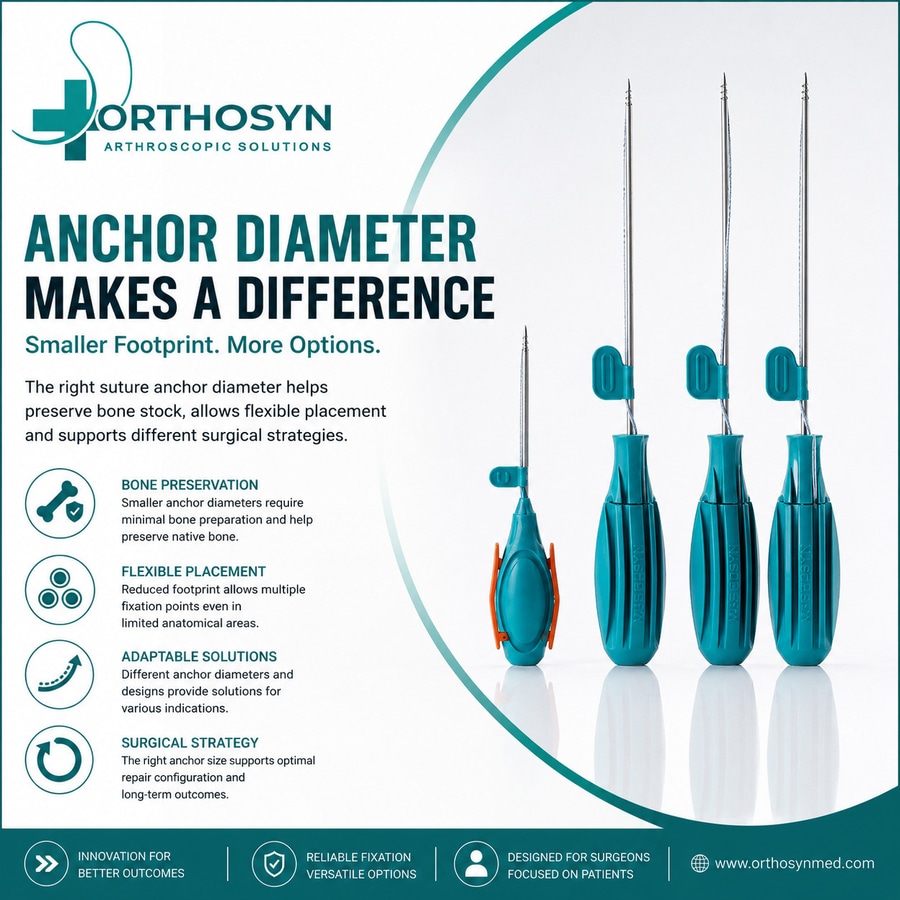
Anchor diameter is particularly important because it directly influences the amount of bone required for implantation and can affect how multiple fixation points are positioned within a limited anatomical area.
The Orthosyn arthroscopy portfolio includes different anchor technologies and diameters, including PEEK, titanium, knotless, and soft / all-suture anchor systems.
What Does Suture Anchor Diameter Mean?
Anchor diameter refers to the width of the implant or the bone tunnel required for its placement.
Even differences of only a few millimeters can become important during arthroscopic surgery, particularly when several anchors need to be positioned close to one another.
Anchor diameter can influence:
Bone tunnel size
Amount of bone removed during preparation
Available spacing between anchors
Implant footprint
Fixation strategy
Options for multiple-anchor constructs
For this reason, surgeons do not select anchor size solely according to implant strength. The anatomical environment and overall repair configuration must also be considered.
Why Is Bone Preservation Important?
Every conventional suture anchor requires preparation of a site within the bone. As anchor diameter increases, the amount of bone required for placement generally increases as well.
Bone preservation can be particularly important in anatomical areas where available bone stock is limited, such as the glenoid during shoulder instability repair.
Smaller-diameter anchors may allow surgeons to reduce the size of the required bone tunnel and preserve more surrounding bone.
This can be especially relevant when multiple anchors are required, anchors must be positioned close together, available bone stock is limited, or revision surgery may be necessary in the future.
Anchor Diameter in Labral Repair
Labral repair is a good example of why anchor diameter matters.
During procedures such as Bankart repair, several anchors may be positioned along the glenoid rim to restore the labrum and capsulolabral complex.
Because the glenoid provides a limited area for anchor placement, surgeons must carefully consider the number of anchors, distance between anchors, anchor diameter, insertion angle and available bone stock.
Using smaller anchors can provide greater flexibility when several fixation points are required.
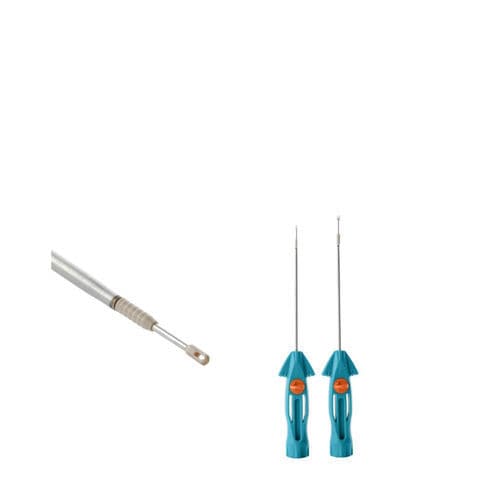
Orthosyn Soft / All-Suture Anchors are designed around a small-diameter, bone-preserving fixation concept.
Does a Larger Anchor Mean Stronger Fixation?
Not automatically.
Anchor performance depends on much more than diameter. Important factors include:
Implant geometry
Thread design
Anchor material
Bone density
Insertion depth and angle
Suture configuration
Fixation mechanism
Surgical technique
A smaller, appropriately designed anchor may provide effective fixation in the appropriate clinical setting, while simply increasing anchor diameter does not guarantee better performance.
PEEK and Titanium Anchor Options
PEEK anchors provide a rigid, non-metallic fixation option for arthroscopic soft tissue repair. The combination of diameter, thread geometry, insertion technique and bone quality determines how the implant engages with surrounding bone.
Orthosyn PEEK Suture Anchors
Titanium remains another established material for orthopedic fixation. Titanium anchors can be produced in different diameters according to anatomical and fixation requirements.
Orthosyn Titanium Suture Anchors
Why Soft / All-Suture Anchors Can Use Smaller Bone Tunnels
Soft anchors, also known as all-suture anchors, use high-strength suture material as the primary fixation structure instead of a conventional rigid implant body.
Because there is no large rigid anchor body, these systems can be inserted through smaller bone tunnels.
Potential advantages include:
Reduced bone removal
Smaller insertion diameter
Preservation of surrounding bone stock
Greater flexibility for multiple-anchor placement
Minimal rigid implant material
Potential advantages in anatomically constrained areas
Explore the Orthosyn Soft / All-Suture Anchor System.
What About Knotless Anchors?
Anchor diameter should also be considered together with the fixation mechanism.
Knotless anchors secure sutures without requiring traditional arthroscopic knot tying and can be incorporated into different modern repair constructs.
Orthosyn provides:
Orthosyn PEEK + PEEK Knotless Anchor – Push Lock System
Orthosyn PEEK + Titanium Knotless Anchor
When selecting a knotless system, anchor diameter should be evaluated alongside implant material, fixation mechanism, bone quality and intended suture configuration.
Diameter Is Only One Part of Anchor Selection
No single diameter is ideal for every arthroscopic procedure.
Anchor selection should consider:
Anchor diameter and length
Implant material
Thread or fixation geometry
Knotted or knotless fixation
Suture configuration
Bone quality
Tissue quality
Anatomical location
Number of fixation points
Available bone stock
Surgeon preference and technique
The objective is not simply to choose the smallest or largest anchor, but to select an implant appropriate for the specific repair.
Orthosyn Suture Anchor Portfolio
The Orthosyn arthroscopy portfolio includes:
PEEK Suture Anchors
Titanium Suture Anchors
PEEK + PEEK Knotless Anchors
PEEK + Titanium Knotless Anchors
Soft / All-Suture Anchors
Conclusion
Anchor diameter is an important consideration in arthroscopic soft tissue repair because it influences bone tunnel size, bone preservation, implant spacing and overall fixation strategy.
Larger diameter does not automatically mean better fixation, just as smaller diameter does not automatically mean a better implant. Successful anchor selection depends on the interaction between implant geometry, material, bone quality, anatomical location, suture configuration and surgical technique.
Small-diameter and all-suture technologies can be particularly useful when bone preservation and multiple fixation points are important, while rigid PEEK and titanium anchors continue to provide established fixation options for a wide range of arthroscopic procedures.
Orthosyn Medikal offers PEEK, titanium, knotless and soft / all-suture anchor systems in different configurations to support modern arthroscopic soft tissue repair.