#Industry News
What Does Hyaluronic Acid Molecular Weight Mean in Joint Injections? | AlkaFlex
Understanding how hyaluronic acid molecular weight influences the physical characteristics, viscosity, degradation profile, and formulation strategy of intra-articular HA injections.
Hyaluronic acid (HA) injections are widely used for intra-articular viscosupplementation, particularly in the management of knee osteoarthritis. However, not all HA injections have the same molecular characteristics.
One of the most important terms used when comparing hyaluronic acid products is molecular weight, usually expressed in Daltons (Da) or MegaDaltons (MDa).
But what does molecular weight actually mean, and why does it matter in joint injections?
Molecular weight describes the approximate size of the hyaluronic acid molecules within a formulation. It can influence properties such as viscosity, viscoelasticity, molecular behavior and degradation profile. However, molecular weight should not be evaluated alone. HA concentration, total dose, linear or cross-linked structure, injection volume and overall formulation are also important.
The AlkaFlex Hyaluronic Acid Injection portfolio from Orthosyn Medikal includes different HA formulations designed for intra-articular viscosupplementation.
What Is Hyaluronic Acid Molecular Weight?
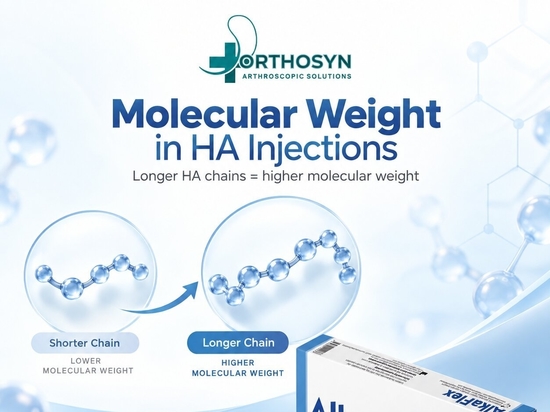
Hyaluronic acid is a long-chain molecule composed of repeating units. The length and size of these molecular chains are reflected in their molecular weight.
In simple terms:
Lower molecular weight HA consists of comparatively shorter molecular chains.
Higher molecular weight HA consists of comparatively longer molecular chains.
Molecular weight is commonly expressed in:
kDa – kilodaltons
MDa – megadaltons
For example, 1 MDa corresponds to approximately one million Daltons.
The molecular weight of HA can influence how a formulation behaves physically, but it does not independently determine its clinical performance.
Why Does Molecular Weight Matter in Joint Injections?
Natural synovial fluid contains hyaluronic acid that contributes to the lubrication and viscoelastic properties of the joint environment.
In osteoarthritis, changes can occur in the concentration and molecular characteristics of endogenous HA.
Intra-articular HA injections are designed to supplement the synovial environment. The molecular weight of the injected HA is one of the characteristics that influences the physical behavior of the formulation.
Depending on the complete formulation, molecular weight may influence:
Viscosity
Elasticity
Rheological behavior
Interaction between HA chains
Resistance to degradation
Injectability
This is why molecular weight is commonly included among the technical specifications of viscosupplementation products.
Low vs High Molecular Weight HA
The terms low molecular weight and high molecular weight describe the relative size of HA molecular chains.
Lower Molecular Weight HA
Lower molecular weight formulations contain comparatively shorter HA chains.
Their characteristics depend on concentration and formulation, but they may generally exhibit lower viscosity than comparable higher molecular weight formulations.
Higher Molecular Weight HA
Higher molecular weight HA contains longer molecular chains.
These longer chains can contribute to greater molecular entanglement and may influence the viscosity and viscoelastic behavior of the formulation.
However, it is important to avoid assuming that higher molecular weight automatically means better clinical performance.
The complete product formulation must always be considered.
Does Higher Molecular Weight Mean Higher Viscosity?
Molecular weight can influence viscosity, but the relationship is not determined by molecular weight alone.
Viscosity can also be affected by:
HA concentration
Molecular weight distribution
Linear or cross-linked structure
Cross-linking technology
Temperature
Overall formulation
For example, two HA products with similar molecular weights may have different rheological properties if their concentrations or molecular structures differ.
Therefore, molecular weight and viscosity should not be treated as interchangeable terms.
Molecular Weight vs HA Concentration
Molecular weight and concentration describe two completely different characteristics.
Molecular weight describes the approximate size of the HA molecules.
Concentration describes how much HA is present within a specific volume, usually expressed as mg/mL.
A product can therefore have:
High molecular weight with a lower concentration
High molecular weight with a higher concentration
Lower molecular weight with a high concentration
Different combinations of these characteristics
This distinction is essential when comparing viscosupplementation products.
The AlkaFlex Hyaluronic Acid Injection range includes different HA dosing and formulation options for intra-articular use.
Molecular Weight vs Total HA Dose
Another common source of confusion is the difference between molecular weight and total dose.
A syringe containing 90 mg of HA does not necessarily contain HA with a higher molecular weight than a syringe containing 60 mg.
The 90 mg or 60 mg figure represents the total quantity of hyaluronic acid, not the molecular size of the HA chains.
When comparing products, these characteristics should therefore be evaluated separately:
Molecular weight
HA concentration
Total HA dose
Injection volume
A higher number of milligrams does not automatically indicate a higher molecular weight.
How Does Cross-Linking Affect the Discussion?
Cross-linking adds another important dimension.
Linear hyaluronic acid consists of individual HA molecular chains. In a cross-linked formulation, connections are created between these chains, producing a more interconnected molecular network.
Cross-linking can modify properties such as:
Viscosity
Elasticity
Structural stability
Resistance to degradation
Intra-articular persistence
For this reason, a cross-linked HA product should not be evaluated simply by comparing its molecular weight with that of a linear HA product.
Molecular weight and cross-linking are different characteristics.
A high-molecular-weight linear HA formulation can remain completely non-cross-linked, while a cross-linked formulation uses connections between HA chains to create a different molecular structure.
Does Cross-Linking Increase Molecular Weight?
This question requires an important distinction.
Cross-linking connects multiple HA chains into a larger molecular network, but this should not simply be interpreted as increasing the molecular weight of an individual linear HA chain.
Therefore, when comparing linear and cross-linked HA, it is more appropriate to evaluate the complete molecular architecture and rheological properties rather than relying on a single molecular-weight number.
This distinction is particularly important when comparing different technologies used in modern viscosupplementation.
Does Higher Molecular Weight Mean Longer Joint Residence?
Higher molecular weight can influence degradation behavior, but molecular weight alone does not determine how long an HA formulation remains within the joint.
Intra-articular persistence can also depend on:
Cross-linking
HA concentration
Molecular structure
Enzymatic degradation
Formulation technology
Individual joint environment
Cross-linked HA formulations, for example, are generally designed to increase resistance to degradation through their interconnected molecular structure.
Therefore, joint residence time should not be predicted solely from the molecular weight stated for a product.
Is Higher Molecular Weight HA Better?
Not necessarily.
A higher molecular weight is a formulation characteristic, not a universal measure of product quality.
The suitability of an HA injection depends on the complete product profile and intended treatment strategy.
Relevant factors include:
Molecular weight
Molecular weight distribution
HA concentration
Total HA dose
Linear or cross-linked structure
Rheological properties
Injection volume
Number of injections
Patient characteristics
Clinical indication
For this reason, one HA product should not be considered superior to another simply because it has a higher molecular-weight value.
AlkaFlex and Hyaluronic Acid Formulation
AlkaFlex by Orthosyn Medikal includes different hyaluronic acid formulations developed for intra-articular viscosupplementation.
The AlkaFlex portfolio includes linear and cross-linked HA options, allowing different molecular characteristics, concentrations, doses and treatment approaches to be considered.
Rather than evaluating HA injections according to a single parameter, AlkaFlex represents a portfolio approach in which molecular weight is considered together with the overall formulation.
Explore the complete AlkaFlex Hyaluronic Acid Injection portfolio.
What Should You Compare When Evaluating HA Injections?
When comparing intra-articular hyaluronic acid products, molecular weight is important, but it should be evaluated alongside other technical characteristics.
Important parameters include:
Molecular weight
Molecular weight distribution
HA concentration in mg/mL
Total HA dose
Injection volume
Linear or cross-linked structure
Cross-linking technology
Rheological characteristics
Injection protocol
Manufacturing quality
Intended use and clinical documentation
Looking at these characteristics together provides a more meaningful comparison than focusing on molecular weight alone.
Conclusion
Hyaluronic acid molecular weight describes the approximate size of HA molecular chains and is an important characteristic of intra-articular HA formulations.
Higher molecular weight can influence properties such as viscosity and viscoelastic behavior, but higher molecular weight does not automatically mean a better HA injection.
Molecular weight should always be considered together with HA concentration, total dose, molecular structure, cross-linking technology, rheological properties and injection protocol.
Understanding these differences allows healthcare professionals and distributors to evaluate viscosupplementation products based on the complete formulation rather than a single technical number.
AlkaFlex by Orthosyn Medikal offers linear and cross-linked hyaluronic acid formulations with different dosing and formulation strategies for intra-articular viscosupplementation.
Explore AlkaFlex
AlkaFlex Hyaluronic Acid Injections
AlkaFlex Hyaluronic Acid Injections | Orthosyn Medikal — linear and cross-linked HA solutions for intra-articular viscosupplementation and modern joint care.