#Product Trends
Knotless vs Knotted Suture Anchors: What Is the Difference? | Orthosyn
Understanding the differences between knotless and knotted suture anchors, including fixation technique, knot management, tension control, implant design, and their role in modern arthroscopic soft tissue repair.
Suture anchors are widely used in arthroscopic surgery to secure soft tissue to bone. They play an important role in procedures such as rotator cuff repair, Bankart repair, SLAP repair, and other shoulder soft tissue reconstructions.
One of the major decisions when selecting an anchor system is whether to use a knotted or knotless fixation technique.
Traditional knotted suture anchors rely on arthroscopic knots to secure the repaired tissue, while knotless anchors are designed to achieve fixation without requiring a surgical knot.
Both techniques are established approaches in arthroscopic surgery, but they differ in implant design, surgical workflow, tensioning technique, knot management, and repair configuration.
The Orthosyn arthroscopy portfolio includes conventional PEEK and titanium suture anchors as well as PEEK + PEEK and PEEK + Titanium knotless anchor systems.
What Is a Knotted Suture Anchor?
A knotted suture anchor typically consists of an anchor implanted into bone with one or more high-strength sutures.
After the anchor is inserted, the sutures are passed through the target tissue. The surgeon then creates arthroscopic knots to secure the tissue against the bone.
The general sequence includes:
Preparing the anchor site
Inserting the suture anchor
Passing the sutures through the tissue
Managing the suture limbs
Applying appropriate tension
Creating and securing the arthroscopic knot
This approach provides the surgeon with direct control over suture management and knot configuration.
Orthosyn offers conventional PEEK Suture Anchors and Titanium Suture Anchors for arthroscopic soft tissue fixation.
What Is a Knotless Suture Anchor?
A knotless suture anchor is designed to secure the suture and tissue without requiring the surgeon to create a traditional arthroscopic knot.
After the suture is passed through the tissue, it is loaded into or incorporated into the knotless fixation mechanism. The surgeon adjusts the desired tension before the anchor is fully secured.
The implant then maintains the suture fixation mechanically.
The general workflow can include:
Preparing the anchor site
Passing the suture through the tissue
Loading the suture into the knotless system
Adjusting tissue tension
Inserting and securing the anchor
The absence of knot tying is the defining characteristic of this fixation concept.
Orthosyn offers both PEEK + PEEK Knotless Anchors – Push Lock System and PEEK + Titanium Knotless Anchors.
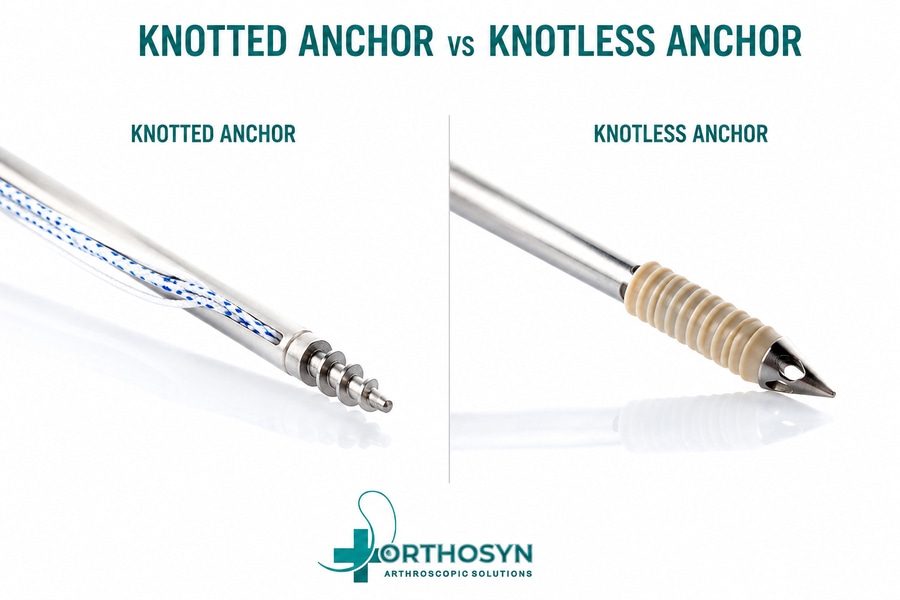
The Main Difference: How the Suture Is Secured
The fundamental difference between knotted and knotless anchors is how the suture is secured after passing through the tissue.
Knotted Anchor
The suture is secured by creating an arthroscopic knot.
Knotless Anchor
The suture is secured through the fixation mechanism of the anchor itself, eliminating the need for a traditional knot.
This difference affects several aspects of the procedure, including suture management, tensioning, surgical workflow and the final repair construct.
Knot Management in Arthroscopic Surgery
Arthroscopic knot tying requires technical skill.
The surgeon must manage multiple suture limbs inside a limited working space while maintaining appropriate tissue tension.
Knotted techniques may require:
Suture organization
Knot-pushing instruments
Controlled knot advancement
Appropriate knot configuration
Management of multiple suture limbs
In complex repairs involving several anchors, the number of sutures inside the joint can increase considerably.
Knotless systems can simplify this part of the procedure by removing the knot-tying step.
Why Are Knotless Anchors Used?
Knotless anchors were developed partly to simplify suture management and provide alternative fixation strategies.
Potential advantages can include:
No arthroscopic knot tying
Reduced knot management
Controlled tensioning before final fixation
Lower risk of knot-related prominence
Simplified suture organization in certain procedures
Integration into different repair configurations
However, these advantages do not mean that knotless anchors are universally superior to knotted systems.
The appropriate technique depends on the anatomy, repair strategy, tissue quality, bone quality and surgeon preference.
Advantages of Knotted Suture Anchors
Traditional knotted anchors remain widely used because they provide considerable flexibility in suture management.
Potential advantages include:
Direct control of knot configuration
Familiar technique for many surgeons
Flexibility in suture passage patterns
Ability to use different arthroscopic knot techniques
Compatibility with different soft tissue repair strategies
Established use across many arthroscopic procedures
Knotted anchors remain an important option in modern arthroscopic surgery.
Advantages of Knotless Suture Anchors
Knotless anchors provide a different approach to tissue fixation.
Potential advantages include:
Elimination of traditional arthroscopic knots
Reduced need for knot management
Ability to tension the repair before final anchor fixation
Reduced knot bulk
Potential simplification of certain repair constructs
Efficient incorporation into modern knotless techniques
The actual performance of a knotless system depends on implant geometry, fixation mechanism, bone quality, suture characteristics and surgical technique.
Tension Control: Knotted vs Knotless
Tension is critical in soft tissue repair.
The objective is to restore appropriate tissue position and contact without unnecessarily over-tensioning the repair.
With a knotted technique, tension is established through suture manipulation and knot advancement.
With a knotless technique, the surgeon can typically position and tension the suture before completing anchor fixation.
These are different methods of achieving the same general objective: stable tissue-to-bone fixation.
Neither method should automatically be considered superior. The effectiveness of tension control depends strongly on surgical technique and the design of the fixation system.
What About Knot Prominence?
One characteristic of knotted fixation is that the final knot remains within the surgical area.
Depending on the procedure and knot position, surgeons may consider knot profile when planning the repair.
Knotless systems eliminate the external arthroscopic knot from the construct.
This can reduce knot bulk and may be useful in anatomical areas where minimizing prominent suture material is desirable.
However, the clinical significance depends on the specific procedure and repair configuration.
Does Knotless Mean Faster Surgery?
Knotless fixation can reduce the number of steps associated with arthroscopic knot tying and suture management.
In certain procedures, this may simplify the surgical workflow.
However, total surgical time depends on many factors, including:
Procedure complexity
Number of anchors
Surgeon experience
Suture configuration
Anchor insertion technique
Tissue quality
Additional procedures performed during surgery
Therefore, knotless fixation should not automatically be interpreted as guaranteeing a shorter operation.
Does Knotless Mean Stronger Fixation?
Not necessarily.
Fixation strength depends on multiple factors, including:
Anchor design
Anchor diameter and length
Implant material
Bone quality
Suture strength
Suture configuration
Tissue quality
Insertion technique
Fixation mechanism
Whether an anchor is knotted or knotless represents only one part of the complete fixation system.
A properly selected and correctly implanted knotted or knotless anchor can provide an appropriate fixation strategy depending on the clinical situation.
PEEK in Knotted and Knotless Fixation
PEEK is widely used in arthroscopic anchor systems because it provides a rigid, non-metallic implant option.
Orthosyn offers PEEK Suture Anchors for conventional suture-anchor fixation.
For knotless techniques, Orthosyn also provides a PEEK + PEEK Knotless Anchor – Push Lock System.
This allows PEEK-based implant technology to be used across different arthroscopic fixation strategies.
PEEK + Titanium Knotless Fixation
Knotless anchor design can also combine different implant materials.
The Orthosyn PEEK + Titanium Knotless Anchor combines PEEK and titanium components within a knotless fixation concept.
Material selection should be evaluated together with anchor geometry, fixation mechanism, anatomical location and the intended repair technique.
What About Soft / All-Suture Anchors?
Soft anchors, also known as all-suture anchors, represent another option in arthroscopic soft tissue fixation.
Instead of relying on a conventional rigid anchor body, these systems use high-strength suture material as the primary fixation structure.
This allows the use of smaller bone tunnels and can support bone-preserving fixation strategies.
Explore the Orthosyn Soft / All-Suture Anchor System.
The distinction between rigid and all-suture anchors should not be confused with the distinction between knotted and knotless techniques. These terms describe different characteristics of the fixation system.
Which Technique Is Better for Rotator Cuff Repair?
Both knotted and knotless techniques can be incorporated into rotator cuff repair.
Depending on the selected surgical technique, anchors may be used in:
Single-row repairs
Double-row repairs
Medial-row fixation
Lateral-row fixation
Suture bridge constructs
Other tissue-to-bone fixation configurations
The appropriate system depends on tear characteristics, tissue quality, bone quality and the surgeon's preferred repair strategy.
Which Technique Is Better for Labral Repair?
Both fixation concepts can also be used in shoulder instability and labral repair.
When selecting an anchor for procedures such as Bankart repair, surgeons may consider:
Glenoid bone stock
Anchor diameter
Number of fixation points
Suture management
Knot profile
Tissue quality
Desired tension
Anchor insertion angle
Knotless technology can reduce knot management, while traditional suture anchors provide flexibility in arthroscopic knot configuration.
The appropriate option depends on the specific repair.
Knotted vs Knotless Anchors: Key Differences
Feature Knotted Suture Anchor Knotless Suture Anchor
Arthroscopic knot Required Not required
Suture fixation Surgical knot Anchor fixation mechanism
Knot management Required Reduced
Tensioning Through suture and knot management Typically before final anchor fixation
Knot profile Present No traditional knot
Technique Established conventional approach Modern knotless approach
Implant design Conventional suture anchor Dedicated knotless mechanism
The table highlights the fundamental technical differences, but product selection should always be based on the complete clinical situation.
Orthosyn Suture Anchor Portfolio
Orthosyn Medikal provides different anchor technologies for modern arthroscopic soft tissue repair:
Orthosyn PEEK Suture Anchors
Orthosyn Titanium Suture Anchors
Orthosyn PEEK + PEEK Knotless Anchors – Push Lock System
Orthosyn PEEK + Titanium Knotless Anchors
Orthosyn Soft / All-Suture Anchors
These different technologies allow surgeons to consider implant material, anchor design, diameter, suture configuration and fixation technique according to the requirements of the arthroscopic repair.
Conclusion
The main difference between knotted and knotless suture anchors is how the suture is secured.
Knotted anchors rely on arthroscopic knot tying after the suture has been passed through the tissue. Knotless anchors use the implant's fixation mechanism to secure the suture without requiring a traditional surgical knot.
Knotless systems can simplify knot management, reduce knot bulk and provide a different approach to tensioning, while traditional knotted anchors continue to offer flexibility and an established fixation technique.
Neither approach is universally better.
The appropriate choice depends on anatomy, bone quality, tissue quality, anchor design, suture configuration, repair technique and surgeon preference.
Orthosyn Medikal offers PEEK, titanium, knotless and Soft / All-Suture anchor technologies to support different strategies in modern arthroscopic soft tissue repair.