#Product Trends
What Is Syndesmosis Fixation and How Does a Suture Button System Work? | Orthosyn
Learn what ankle syndesmosis injuries are, why fixation may be required, and how suture button systems provide dynamic stabilization between the tibia and fibula while supporting healing of the distal tibiofibular syndesmosis.
The distal tibiofibular syndesmosis is an important stabilizing structure of the ankle. It connects the distal tibia and fibula and helps maintain the normal relationship of the ankle mortise during walking, running, and rotational movement.
When the syndesmotic ligaments are injured, the tibia and fibula may become abnormally mobile relative to each other. This can compromise ankle stability and alter joint mechanics.
Some stable syndesmotic injuries can be managed without surgery. However, unstable injuries, certain ankle fractures, and significant disruption of the distal tibiofibular relationship may require surgical stabilization.
One modern fixation method is the suture button system.
A suture button construct typically uses two cortical buttons connected by high-strength suture material. The system stabilizes the tibia and fibula while allowing a small degree of physiological micromotion compared with completely rigid fixation.
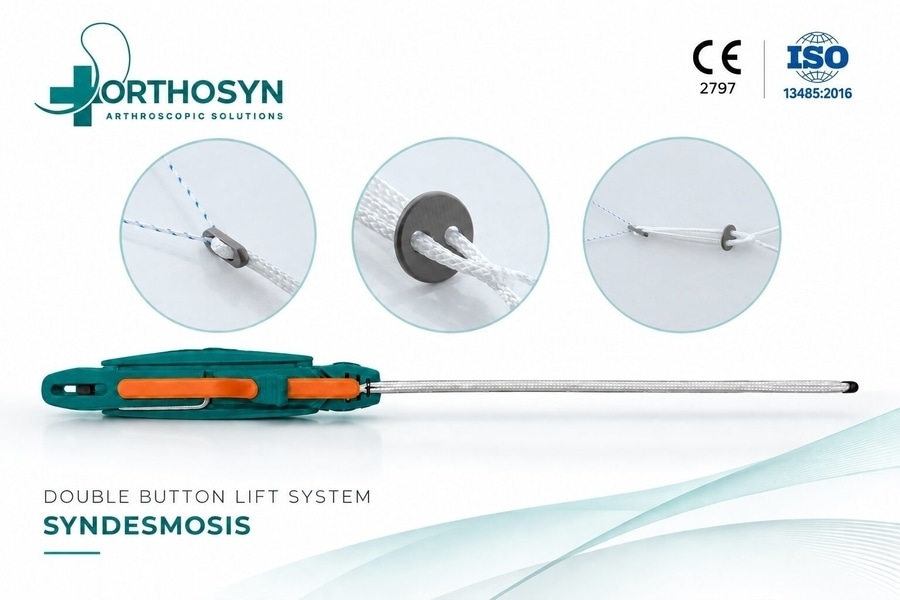
Orthosyn Medikal offers a Syndesmosis Fixation System within its ligament fixation portfolio for selected distal tibiofibular stabilization procedures.
What Is the Ankle Syndesmosis?
The ankle syndesmosis is the fibrous joint connecting the distal tibia and fibula just above the ankle joint.
The major stabilizing structures include:
Anterior inferior tibiofibular ligament
Posterior inferior tibiofibular ligament
Interosseous ligament
Distal interosseous membrane
Together, these structures help maintain the correct spacing and rotational relationship between the tibia and fibula.
This relationship is important because the talus must remain properly positioned within the ankle mortise.
What Is a Syndesmosis Injury?
A syndesmotic injury occurs when one or more of the ligaments connecting the distal tibia and fibula are stretched or torn.
These injuries are often referred to as high ankle sprains.
They may occur during:
External rotation of the foot
Forced ankle dorsiflexion
Contact sports
Skiing injuries
Football injuries
Falls
Ankle fractures
Unlike a typical lateral ankle sprain, which usually involves ligaments on the outer side of the ankle, a syndesmotic injury affects the structures between the tibia and fibula.
Why Does Syndesmosis Stability Matter?
The tibia and fibula form the ankle mortise around the talus.
If the syndesmosis becomes unstable, the relationship between these bones may change.
Even relatively small changes in the distal tibiofibular relationship can affect:
Talus positioning
Ankle contact mechanics
Joint stability
Weight distribution
Rotational control
For this reason, restoring appropriate syndesmotic alignment is an important objective when surgical fixation is required.
Are All Syndesmosis Injuries Treated Surgically?
No.
Treatment depends on the stability and severity of the injury.
Important considerations include:
Degree of ligament disruption
Presence of tibiofibular diastasis
Associated ankle fracture
Instability during stress examination
Patient activity level
Acute or chronic injury
Bone quality
Surgeon assessment
Stable injuries may often be treated conservatively.
Surgical fixation may be considered when there is significant instability or loss of the normal distal tibiofibular relationship.
What Is Syndesmosis Fixation?
Syndesmosis fixation is a surgical method used to stabilize the distal tibia and fibula after disruption of the syndesmotic ligament complex.
The objective is to:
Restore the normal tibiofibular relationship
Maintain ankle mortise stability
Support ligament healing
Limit abnormal separation
Control excessive rotational movement
Different fixation techniques can be used.
Two commonly discussed concepts are:
Syndesmotic screw fixation
Suture button fixation
These techniques stabilize the same anatomical region but use different mechanical principles.
What Is a Suture Button System?
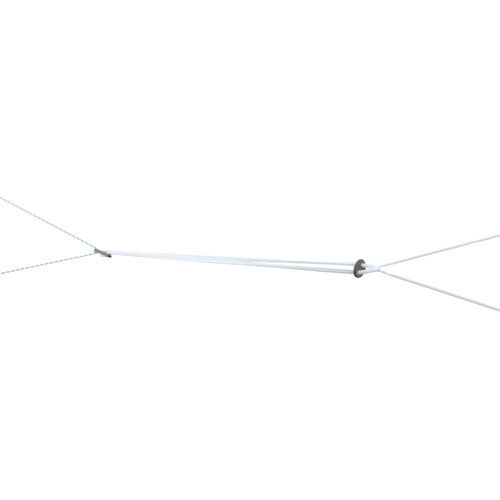
A suture button system is a cortical fixation construct consisting of high-strength suture material connecting two small buttons.
One button is positioned on the fibular side and the other on the tibial side.
The basic principle can be represented as:
Fibular Button → High-Strength Suture → Tibial Button
The suture construct spans the distal tibiofibular interval and helps maintain reduction of the syndesmosis.
Because the connection is based on flexible suture material rather than a rigid metal screw passing directly between the bones, the system can permit controlled physiological micromotion.
How Does a Suture Button System Work?
The exact surgical technique varies, but the fundamental concept generally includes the following steps:
The syndesmotic injury is evaluated.
The tibia and fibula are reduced into the intended anatomical relationship.
A controlled bone tunnel is created across the fibula and tibia.
A passing mechanism is used to deliver the fixation construct.
The tibial button is passed through the prepared tunnel.
The button is positioned against the opposite tibial cortex.
The fibular-side button is seated against the fibular cortex.
The suture construct is tensioned.
Final reduction and implant position are assessed.
The resulting construct helps resist abnormal separation between the tibia and fibula.
Why Are Two Buttons Used?
The two buttons create opposing cortical fixation points.
The fibular button distributes force over the fibular cortex.
The tibial button provides the opposing fixation point against the tibial cortex.
High-strength sutures connect the two buttons and transfer load between them.
This produces a suspensory fixation construct across the syndesmosis.
The effectiveness of the construct depends on:
Correct reduction
Appropriate tunnel position
Proper button seating
Suture integrity
Bone quality
Construct tension
Surgical technique
What Is Dynamic Syndesmosis Fixation?
Suture button systems are commonly described as dynamic fixation systems.
This does not mean that the syndesmosis is left unstable.
Instead, the construct is designed to provide sufficient stabilization while permitting a small amount of controlled physiological movement between the tibia and fibula.
The natural syndesmosis is not completely rigid.
During ankle motion, especially dorsiflexion and rotation, small changes can occur in the relationship between the tibia and fibula.
A dynamic fixation concept aims to stabilize pathological motion while avoiding unnecessary complete rigidity.
Suture Button vs Syndesmotic Screw: What Is the Difference?
The main difference lies in how the tibia and fibula are mechanically connected.
Syndesmotic Screw
A screw creates a relatively rigid connection between the tibia and fibula.
Suture Button
A suture button construct connects the bones through high-strength flexible suture material supported by cortical buttons.
The differences can be summarized as follows:
Feature Suture Button Syndesmotic Screw
Fixation concept Dynamic cortical fixation Rigid screw fixation
Main components Buttons + high-strength suture Metallic screw
Physiological micromotion Can allow controlled movement More restricted
Implant support Cortical surfaces Screw purchase in bone
Fixation across syndesmosis Flexible construct Rigid implant
Removal Depends on clinical situation Some techniques may require later removal
Neither method should automatically be considered superior in every clinical situation.
The appropriate fixation strategy depends on the injury pattern, bone quality, surgeon preference, and overall ankle reconstruction plan.
Why Can Dynamic Fixation Be Useful?
The distal tibiofibular syndesmosis normally permits a small degree of movement.
During ankle dorsiflexion, the wider anterior portion of the talus moves into the ankle mortise, which can create subtle changes in the distal tibiofibular relationship.
A flexible fixation construct may therefore allow controlled physiological movement while maintaining stability.
Potential considerations include:
Preservation of limited physiological micromotion
Avoidance of a completely rigid tibiofibular connection
Maintenance of syndesmotic reduction
Cortical fixation on both sides
However, implant choice must always be based on the individual injury and surgical strategy.
Why Is Accurate Reduction Important?
Correct reduction of the syndesmosis is one of the most important parts of the procedure.
The fixation implant is designed to maintain the relationship established by the surgeon.
It cannot compensate for an inaccurate reduction.
The surgeon may evaluate:
Tibiofibular alignment
Fibular position within the incisura
Rotational relationship
Medial clear space
Ankle mortise symmetry
Stability under stress
Once the appropriate relationship is achieved, the fixation construct helps maintain it.
Why Does Tunnel Position Matter?
The bone tunnel determines the path of the suture button construct.
Incorrect tunnel positioning can potentially affect:
Direction of fixation
Button seating
Bone stock
Reduction
Suture orientation
Mechanical load distribution
Tunnel position should therefore be selected according to the anatomy and surgical technique.
Controlled drilling and appropriate guidance are important elements of the procedure.
Why Is Button Seating Important?
Both buttons should rest appropriately against the cortical surfaces.
If a button is not fully seated, the construct may not function as intended.
The surgeon may therefore check:
Button orientation
Cortical contact
Soft tissue interposition
Construct tension
Final implant position
Correct seating helps distribute load across the cortical surface.
What Is the Role of the Tibial Button?
The tibial button provides the medial cortical fixation point.
After passing through the bone tunnel, it is positioned against the tibial cortex.
Once deployed correctly, it resists pull-through of the suture construct.
This allows the high-strength sutures to maintain tension across the distal tibiofibular interval.
What Is the Role of the Fibular Button?
The fibular button provides the lateral cortical fixation point.
It rests against the fibular cortex and works together with the tibial button.
The mechanical pathway can be summarized as:
Fibula → Button → Suture Construct → Tibial Button → Tibia
Together, the two buttons create the cortical support required for the fixation system.
Why Is Construct Tension Important?
The suture construct must be tensioned appropriately.
Insufficient tension may allow excessive separation or residual instability.
Excessive tension may over-compress the syndesmosis or alter the intended tibiofibular relationship.
The objective is to maintain the anatomical reduction without unnecessary overconstraint.
Final tension depends on:
Injury characteristics
Reduction
Bone anatomy
Implant design
Surgical technique
What Happens If the Syndesmosis Is Malreduced?
Malreduction means that the tibia and fibula are fixed in an inappropriate relationship.
Potential problems may include:
Abnormal fibular rotation
Excessive widening or compression
Altered ankle mortise geometry
Changes in joint mechanics
Persistent discomfort or instability
For this reason, reduction should be carefully assessed before and after final fixation.
The quality of reduction is at least as important as the choice of fixation implant.
What About Associated Ankle Fractures?
Syndesmotic injuries frequently occur together with ankle fractures.
The surgeon must therefore consider the entire injury pattern, including:
Fibular fracture
Medial malleolar fracture
Posterior malleolar fracture
Deltoid ligament injury
Syndesmotic disruption
Fracture reduction and syndesmotic stabilization should be considered as components of the same overall ankle reconstruction strategy.
The order of fixation depends on the fracture pattern and surgical technique.
Acute vs Chronic Syndesmosis Injuries
The timing of the injury can influence management.
Acute Injury
In an acute injury, fixation may be used to maintain the reduced position while the injured syndesmotic ligaments heal.
Chronic Injury
In chronic cases, the soft tissues may not have the same healing potential.
More complex reconstruction may be required depending on instability, alignment, tissue quality, and associated pathology.
Suture button fixation may therefore be used differently depending on the clinical context.
Is a Suture Button System Permanent?
The implant can remain in place depending on the clinical situation and surgeon preference.
Unlike some rigid screw fixation strategies, routine removal may not always be necessary.
However, implant management should always be determined according to:
Symptoms
Implant position
Soft tissue response
Healing
Surgeon evaluation
Individual clinical circumstances
No fixation system should be considered completely free from the possibility of later intervention.
Can More Than One Suture Button Be Used?
Yes, depending on the injury pattern and chosen technique.
Some injuries may be stabilized with a single construct, while other situations may use multiple fixation points.
Factors influencing the number of constructs may include:
Degree of instability
Injury level
Bone quality
Associated fracture pattern
Surgeon preference
Fixation strategy
The goal is not simply to maximize the number of implants, but to provide sufficient stabilization for the specific injury.
What Are the Potential Advantages of Suture Button Fixation?
Potential advantages of the fixation concept may include:
Dynamic stabilization
Cortical fixation
Controlled physiological micromotion
Reduced reliance on rigid tibiofibular fixation
Low-profile button components
Potential to avoid routine implant removal in some cases
These characteristics do not mean that a suture button system is automatically the best option for every patient.
Appropriate patient selection and surgical technique remain essential.
What Factors Should Be Considered When Selecting a Syndesmosis Fixation Method?
Relevant factors may include:
Injury stability
Associated ankle fractures
Bone quality
Tibiofibular anatomy
Acute or chronic injury
Reduction quality
Implant design
Tunnel dimensions
Desired fixation rigidity
Patient activity level
Surgeon experience and preference
Fixation should be considered as one component of the complete treatment strategy.
Orthosyn Syndesmosis Fixation System
Orthosyn Medikal offers a Syndesmosis Fixation System based on the suture button fixation concept.
The system uses cortical fixation across the distal tibiofibular region and is designed to support stabilization of the syndesmosis following selected ligamentous injuries or ankle trauma.
The fixation concept combines:
Cortical buttons
High-strength connecting suture
Tibia-fibula stabilization
Dynamic fixation principles
Orthosyn's sports medicine fixation portfolio also includes femoral fixation systems, fixed-loop buttons, Double Button AC fixation systems, interference screws, and other ligament reconstruction solutions.
Syndesmosis Fixation vs AC Joint Double Button Fixation
Although both systems can use cortical buttons and high-strength suture constructs, they are designed for different anatomical regions.
Feature Syndesmosis Fixation AC Double Button Fixation
Anatomical region Ankle Shoulder
Bones stabilized Tibia and fibula Clavicle and coracoid
Main pathology Syndesmotic instability AC/CC instability
Fixation concept Cortical suture button Cortical double button
Primary objective Restore distal tibiofibular stability Restore coracoclavicular stability
The mechanical concept may be similar, but the anatomy, surgical technique, and intended application are different.
Conclusion
Syndesmosis fixation is a surgical technique used to stabilize the distal tibia and fibula after disruption of the syndesmotic ligament complex.
A suture button system uses opposing cortical buttons connected by high-strength suture material.
One button is positioned on the fibular side and the other on the tibial side, creating a fixation construct across the syndesmosis.
The basic principle can be summarized as:
Fibula → Cortical Button → High-Strength Suture → Cortical Button → Tibia
Unlike completely rigid fixation, a suture button system can provide dynamic stabilization, allowing limited physiological micromotion while restricting pathological separation and rotation.
However, the success of syndesmosis fixation depends on more than the implant itself. Accurate reduction, tunnel positioning, button seating, bone quality, construct tension, associated fractures, and surgical technique must all be considered.
Orthosyn Medikal offers a Syndesmosis Fixation System designed to support dynamic cortical stabilization of the distal tibiofibular syndesmosis in selected ankle reconstruction procedures.