#Product Trends
What Is a Hyaluronic Acid Knee Injection? | AlkaFlex
Learn what a hyaluronic acid knee injection is, how intra-articular HA is used in knee osteoarthritis, how viscosupplementation works, and how factors such as molecular weight, concentration, and cross-linking can influence product characteristics.
A hyaluronic acid knee injection is an intra-articular injection administered directly into the knee joint to supplement the properties of synovial fluid.
Hyaluronic acid (HA) is naturally present in synovial fluid, where it contributes to lubrication, shock absorption, and the viscoelastic characteristics of the joint environment.
In patients with knee osteoarthritis, the concentration and molecular characteristics of naturally occurring hyaluronic acid may change. As a result, the synovial fluid may become less effective at performing its normal mechanical functions.
Hyaluronic acid knee injections are therefore used as a form of viscosupplementation.
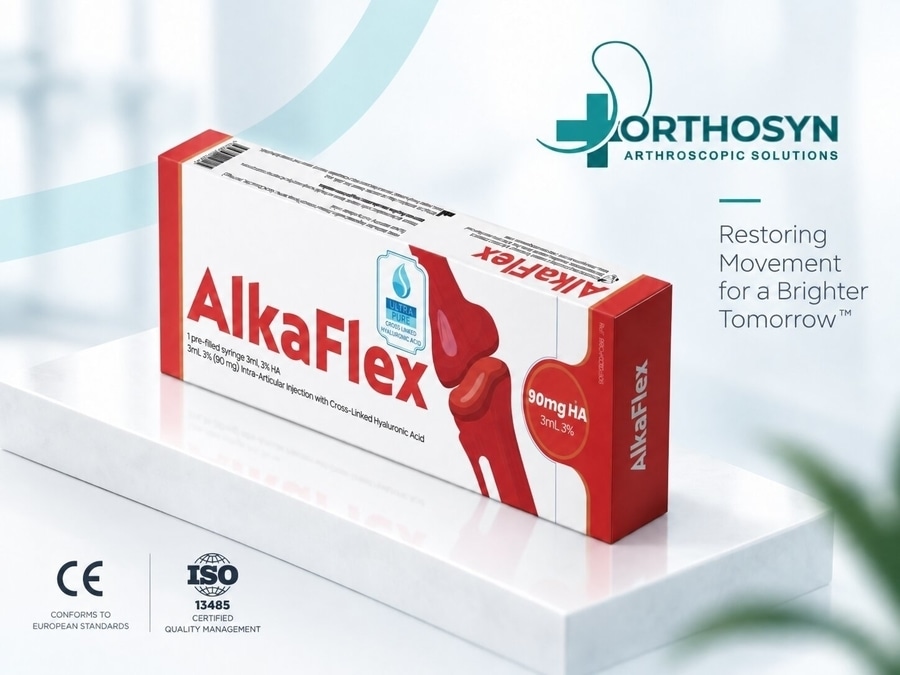
The AlkaFlex portfolio by Orthosyn Medikal includes different intra-articular hyaluronic acid formulations, including linear and cross-linked HA options with different concentrations, molecular characteristics, and total HA doses.
What Is Hyaluronic Acid?
Hyaluronic acid is a naturally occurring glycosaminoglycan found throughout the human body.
It is present in:
Synovial fluid
Articular cartilage
Connective tissue
Skin
Vitreous fluid of the eye
Within the knee joint, HA contributes to the physical properties of synovial fluid.
Its ability to bind water helps create a viscoelastic environment that supports smooth joint movement.
Two of its most important functions are:
Joint lubrication
Shock absorption
For this reason, hyaluronic acid plays an important role in the normal mechanical environment of the knee.
What Does “Intra-Articular” Mean?
Intra-articular means “inside the joint.”
A hyaluronic acid knee injection is therefore injected directly into the synovial space of the knee rather than into muscle, subcutaneous tissue, or a vein.
This allows the HA formulation to interact directly with the existing synovial fluid.
Why Are Hyaluronic Acid Knee Injections Used?
Hyaluronic acid injections are mainly discussed in relation to the non-surgical management of knee osteoarthritis.
Osteoarthritis involves changes in several structures, including:
Articular cartilage
Subchondral bone
Synovial membrane
Joint fluid
Surrounding soft tissues
The properties of synovial fluid may also change as osteoarthritis progresses.
These changes may include alterations in:
HA concentration
Molecular weight
Viscosity
Elasticity
Lubricating properties
The concept behind HA injection is to supplement the joint environment with additional hyaluronic acid.
What Is Viscosupplementation?
Viscosupplementation refers to the intra-articular administration of hyaluronic acid.
The principle is to supplement the viscoelastic properties of synovial fluid.
Different viscosupplementation products can vary in several important ways:
Molecular weight
HA concentration
Total HA dose
Injection volume
Linear or cross-linked structure
Number of injections
Rheological properties
Therefore, not every hyaluronic acid knee injection is the same.
How Does a Hyaluronic Acid Knee Injection Work?
A hyaluronic acid injection should not be viewed simply as adding a lubricant to the knee.
HA may contribute to the intra-articular environment through several mechanisms.
These may include:
Supplementing synovial fluid viscosity
Supporting lubrication between joint surfaces
Supporting shock-absorbing properties
Interacting with synovial and cartilage-related cells
Influencing the intra-articular environment
The relative importance of these effects may depend on the HA formulation and the condition of the joint.
What Happens to Hyaluronic Acid in Osteoarthritis?
In a healthy joint, endogenous hyaluronic acid contributes to the viscosity and elasticity of synovial fluid.
In osteoarthritis, the concentration and average molecular characteristics of HA can change.
This can reduce the normal viscoelastic behavior of synovial fluid.
Intra-articular HA administration is intended to temporarily supplement this altered joint environment.
This is the fundamental concept behind viscosupplementation.
What Is the Difference Between Linear and Cross-Linked HA?
Hyaluronic acid formulations can generally be categorized according to their molecular structure.
Linear Hyaluronic Acid
Linear HA consists of long molecular chains that are not chemically linked together into a larger network.
Linear formulations can vary according to:
Molecular weight
HA concentration
Total dose
Injection volume
Cross-Linked Hyaluronic Acid
Cross-linked HA is modified so that individual HA chains become connected into a three-dimensional molecular network.
Cross-linking can influence:
Viscosity
Elasticity
Rheological behavior
Resistance to molecular degradation
Residence characteristics
For this reason, linear and cross-linked HA should not be considered identical simply because both contain hyaluronic acid.
Why Does Molecular Weight Matter?
The molecular weight of hyaluronic acid describes the approximate size of the HA molecules.
It is commonly expressed in Daltons or megaDaltons (MDa).
Molecular weight can affect:
Viscosity
Viscoelasticity
Molecular interactions
Physical behavior of the formulation
However, molecular weight should not be considered in isolation.
The behavior of a knee injection also depends on:
HA concentration
Cross-linking
Total dose
Injection volume
Manufacturing technology
Why Does HA Concentration Matter?
HA concentration indicates the amount of hyaluronic acid present within a given volume.
For example, two syringes may contain different concentrations even if their total HA doses are similar.
Concentration may influence:
Viscosity
Rheological behavior
Injectability
Physical characteristics of the formulation
A higher concentration does not automatically mean better clinical performance.
The complete formulation needs to be considered.
Total HA Dose vs HA Concentration
These two terms are often confused.
HA Concentration
The amount of HA per unit of volume, usually expressed as mg/mL or a percentage.
Total HA Dose
The complete amount of hyaluronic acid contained within the syringe.
For example, a formulation may have:
High concentration with a smaller volume
Lower concentration with a larger volume
The total formulation therefore matters more than one isolated number.
Why Are Some HA Knee Injections Cross-Linked?
Cross-linking creates connections between HA chains.
This can change the physical characteristics of the formulation.
Potential effects include:
Increased viscoelasticity
Modified resistance to degradation
Different residence characteristics
Different rheological properties compared with linear HA
However, cross-linked HA products may still differ substantially from each other.
Factors such as concentration, cross-linking technology, total HA dose, and injection volume should also be considered.
What Is a Single-Injection Hyaluronic Acid Product?
Some HA formulations are designed to be administered as a single intra-articular injection.
Other products may require a series of injections.
Single-injection formulations can differ from multi-injection products in terms of:
Total HA dose
Concentration
Molecular structure
Cross-linking
Injection volume
Rheological properties
A single-injection product is therefore not necessarily just a larger version of a multi-injection syringe.
The formulation itself may be different.
How Is Hyaluronic Acid Produced?
Medical-grade hyaluronic acid can be produced using different manufacturing technologies.
Many modern HA products use bacterial fermentation.
This process allows purified HA to be produced without relying on animal-derived tissue.
Manufacturing technology can influence:
Purity
Molecular weight
Consistency
Endotoxin control
Final formulation characteristics
The AlkaFlex hyaluronic acid portfolio uses HA produced through bacterial fermentation.
How Is a Hyaluronic Acid Knee Injection Performed?
A knee injection should be performed by a qualified healthcare professional.
A general procedure may include:
Positioning the patient.
Identifying the appropriate injection site.
Preparing the skin using aseptic technique.
Introducing the needle into the knee joint.
Aspirating excess joint fluid when clinically appropriate.
Injecting the HA formulation.
Removing the needle and completing post-injection care.
The exact approach can vary depending on anatomy, clinical circumstances, and physician preference.
Who May Be Considered for a Hyaluronic Acid Knee Injection?
Patient selection is based on clinical evaluation.
Factors that may be considered include:
Severity of osteoarthritis
Symptoms
Age
Activity level
Previous treatments
Joint condition
Medical history
Presence of inflammation
Physician assessment
Hyaluronic acid injections are not suitable for every patient.
Treatment decisions should be made by an appropriately qualified healthcare professional.
When Are HA Knee Injections Usually Considered?
Hyaluronic acid injections may be considered as part of the non-operative management of symptomatic knee osteoarthritis.
They may be discussed alongside other approaches such as:
Exercise
Physiotherapy
Weight management
Activity modification
Analgesic treatment
Other intra-articular therapies
The appropriate treatment strategy varies from patient to patient.
Are Hyaluronic Acid Injections the Same as Cortisone Injections?
No.
Although both can be administered directly into the knee joint, they are fundamentally different.
Hyaluronic Acid
HA is a naturally occurring viscoelastic molecule found in synovial fluid.
The treatment concept is based on supplementation of the joint environment.
Corticosteroids
Corticosteroids are anti-inflammatory medications.
Their principal role is related to reducing inflammatory activity.
Therefore, HA and corticosteroid injections differ in:
Composition
Mechanism
Treatment objective
Clinical use
Are Hyaluronic Acid Injections the Same as PRP?
No.
Platelet-rich plasma (PRP) is prepared from the patient's own blood.
Hyaluronic acid is a manufactured viscoelastic biomolecule.
They differ in:
Source
Composition
Preparation
Standardization
Biological concept
Both may be discussed as intra-articular treatment options, but they are not the same therapy.
Do Hyaluronic Acid Knee Injections Regenerate Cartilage?
Hyaluronic acid injections should not be described as directly rebuilding lost articular cartilage.
Knee osteoarthritis involves structural changes that cannot simply be reversed by injecting HA.
The established concept of HA treatment is viscosupplementation and symptomatic joint management, rather than direct cartilage regeneration.
How Long Does HA Stay in the Knee?
The residence characteristics of HA can vary depending on the formulation.
Important factors include:
Molecular weight
Cross-linking
Concentration
Molecular structure
Enzymatic degradation
Individual joint environment
Cross-linked formulations may have different degradation characteristics compared with linear HA.
However, the physical residence time of HA in the joint should not automatically be considered the same as the duration of clinical effects.
Does a Higher HA Dose Mean a Better Injection?
Not necessarily.
Comparing knee injections only by the number of milligrams of HA can be misleading.
A meaningful comparison should include:
Parameter Why It Matters
Total HA dose Total amount of HA administered
HA concentration Amount of HA per unit volume
Molecular weight Influences molecular and rheological characteristics
Linear vs cross-linked Changes molecular structure
Injection volume Affects formulation characteristics
Number of injections Determines treatment protocol
HA source Related to manufacturing technology
Cross-linking method Influences network structure and degradation behavior
The complete formulation is therefore more important than any single specification.
AlkaFlex Hyaluronic Acid Knee Injections
AlkaFlex is Orthosyn Medikal's intra-articular hyaluronic acid product family.
The AlkaFlex portfolio includes different formulations based on parameters such as:
Linear hyaluronic acid
Cross-linked hyaluronic acid
Different HA doses
Different concentrations
Different injection volumes
Different formulation strategies
AlkaFlex is designed to provide healthcare professionals with multiple intra-articular HA options rather than treating all viscosupplementation products as identical.
Explore the AlkaFlex hyaluronic acid injection portfolio:
https://orthosynmed.com/category/8/hyaluronic-acid-injections
What Should Be Considered When Comparing HA Knee Injections?
Healthcare professionals evaluating HA products may consider:
Approved indication
HA source
Molecular weight
Concentration
Total HA dose
Linear or cross-linked structure
Injection volume
Treatment protocol
Product documentation
Patient characteristics
A product should therefore be evaluated as a complete formulation.
Conclusion
A hyaluronic acid knee injection is an intra-articular viscosupplement administered directly into the knee joint to supplement the properties of synovial fluid, particularly in the management of knee osteoarthritis.
Hyaluronic acid naturally contributes to:
Joint lubrication
Shock absorption
Viscoelasticity of synovial fluid
However, hyaluronic acid knee injections can differ significantly.
Important characteristics include:
Molecular weight
HA concentration
Total HA dose
Linear or cross-linked structure
Injection volume
Treatment protocol
Understanding these parameters allows a more meaningful comparison between different viscosupplementation products.
AlkaFlex by Orthosyn Medikal includes linear and cross-linked intra-articular hyaluronic acid formulations designed to provide different options for modern viscosupplementation strategies.
AlkaFlex Hyaluronic Acid Injections:
https://orthosynmed.com/category/8/hyaluronic-acid-injections