#Product Trends
What Is a Bankart Repair and How Are Suture Anchors Used in Shoulder Stabilization? | Orthosyn
Learn what a Bankart lesion is, why it can lead to recurrent anterior shoulder instability, how arthroscopic Bankart repair is performed, and how suture anchors are used to reattach and stabilize the capsulolabral tissue to the glenoid.
A Bankart repair is a surgical procedure used to treat certain cases of anterior shoulder instability associated with a Bankart lesion.
A Bankart lesion occurs when the anteroinferior labrum and associated capsuloligamentous structures become detached from the glenoid rim, commonly following an anterior shoulder dislocation.
Because the labrum and capsule contribute to shoulder stability, this injury can compromise the stabilizing mechanism of the glenohumeral joint and may contribute to recurrent instability.
During an arthroscopic Bankart repair, the detached capsulolabral tissue is mobilized and reattached to the glenoid rim.
Suture anchors are commonly used to secure sutures to the glenoid bone. These sutures are passed through the capsulolabral tissue and tensioned to restore its attachment and support shoulder stability.
Orthosyn Medikal offers a range of suture anchors for arthroscopic soft tissue repair, including titanium, PEEK, knotless, and soft all-suture anchor options in different diameters.
What Is a Bankart Lesion?
A Bankart lesion is an injury involving the anterior-inferior portion of the glenoid labrum.
The glenoid labrum is a fibrocartilaginous structure surrounding the rim of the glenoid.
It contributes to shoulder stability by:
Increasing the effective depth of the glenoid
Supporting the capsuloligamentous structures
Contributing to the stabilizing effect around the humeral head
Helping maintain the relationship between the humeral head and glenoid
During an anterior shoulder dislocation, the humeral head can move forward relative to the glenoid and damage the anterior-inferior labrum.
The labrum may become detached from the glenoid rim together with portions of the joint capsule.
This injury is commonly referred to as a Bankart lesion.
How Does a Bankart Lesion Cause Shoulder Instability?
The shoulder provides a large range of motion, but this mobility also means that stability depends heavily on soft tissue structures.
Important stabilizers include:
Glenoid labrum
Joint capsule
Glenohumeral ligaments
Rotator cuff
Surrounding muscles
When the anterior-inferior labrum becomes detached, the normal stabilizing effect of the capsulolabral complex can be reduced.
As a result, the shoulder may become more susceptible to:
Recurrent dislocation
Subluxation
Apprehension
Instability during certain movements
The objective of Bankart repair is to restore the damaged soft tissue attachment and improve anterior shoulder stability.
What Is a Bankart Repair?
A Bankart repair involves reattaching the detached anterior-inferior capsulolabral tissue to the glenoid rim.
The procedure may be performed arthroscopically through small portals around the shoulder.
During the procedure, the surgeon generally:
Evaluates the glenohumeral joint.
Identifies the Bankart lesion.
Mobilizes the detached labrum and capsule.
Prepares the glenoid rim.
Places suture anchors into the glenoid.
Passes sutures through the capsulolabral tissue.
Tensions and secures the tissue back to the glenoid.
The exact surgical technique depends on the lesion, patient anatomy, degree of instability, bone loss, and surgeon preference.
Why Are Suture Anchors Used in Bankart Repair?
A Bankart lesion involves soft tissue that has separated from bone.
The repair therefore requires a method of securing the capsulolabral tissue back to the glenoid.
A suture anchor creates a fixation point within the glenoid bone.
The anchor remains within the bone while the attached suture is passed through the labrum and capsule.
The basic fixation concept can be summarized as:
Glenoid Bone → Suture Anchor → Suture → Capsulolabral Tissue
When the sutures are tensioned, the detached tissue is brought back toward the prepared glenoid rim.
This allows the surgeon to reconstruct the capsulolabral attachment.
How Is Arthroscopic Bankart Repair Performed?
Although techniques vary, arthroscopic Bankart repair generally involves several key stages.
1. Arthroscopic Evaluation
The surgeon examines the glenohumeral joint using an arthroscope.
The evaluation may include:
Bankart lesion
Labral tissue quality
Glenoid bone loss
Humeral head defects
Capsular laxity
Rotator cuff
Biceps-labral complex
Other associated injuries
This assessment helps determine whether an isolated Bankart repair is appropriate.
2. Mobilization of the Capsulolabral Tissue
The detached labrum may heal in an abnormal position after injury.
The surgeon therefore mobilizes the tissue so that it can be repositioned onto the glenoid rim.
Adequate mobilization is important for restoring the capsulolabral complex to the desired anatomical position.
3. Glenoid Preparation
The anterior glenoid rim is prepared to create an appropriate surface for tissue healing.
The objective is to establish contact between the repaired capsulolabral tissue and the prepared bone.
4. Anchor Placement
Suture anchors are inserted into selected positions along the anterior-inferior glenoid rim.
The number, diameter, material, and position of the anchors can vary depending on:
Lesion size
Tissue quality
Glenoid anatomy
Surgical technique
Surgeon preference
5. Suture Passage
The sutures are passed through the labrum and, when required, through an appropriate portion of the capsule.
The amount and position of captured tissue can influence the final repair configuration.
6. Tissue Fixation
The sutures are secured using either a knotted or knotless technique.
The repaired tissue is positioned against the glenoid rim to reconstruct the capsulolabral attachment.
Where Are Anchors Positioned During Bankart Repair?
Bankart lesions typically involve the anterior-inferior region of the glenoid.
Anchors are therefore commonly positioned along the affected portion of the glenoid rim.
Rather than relying on a single fixation point, multiple anchors may be distributed along the lesion.
This can create multiple points of fixation between the capsulolabral tissue and bone.
Anchor placement strategy depends on:
Extent of the lesion
Glenoid morphology
Bone quality
Tissue quality
Desired capsular shift
Surgical technique
Accurate placement is important because the glenoid provides a relatively limited bone volume for anchor fixation.
Why Does Anchor Diameter Matter in Bankart Repair?
The glenoid is a relatively small anatomical structure.
Each anchor requires a bone tunnel or insertion pathway.
Anchor diameter therefore influences the amount of bone involved in fixation.
Smaller-diameter anchors may allow:
Smaller bone tunnels
Reduced bone removal
Placement of multiple fixation points
Greater flexibility in anchor positioning
However, anchor selection should not be based on diameter alone.
Other factors include:
Bone quality
Anchor design
Material
Fixation mechanism
Suture configuration
Surgical technique
The appropriate anchor must provide a balance between fixation requirements and preservation of glenoid bone.
How Many Suture Anchors Are Used in a Bankart Repair?
There is no universal number of anchors for every Bankart repair.
The required number depends on factors such as:
Size of the Bankart lesion
Extent of labral detachment
Capsular laxity
Patient anatomy
Tissue quality
Anchor type
Surgical technique
Multiple anchors are often used to create fixation along the repaired capsulolabral complex.
The surgeon determines the number and location of anchors according to the individual repair.
Knotted vs Knotless Anchors in Bankart Repair
Both knotted and knotless fixation techniques may be used in arthroscopic Bankart repair.
Knotted Suture Anchors
With a conventional suture anchor, the suture is passed through the capsulolabral tissue and secured using arthroscopic knots.
This allows the surgeon to control tissue tension and fixation.
Knotless Suture Anchors
Knotless anchors secure the suture without requiring a traditional arthroscopic knot stack.
Potential procedural characteristics include:
Elimination of knot tying
Controlled suture tensioning
Reduced knot prominence
Streamlined fixation workflow
The choice between knotted and knotless fixation depends on the surgeon's technique and the requirements of the repair.
What Is a Soft All-Suture Anchor?
A soft all-suture anchor is an anchor primarily composed of high-strength suture material rather than a conventional solid implant body.
It is inserted through a relatively small bone tunnel and expands or deploys within the bone to create fixation.
Potential characteristics include:
Small insertion diameter
Reduced bone tunnel size
Minimal implant volume
Ability to position multiple anchors in limited anatomical areas
These characteristics can make soft anchors relevant to procedures in which bone preservation and multiple fixation points are important.
Orthosyn offers soft all-suture anchor options in multiple diameters for arthroscopic soft tissue repair.
What Is a PEEK Suture Anchor?
PEEK, or polyether ether ketone, is a high-performance polymer used in orthopedic implants.
PEEK anchors provide a solid anchor body without being metallic.
Characteristics associated with PEEK include:
High mechanical strength
Biocompatibility
Radiolucency
Resistance to degradation
Established orthopedic implant applications
PEEK anchors are used in different arthroscopic soft tissue fixation procedures, including shoulder repair techniques.
What Is a Titanium Suture Anchor?
Titanium is a metallic biomaterial widely used in orthopedic implants.
Titanium suture anchors provide rigid fixation within bone and have a long history of use in arthroscopic procedures.
Characteristics include:
High mechanical strength
Biocompatibility
Permanent implant structure
Established clinical use
The selection between titanium, PEEK, soft, or other anchor technologies depends on surgical requirements and surgeon preference.
Why Is the Inferior Anchor Important?
The inferior portion of a Bankart lesion is important because anterior shoulder instability frequently involves the anterior-inferior capsulolabral complex.
Achieving access to this region can be technically demanding.
The surgeon must consider:
Portal position
Drill guide angle
Glenoid orientation
Anchor trajectory
Distance from the articular surface
Appropriate instrumentation can help facilitate controlled anchor placement in this anatomically constrained region.
What Is Capsular Shift During Bankart Repair?
Bankart repair may involve more than simply reattaching the labrum.
Some patients also have capsular redundancy or laxity.
When sutures capture both the labrum and capsule, the surgeon may reposition the capsular tissue while securing the repair.
This is sometimes described as capsular shift or capsular plication.
The objective is to restore appropriate tension to the capsulolabral complex while avoiding excessive restriction of shoulder motion.
What Is a Hill-Sachs Lesion?
A Hill-Sachs lesion is an impaction defect of the humeral head that may occur during anterior shoulder dislocation.
When the humeral head dislocates anteriorly, its posterolateral surface can impact against the anterior glenoid rim.
This can create a bony defect in the humeral head.
Bankart and Hill-Sachs lesions can therefore occur together.
The presence, size, and engagement characteristics of a Hill-Sachs lesion may influence the surgical strategy.
Bankart Repair vs Remplissage
Bankart repair and remplissage address different components of anterior shoulder instability.
Bankart Repair
Repairs the anterior-inferior capsulolabral lesion on the glenoid side.
Remplissage
Addresses certain Hill-Sachs defects on the humeral head side by fixing posterior soft tissue into the defect.
In selected cases, the two procedures may be performed together.
The concept can be summarized as:
Bankart Repair → Glenoid-Side Soft Tissue Stabilization
Remplissage → Humeral-Side Management of the Hill-Sachs Defect
Suture anchors may play an important role in both procedures.
What About Glenoid Bone Loss?
Not every case of anterior shoulder instability can be treated adequately with an isolated soft tissue Bankart repair.
Glenoid bone loss can significantly influence shoulder stability.
Important considerations include:
Amount of anterior glenoid bone loss
Hill-Sachs lesion characteristics
Recurrent dislocation history
Patient activity
Contact or collision sports
Previous stabilization surgery
When substantial bone loss is present, alternative or additional stabilization procedures may be considered.
Therefore, patient selection is important when planning Bankart repair.
Bankart Repair vs Latarjet Procedure
These procedures use different stabilization principles.
Arthroscopic Bankart Repair
Primarily restores the anterior capsulolabral soft tissue attachment using suture anchors.
Latarjet Procedure
Transfers the coracoid process to the anterior glenoid and provides a bony augmentation and additional stabilizing mechanisms.
Feature Bankart Repair Latarjet
Main strategy Soft tissue repair Bone augmentation
Primary fixation target Capsulolabral tissue Coracoid bone block
Suture anchors Commonly used Different fixation strategy
Arthroscopic approach Common Open or arthroscopic techniques
Bone loss consideration Important Often relevant in bone-deficient instability
The appropriate procedure depends on the patient's instability pattern and anatomy.
Why Is Bone Preservation Important in Shoulder Stabilization?
Bankart repair may require several anchors along a relatively small glenoid rim.
Preserving bone can be particularly important when:
Multiple anchors are required
Revision surgery may be necessary in the future
The glenoid is anatomically small
Previous anchor tunnels are present
Bone stock is limited
For this reason, implant diameter and tunnel size can be relevant considerations during anchor selection.
What Instruments Are Used During Arthroscopic Bankart Repair?
Bankart repair typically requires a combination of arthroscopic instruments, which may include:
Arthroscope
Cannulas
Suture anchors
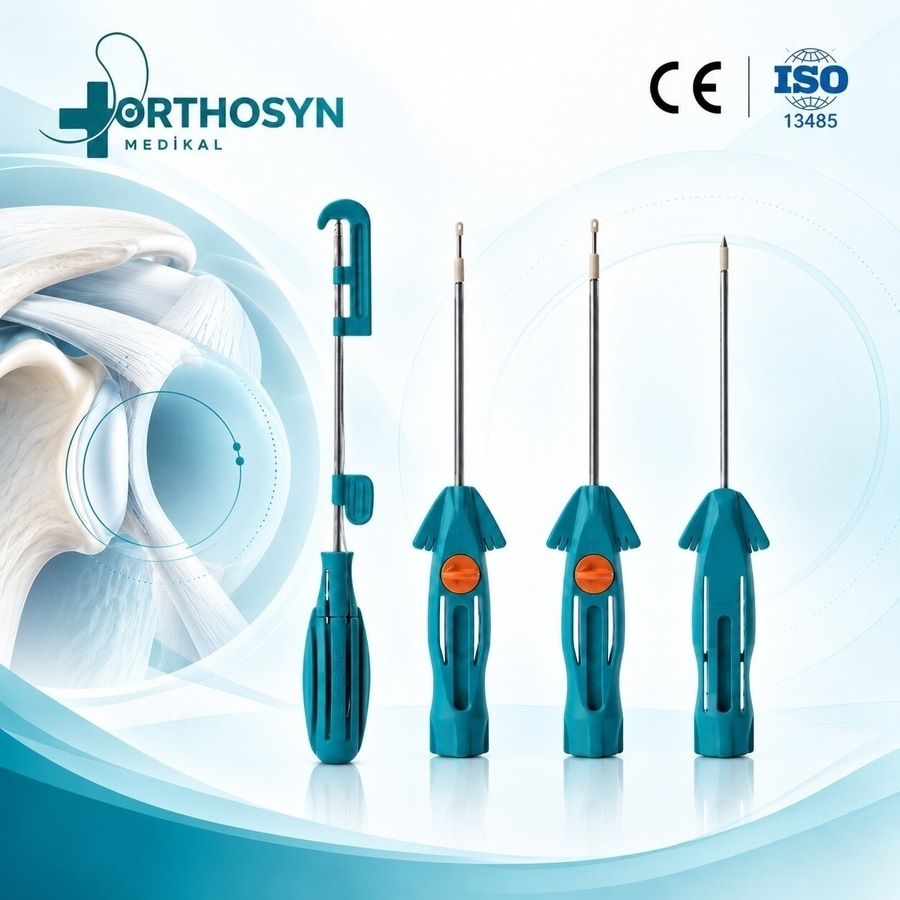
Anchor drill guides
Drills
Suture passers
Tissue penetrators
Graspers
Probes
Suture management instruments
Controlled access and suture management are particularly important because the procedure is performed within a limited arthroscopic working space.
What Factors Influence Anchor Selection?
Anchor selection may depend on several factors:
Glenoid bone quality
Available bone stock
Anchor diameter
Anchor material
Suture configuration
Knotted or knotless technique
Number of fixation points
Revision considerations
Surgeon preference
There is no single anchor design that is optimal for every Bankart repair.
The implant should be selected according to the anatomical and surgical requirements of the individual procedure.
Orthosyn Suture Anchors for Arthroscopic Shoulder Repair
Orthosyn Medikal offers a range of suture anchor systems for arthroscopic soft tissue fixation and shoulder repair procedures.
The portfolio includes:
Titanium Suture Anchors
PEEK Suture Anchors
Knotless Anchors
Soft All-Suture Anchors
Multiple anchor diameters and configurations
Different anchor technologies allow surgeons to select fixation according to anatomical requirements, bone preservation considerations, and preferred repair technique.
The broader Orthosyn arthroscopy portfolio also includes instruments and fixation solutions for shoulder, knee, and other sports medicine procedures.
What Should Be Considered When Selecting a Suture Anchor for Bankart Repair?
A meaningful evaluation should consider the complete fixation system rather than anchor material alone.
Important parameters include:
Parameter Why It Matters
Anchor diameter Determines bone tunnel requirements
Anchor material Influences implant characteristics
Suture configuration Determines available repair options
Knotted vs knotless Influences fixation technique
Insertion system Affects surgical workflow
Drill guide Supports controlled trajectory
Bone quality Influences fixation requirements
Number of anchors Affects overall repair configuration
Anchor selection should therefore be considered as part of the complete surgical strategy.
Conclusion
A Bankart repair is a shoulder stabilization procedure used to reattach the detached anterior-inferior capsulolabral complex to the glenoid rim following a Bankart lesion.
During arthroscopic Bankart repair, the surgeon prepares the glenoid rim and uses suture anchors to create fixation points within the glenoid bone.
Sutures are then passed through the capsulolabral tissue and secured to restore its attachment.
The fundamental concept is:
Bankart Lesion → Glenoid Preparation → Anchor Placement → Suture Passage → Capsulolabral Fixation → Shoulder Stabilization
Suture anchor characteristics such as diameter, material, fixation mechanism, suture configuration, and knotted or knotless design can influence the surgical approach.
Patient anatomy, tissue quality, glenoid bone loss, associated Hill-Sachs lesions, and the overall instability pattern must also be considered when selecting the appropriate stabilization strategy.
Orthosyn Medikal provides titanium, PEEK, knotless, and soft all-suture anchor solutions designed for arthroscopic soft tissue fixation and shoulder stabilization procedures.