#Product Trends
How Are Suture Anchors Used in Hip Labral Repair? | Orthosyn
Learn what a hip labral tear is, why the acetabular labrum is important for hip stability and joint mechanics, how arthroscopic labral repair is performed, and how small-diameter suture anchors can be used to reattach the labrum to the acetabular rim
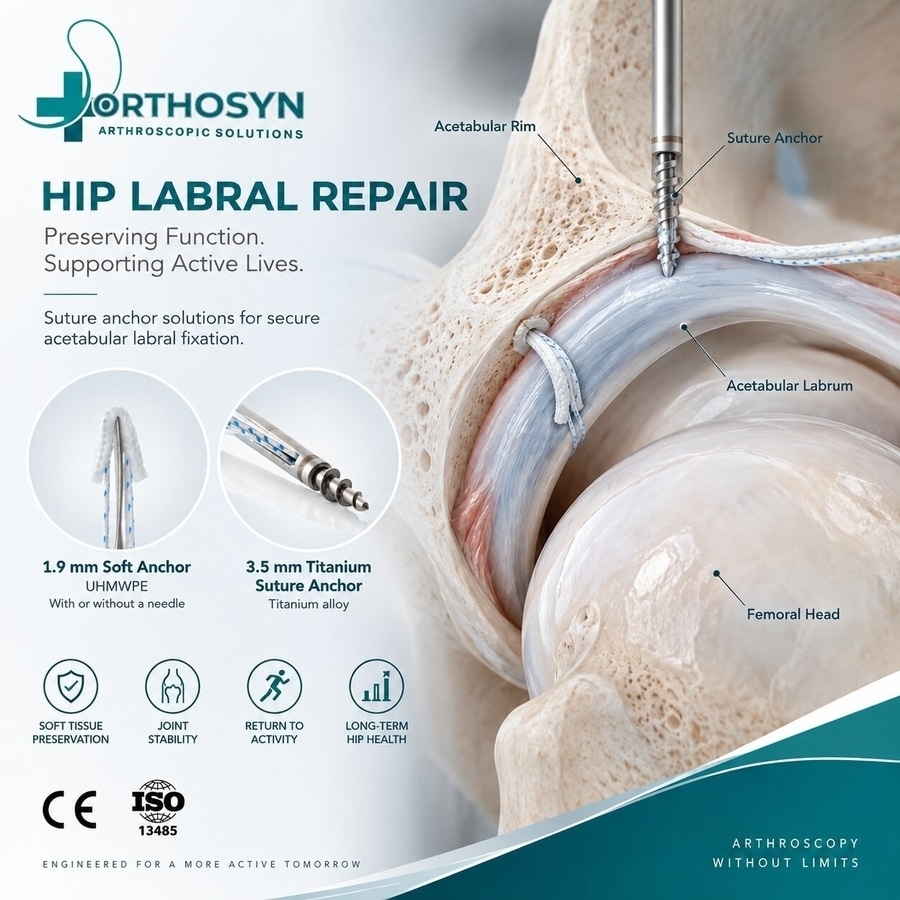
A hip labral repair is an arthroscopic procedure used to preserve and reattach damaged acetabular labral tissue when repair is considered appropriate.
The acetabular labrum is a fibrocartilaginous structure surrounding the rim of the acetabulum. It contributes to hip stability, helps maintain the fluid seal of the joint, and supports normal load distribution between the femoral head and acetabulum.
When the labrum becomes detached from the acetabular rim, suture anchors can be used to create fixation points in the bone. Sutures connected to the anchors are passed around or through the labral tissue and tensioned to restore its attachment to the acetabular rim.
Because the acetabular rim provides limited bone volume and multiple fixation points may be required, anchor diameter, drilling trajectory, implant position, suture configuration, and preservation of surrounding bone and cartilage are important considerations.
Within the Orthosyn portfolio, 1.9 mm Soft Suture Anchors and 3.5 mm Titanium Suture Anchors can provide anchor options for arthroscopic soft-tissue fixation where their dimensions, fixation characteristics, and the selected surgical technique are appropriate.
What Is the Acetabular Labrum?
The acetabular labrum is a ring of fibrocartilaginous tissue surrounding the edge of the acetabulum.
The acetabulum forms the socket of the hip joint, while the femoral head forms the ball.
The labrum helps:
Increase the functional depth of the acetabulum
Support hip stability
Maintain the fluid seal around the femoral head
Contribute to joint lubrication
Support load distribution
Preserve normal hip joint mechanics
Damage to this structure can therefore affect more than the labral tissue itself.
What Is a Hip Labral Tear?
A hip labral tear is a disruption of the acetabular labrum.
Labral pathology can occur in association with several conditions, including:
Femoroacetabular impingement
Hip instability
Trauma
Repetitive rotational loading
Acetabular dysplasia
Degenerative joint changes
The location, morphology, tissue quality, and underlying cause of the tear can influence treatment.
Not every labral tear requires surgery, and not every tear is suitable for repair.
Why Is the Hip Labrum Important?
The labrum contributes to both the mechanical and fluid environment of the hip.
One of its important functions is maintaining the labral seal around the femoral head.
This seal contributes to normal joint fluid behavior and helps maintain the relationship between the femoral head and acetabulum.
When the labrum becomes detached or significantly damaged, this function may be compromised.
For this reason, modern hip arthroscopy may prioritize labral preservation and repair when the tissue and clinical situation are appropriate.
What Is Hip Labral Repair?
Hip labral repair is a procedure in which damaged but repairable labral tissue is reattached to the acetabular rim.
The fundamental concept is:
Acetabular Rim → Suture Anchor → Suture → Labral Tissue
The anchor creates a fixation point in the acetabular bone.
The suture is then positioned through or around the labrum and secured so that the tissue is approximated to the acetabular rim.
The objective is not simply to hold the tissue in place but to restore an appropriate anatomical relationship while preserving the functional contour of the labrum.
How Are Suture Anchors Used in Hip Labral Repair?
Suture anchors provide the connection between the acetabular bone and the labral tissue.
During an arthroscopic repair, the surgeon may:
Evaluate the labral tear and surrounding structures.
Mobilize the detached labrum when necessary.
Prepare the acetabular rim.
Establish the appropriate drilling trajectory.
Create a bone tunnel for the anchor.
Insert the suture anchor.
Pass the suture through or around the labral tissue.
Tension the repair.
Secure the suture according to the selected fixation technique.
Evaluate the final position and stability of the repaired labrum.
Multiple anchors may be placed along the acetabular rim when the tear extends over a larger area.
Why Is Anchor Position Important?
The acetabular rim is located close to the articular cartilage and other important anatomical structures.
The surgeon must therefore control:
Entry point
Drill angle
Anchor trajectory
Insertion depth
Distance from the articular surface
Spacing between anchors
Improper trajectory may compromise the intended fixation or risk damage to surrounding structures.
For this reason, dedicated drill guides and controlled arthroscopic instrumentation are important components of anchor placement.
Why Does Anchor Diameter Matter in Hip Labral Repair?
Hip labral repair may require several fixation points along a relatively limited section of the acetabular rim.
Each anchor requires bone preparation.
A smaller-diameter anchor generally requires a smaller bone tunnel, which can be relevant when the objective is to preserve bone while creating multiple fixation points.
Potential considerations associated with smaller anchors include:
Reduced tunnel diameter
Preservation of acetabular bone stock
Ability to position multiple anchors
Greater flexibility in limited anatomical regions
However, smaller is not automatically better.
Anchor selection must also consider fixation requirements, bone quality, implant design, tissue quality, suture configuration, and surgical technique.
Why Can Soft Suture Anchors Be Relevant in Hip Labral Repair?
A soft or all-suture anchor is primarily constructed from high-strength suture material rather than a conventional solid implant body.
After insertion through a small bone tunnel, the anchor deploys within the bone to establish fixation.
Potential characteristics include:
Small drilling diameter
Reduced implant volume
Bone-preserving fixation concept
Ability to create multiple fixation points within limited bone stock
These characteristics can be relevant in arthroscopic labral procedures where multiple anchors may need to be positioned along the acetabular rim.
Within the Orthosyn portfolio, the 1.9 mm Soft Suture Anchor provides a small-diameter option for arthroscopic soft-tissue fixation.
Orthosyn 1.9 mm Soft Suture Anchor
The Orthosyn 1.9 mm Soft Suture Anchor can be considered where a small-diameter all-suture fixation concept is appropriate for the selected arthroscopic repair technique.
For hip labral fixation, the small diameter may be relevant because it can support a bone-preserving approach when multiple fixation points are required along the acetabular rim.
Important characteristics of the fixation concept include:
1.9 mm diameter
Soft all-suture anchor construction
Small bone tunnel requirement
Reduced solid implant volume
Suitability for arthroscopic soft-tissue fixation techniques
The final choice of anchor must depend on patient anatomy, bone quality, tear configuration, required fixation, and surgeon preference.
Can Titanium Suture Anchors Be Used for Labral Fixation?
Titanium anchors represent another established approach to soft-tissue-to-bone fixation.
A titanium suture anchor has a solid metallic implant body that engages the bone and provides a fixation point for the attached sutures.
Potential characteristics include:
Rigid implant structure
High mechanical strength
Biocompatibility
Permanent fixation implant
Established use in orthopedic soft-tissue fixation
Within the Orthosyn portfolio, the 3.5 mm Titanium Suture Anchor provides a solid-anchor option that can be considered for arthroscopic soft-tissue fixation when the implant dimensions and surgical requirements are appropriate.
1.9 mm Soft vs 3.5 mm Titanium Suture Anchors
Both technologies are designed to establish soft-tissue-to-bone fixation, but they use different implant concepts.
Feature Orthosyn 1.9 mm Soft Anchor Orthosyn 3.5 mm Titanium Anchor
Anchor concept All-suture / soft anchor Solid metallic anchor
Diameter 1.9 mm 3.5 mm
Implant material concept Primarily suture-based Titanium
Bone tunnel Smaller Larger relative to 1.9 mm anchor
Implant volume Low Solid implant body
Bone preservation consideration Particularly relevant Depends on anatomy and placement
Fixation approach Soft anchor deployment Solid anchor engagement
Arthroscopic soft-tissue fixation Applicable depending on technique Applicable depending on technique
The selection should be based on the complete surgical situation rather than material or diameter alone.
How Many Anchors Are Used in Hip Labral Repair?
There is no universal number of suture anchors for every hip labral repair.
The required number depends on factors such as:
Length of the tear
Location of the tear
Labral tissue quality
Acetabular anatomy
Anchor diameter
Desired spacing
Fixation technique
Associated pathology
A short focal tear may require a different repair configuration from a more extensive labral detachment.
The objective is to create sufficient fixation points to restore the labrum without unnecessary bone preparation.
How Are Sutures Passed Through the Labrum?
Different suture configurations may be used during hip labral repair.
Two general concepts include:
Labral Base Fixation
The suture captures tissue closer to the base of the labrum.
This approach may help preserve the free edge and contour of the labrum in selected repairs.
Circumferential Suture Configuration
The suture may pass around the labral tissue.
This creates a different fixation configuration and may be selected depending on tissue quality and tear morphology.
The appropriate configuration depends on the lesion and surgical technique.
Why Is Suture Tension Important?
The objective of repair is not simply to pull the labrum as tightly as possible against the bone.
Excessive tension may alter the shape of the labrum or affect its relationship with the femoral head.
Insufficient tension may fail to provide adequate tissue approximation.
The surgeon therefore aims to achieve enough tension to stabilize the tissue while maintaining an appropriate labral contour.
Why Is the Labral Seal Important?
The acetabular labrum helps create a seal around the femoral head.
This seal contributes to the fluid mechanics of the hip joint.
During repair, the surgeon may therefore consider not only whether the labrum is securely attached, but also whether its position and contour allow it to maintain an appropriate relationship with the femoral head.
This is one reason why anchor placement, suture configuration, and tensioning should be considered together.
What Is the Relationship Between FAI and Labral Tears?
Femoroacetabular impingement (FAI) is frequently associated with acetabular labral pathology.
Two major morphological patterns are commonly described:
Cam Morphology
Excess bone or altered contour at the femoral head-neck junction can create abnormal contact with the acetabular rim.
Pincer Morphology
Acetabular morphology can result in increased coverage and contact between the acetabular rim and femur.
These mechanical factors may contribute to repetitive stress on the labrum.
When appropriate, surgical management may therefore address both the labral injury and the underlying bony morphology rather than repairing the labrum alone.
Hip Labral Repair vs Labral Debridement
Not every damaged labrum is repaired.
Labral Repair
The damaged tissue is preserved and reattached to the acetabular rim.
Labral Debridement
Damaged or unstable tissue is selectively removed or contoured.
The decision may depend on:
Tissue quality
Tear pattern
Tear location
Patient anatomy
Associated pathology
Surgeon assessment
Where repairable tissue is present, preservation of the labrum may be considered because of its role in hip joint mechanics.
What About Labral Reconstruction?
Some labral tissue may be too damaged, deficient, or previously treated to allow conventional repair.
In selected situations, labral reconstruction may be considered.
This involves using graft tissue to reconstruct part or all of the deficient labrum.
Labral repair and labral reconstruction are therefore different procedures, even though suture anchors may be involved in both fixation strategies.
Why Is Bone Preservation Important?
Bone preservation can become especially relevant when multiple anchors are placed along the acetabular rim.
It may also be important when:
The patient has limited local bone stock
Multiple fixation points are needed
Previous anchors are present
Revision surgery is being performed
Future revision procedures may be necessary
For these reasons, smaller-diameter anchor systems may be useful in selected repair strategies.
What Instruments Are Used in Arthroscopic Hip Labral Repair?
Hip labral repair may involve a combination of specialized arthroscopic instruments, including:
Arthroscope
Cannulas
Suture anchors
Anchor drill guides
Drills
Suture passers
Tissue penetrators
Graspers
Probes
Suture management instruments
Accurate instrumentation is especially important because the surgeon must work around the curved acetabular rim while protecting the adjacent articular cartilage.
What Factors Influence Suture Anchor Selection?
Anchor selection should be considered as part of the complete repair strategy.
Important factors include:
Parameter Why It Matters
Anchor diameter Influences bone tunnel size
Anchor material Determines implant characteristics
Acetabular bone stock Influences fixation options
Anchor trajectory Important for safe placement
Suture configuration Influences tissue capture
Tear length May affect number of fixation points
Tissue quality Influences repair strategy
Revision considerations May increase importance of bone preservation
No single anchor design is appropriate for every hip labral tear.
Orthosyn Suture Anchor Options for Hip Labral Fixation
Orthosyn Medikal provides different suture anchor technologies for arthroscopic soft-tissue fixation.
For procedures such as hip labral repair, relevant options within the portfolio include:
Orthosyn 1.9 mm Soft Suture Anchor
A small-diameter all-suture fixation option designed to minimize the required bone tunnel while providing a fixation point for arthroscopic soft-tissue repair.
Orthosyn Soft Suture Anchors
Orthosyn 3.5 mm Titanium Suture Anchor
A solid titanium anchor option for arthroscopic soft-tissue-to-bone fixation where a metallic anchor design and its dimensions are appropriate for the selected technique.
Orthosyn Titanium Suture Anchors
The selection between these technologies should be based on acetabular anatomy, available bone stock, tear configuration, required fixation, anchor trajectory, and surgeon preference.
Conclusion
A hip labral repair is an arthroscopic procedure that reattaches damaged but repairable acetabular labral tissue to the acetabular rim.
Suture anchors provide fixation points within the acetabular bone, allowing sutures to capture the labrum and restore its attachment.
The basic repair concept is:
Labral Tear → Acetabular Rim Preparation → Anchor Placement → Suture Passage → Controlled Tensioning → Labral Fixation
Because multiple fixation points may be required along the acetabular rim, anchor diameter, bone preservation, insertion trajectory, suture configuration, tissue quality, and repair tension are important considerations.
The Orthosyn 1.9 mm Soft Suture Anchor offers a small-diameter, bone-preserving all-suture fixation concept, while the Orthosyn 3.5 mm Titanium Suture Anchor provides a solid metallic fixation option. Their use should be selected according to the anatomical and surgical requirements of the individual arthroscopic repair.
Orthosyn Medikal offers multiple suture anchor technologies designed to support different arthroscopic soft-tissue fixation strategies, including hip labral repair applications where the selected implant and technique are appropriate.