#Product Trends
How Does Hyaluronic Acid Support Cushioning and Shock Absorption in Joints? | AlkaFlex
Learn how hyaluronic acid contributes to the viscoelastic properties of synovial fluid, supports joint lubrication, helps distribute mechanical loads, and contributes to cushioning and shock absorption during movement.
Healthy synovial joints are designed to tolerate repeated mechanical loading during everyday activities such as walking, climbing stairs, running, bending, and standing. Inside these joints, synovial fluid plays an important role in creating an environment that allows the articular surfaces to move smoothly while managing mechanical forces.
One of the key natural components of synovial fluid is hyaluronic acid (HA), also known as hyaluronan.
Hyaluronic acid contributes to the viscosity and viscoelastic behavior of synovial fluid. These properties help synovial fluid perform several mechanical functions, including lubrication, load distribution, cushioning, and resistance to rapid compressive forces.
This relationship can be simplified as:
Hyaluronic Acid → Synovial Fluid Viscoelasticity → Lubrication + Load Distribution + Cushioning → Support for Joint Mechanics
In osteoarthritis, the properties of the synovial environment can change. Intra-articular hyaluronic acid injections, commonly referred to as viscosupplementation, are designed to supplement hyaluronic acid within the joint.
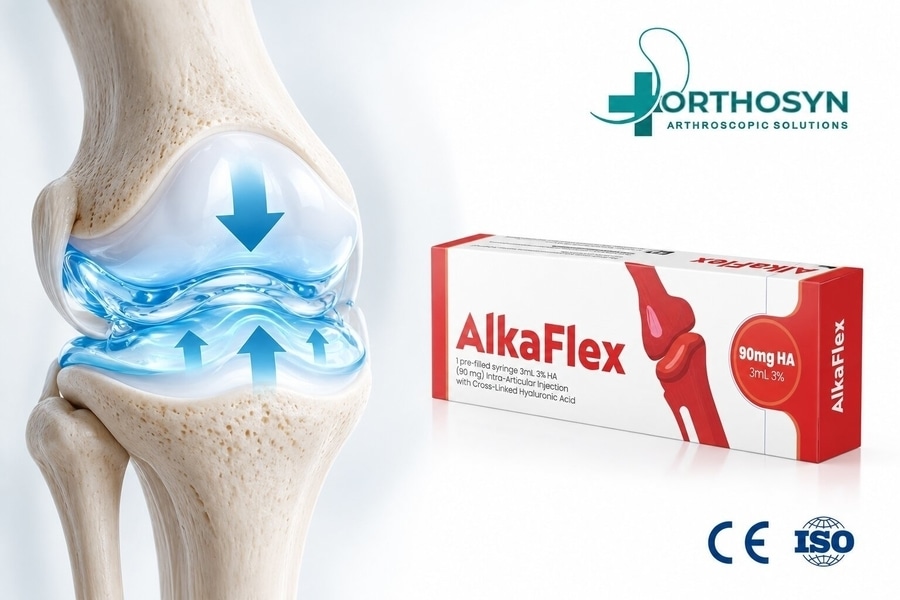
The AlkaFlex Hyaluronic Acid Injection portfolio includes different linear and cross-linked HA formulations developed for intra-articular use.
What Is Hyaluronic Acid?
Hyaluronic acid is a naturally occurring glycosaminoglycan found throughout the human body.
It is present in tissues and biological fluids including:
- Synovial fluid
- Articular cartilage
- Connective tissue
- Skin
- Vitreous humor of the eye
Within synovial joints, HA is particularly important because of its ability to interact with water and contribute to the physical properties of synovial fluid.
Its long molecular chains can create a hydrated molecular network that influences the fluid's viscosity and elasticity.
These characteristics are important for normal joint mechanics.
What Is Synovial Fluid?
Synovial fluid is the viscous biological fluid found within synovial joints such as the:
- Knee
- Hip
- Shoulder
- Ankle
- Elbow
- Wrist
It is produced within the synovial environment and provides an important interface between the moving articular surfaces.
Synovial fluid performs several functions:
Lubrication → Reduction of friction between joint surfaces
Load distribution → Distribution of mechanical forces across the joint
Cushioning → Management of compressive forces
Nutrient transport → Support for the metabolic environment of articular cartilage
Hyaluronic acid is one of the major contributors to the rheological properties that allow synovial fluid to perform these functions.
What Does “Viscoelastic” Mean?
Synovial fluid is commonly described as viscoelastic.
This means it exhibits both viscous and elastic behavior.
Viscous Behavior
Viscosity describes resistance to flow.
A viscous fluid can help create a lubricating layer between moving joint surfaces.
Elastic Behavior
Elastic behavior refers to the ability of a material to deform under mechanical force and respond to that force.
In a joint, these properties work dynamically rather than independently.
The behavior of synovial fluid changes depending on:
- Speed of movement
- Mechanical load
- Shear forces
- Compression
- Molecular characteristics of HA
- Concentration of HA
- Overall composition of synovial fluid
This dynamic behavior helps explain why hyaluronic acid is relevant to both joint lubrication and shock absorption.
How Does Hyaluronic Acid Contribute to Joint Cushioning?
When a joint is loaded, forces are transmitted across the articular surfaces.
Examples include:
- Body weight during standing
- Repeated loading during walking
- Increased forces while climbing stairs
- Impact during running
- Rapid loading during sports
Articular cartilage is the primary load-bearing surface, but it does not function alone.
Synovial fluid contributes to the mechanical environment surrounding the cartilage.
Because HA helps give synovial fluid its viscoelastic properties, it contributes to the fluid's ability to respond to mechanical loading.
The simplified relationship is:
Joint Loading → Compression of Joint Structures → Viscoelastic Response of Synovial Fluid → Distribution of Mechanical Forces
This is one of the mechanisms through which HA contributes to joint cushioning.
How Does Hyaluronic Acid Support Shock Absorption?
“Shock absorption” does not mean that hyaluronic acid independently absorbs every impact experienced by a joint.
Joint shock management is the result of multiple structures working together, including:
- Articular cartilage
- Subchondral bone
- Menisci in the knee
- Ligaments
- Muscles
- Tendons
- Joint geometry
- Synovial fluid
Hyaluronic acid contributes specifically through its influence on the viscoelastic behavior of synovial fluid.
Under rapid mechanical loading, the elastic component of this fluid behavior becomes particularly relevant.
Conceptually:
Rapid Mechanical Load → Viscoelastic Synovial Fluid Response → Force Distribution and Cushioning
HA should therefore be understood as one component of the joint's overall mechanical shock-management system rather than as an isolated shock absorber.
What Happens to Hyaluronic Acid During Slow Movement?
The mechanical behavior of synovial fluid depends partly on the rate of movement.
During relatively slow joint motion, viscous characteristics become particularly relevant.
This supports the formation of a lubricating environment between moving surfaces.
Conceptually:
Slow Movement → Viscous Behavior → Lubrication
This can help reduce friction between articulating surfaces.
What Happens During Faster Loading?
When movement or loading occurs more rapidly, the elastic characteristics of synovial fluid become increasingly relevant.
Conceptually:
Rapid Loading → Elastic/Viscoelastic Response → Cushioning and Load Management
This rate-dependent behavior is one of the reasons synovial fluid cannot be understood simply as a conventional lubricant.
It is a dynamic biological fluid whose mechanical properties change according to the forces applied to it.
Lubrication vs Cushioning: What Is the Difference?
Although closely related, lubrication and cushioning are not identical functions.
Function Primary Mechanical Role
Lubrication Reduces friction between moving surfaces
Cushioning Helps manage compressive loading
Shock absorption Contributes to the response to rapid mechanical forces
Load distribution Helps distribute forces across joint structures
Viscoelasticity Enables rate-dependent mechanical behavior
Hyaluronic acid contributes to several of these functions through its effect on synovial fluid properties.
What Role Does Articular Cartilage Play?
Articular cartilage covers the ends of bones within synovial joints.
It provides a smooth, low-friction surface and plays a major role in distributing loads.
Cartilage contains a highly organized extracellular matrix containing:
- Water
- Collagen
- Proteoglycans
- Chondrocytes
Its mechanical properties allow it to deform under load and recover when the load is reduced.
Synovial fluid and cartilage therefore function together.
A simplified mechanical model is:
Articular Cartilage + Synovial Fluid + Joint Anatomy → Load Distribution and Low-Friction Movement
Hyaluronic acid supports the synovial-fluid component of this system.
What Role Do the Menisci Play in Knee Shock Absorption?
In the knee, the menisci also contribute significantly to mechanical load management.
The medial and lateral menisci help:
- Distribute load
- Increase contact area
- Improve joint congruency
- Contribute to stability
- Manage mechanical forces
Therefore, the cushioning function of the knee cannot be attributed to HA or synovial fluid alone.
Instead, the knee functions as an integrated mechanical system.
Menisci + Cartilage + Synovial Fluid + Ligaments + Muscles → Coordinated Joint Load Management
What Happens to Synovial Fluid in Osteoarthritis?
Osteoarthritis is a complex joint disorder involving more than cartilage alone.
Changes may involve:
- Articular cartilage
- Subchondral bone
- Synovium
- Menisci
- Ligaments
- Periarticular structures
- Synovial fluid
The molecular characteristics and concentration of endogenous hyaluronic acid in the synovial environment can change in osteoarthritis.
These changes can affect the rheological properties of synovial fluid.
In practical terms, the synovial environment may no longer demonstrate the same mechanical characteristics as healthy synovial fluid.
This is one of the biological concepts behind the use of intra-articular hyaluronic acid injections.
What Is Viscosupplementation?
Viscosupplementation refers to the intra-articular administration of hyaluronic acid.
The concept is to supplement HA within the synovial joint environment.
The process can be represented as:
Intra-Articular HA Injection → Supplementation of Synovial HA → Modification of the Intra-Articular Viscoelastic Environment
Hyaluronic acid injections are used as part of non-surgical management strategies for selected patients with osteoarthritis, particularly knee osteoarthritis.
They should not be interpreted as simply adding a physical “cushion” between the bones.
The interaction between injected HA, synovial fluid, joint tissues, mechanical loading, and biological processes is more complex.
Does a Hyaluronic Acid Injection Directly Create a Cushion Inside the Knee?
Not in the literal sense.
An HA injection does not create a solid protective pad between the femur and tibia.
Instead, hyaluronic acid becomes part of the intra-articular fluid environment.
Its relevance is related to its molecular and rheological properties.
A more accurate concept is:
HA Injection → Synovial Environment → Viscoelastic Properties → Lubrication and Mechanical Load Management
This distinction is important when explaining how viscosupplementation works.
Does Hyaluronic Acid Replace Articular Cartilage?
No.
Hyaluronic acid and articular cartilage perform different functions.
An intra-articular HA injection does not physically replace lost cartilage.
Cartilage is a complex biological tissue with a highly organized extracellular matrix.
HA injections are instead intended to supplement the intra-articular hyaluronic acid environment.
Therefore:
HA Injection ≠ Cartilage Replacement
and
Viscosupplementation ≠ Mechanical Resurfacing of the Joint
Does Hyaluronic Acid Regenerate Cartilage?
Hyaluronic acid injections should not be described as a direct method of regenerating lost articular cartilage.
Their clinical role is different.
The main concept of viscosupplementation relates to modifying or supplementing the intra-articular HA environment rather than physically rebuilding a damaged cartilage surface.
Claims regarding cartilage regeneration should therefore be distinguished from the established concept of viscosupplementation.
Why Does Molecular Weight Matter?
The molecular weight of hyaluronic acid influences its physical characteristics.
HA consists of long molecular chains.
Different formulations can therefore vary in:
- Molecular weight
- Chain length
- Rheological behavior
- Concentration
- Residence characteristics
- Formulation design
Higher molecular weight can influence viscosity and viscoelastic behavior, but molecular weight alone does not determine the complete clinical characteristics of an HA injection.
The complete formulation must be considered.
Linear vs Cross-Linked Hyaluronic Acid
Hyaluronic acid formulations can broadly include linear and cross-linked structures.
Linear Hyaluronic Acid
Linear HA consists primarily of non-cross-linked molecular chains.
Its characteristics depend on:
- Molecular weight
- Concentration
- Total HA dose
- Injection volume
- Formulation
Cross-Linked Hyaluronic Acid
Cross-linking connects HA molecular chains into a more complex network.
This can alter:
- Rheological properties
- Resistance to degradation
- Viscoelastic characteristics
- Residence characteristics
Cross-linked HA is not simply “more concentrated” linear HA.
Concentration and cross-linking describe different formulation characteristics.
Why Does HA Concentration Matter?
HA concentration describes how much hyaluronic acid is present within a given volume.
For example, concentration may be expressed in:
mg/mL
However, concentration should not be confused with total dose.
A product can have:
- A high concentration but a relatively small injection volume
- A lower concentration but a larger volume
- Different total HA doses despite similar concentrations
The relationship is:
HA Concentration × Injection Volume = Total HA Amount
These parameters should therefore be evaluated separately.
Does a Higher HA Dose Automatically Provide Better Cushioning?
Not necessarily.
A higher total dose does not automatically mean that an injection provides proportionally greater cushioning or a better clinical result.
The characteristics of an HA formulation depend on multiple variables:
- Molecular weight
- Concentration
- Total HA amount
- Linear or cross-linked structure
- Injection volume
- Rheological properties
- Residence characteristics
- Injection protocol
Therefore, HA products should not be compared using dose alone.
Why Is Cross-Linking Relevant to Mechanical Properties?
Cross-linking modifies the molecular network of hyaluronic acid.
Instead of individual linear chains behaving independently, cross-linked structures create a more interconnected molecular system.
This can influence the material's rheological and viscoelastic characteristics.
Conceptually:
Linear HA → Long Molecular Chains
Cross-Linked HA → Interconnected HA Network
This difference may influence how the formulation behaves under shear and mechanical loading.
However, cross-linking alone should not be interpreted as proof of superior clinical performance.
Single-Injection vs Multiple-Injection Protocols
Hyaluronic acid viscosupplementation products can be designed for different treatment protocols.
These may include:
- Single-injection protocols
- Multiple-injection protocols
The protocol depends on the specific product formulation and its approved instructions for use.
The number of injections should not be determined simply by HA concentration or molecular weight.
Different products may have different:
- HA doses
- Injection volumes
- Molecular structures
- Rheological properties
- Treatment protocols
How Is Hyaluronic Acid Produced?
Hyaluronic acid used in medical devices can be obtained through different manufacturing approaches.
Modern HA formulations may use bacterial fermentation, avoiding animal-derived HA sources.
AlkaFlex hyaluronic acid is produced using bacterial fermentation.
This provides a non-animal-source approach to HA production.
Manufacturing method, purification, molecular characteristics, sterilization strategy, formulation, and quality control are all relevant to the final medical device.
Which Joints Depend on Synovial Fluid?
Synovial fluid is found in multiple movable joints, including:
- Knee
- Hip
- Shoulder
- Ankle
- Elbow
- Wrist
However, the clinical use of a specific HA injection depends on the product's applicable indications and instructions for use.
The biological function of endogenous HA should therefore be distinguished from the approved use of any specific medical device.
What Factors Should Be Considered When Comparing HA Injections?
Parameter Why It Matters
Molecular weight Influences molecular and rheological characteristics
HA concentration Indicates HA amount per unit volume
Total HA dose Indicates total amount delivered
Injection volume Influences total formulation delivered
Linear vs cross-linked Describes molecular structure
Viscoelastic properties Relevant to mechanical fluid behavior
Source of HA Describes manufacturing origin
Injection protocol Defines product-specific administration
Applicable indication Determines intended clinical use
No single parameter should be used alone to characterize the complete performance of an HA formulation.
AlkaFlex Hyaluronic Acid Injections
AlkaFlex is the Orthosyn Medikal hyaluronic acid injection portfolio developed for intra-articular viscosupplementation.
The portfolio includes linear and cross-linked hyaluronic acid formulations with different doses, concentrations, injection volumes, and formulation strategies.
This allows HA products to be evaluated according to multiple characteristics rather than simply comparing the number of milligrams in the syringe.
Key formulation parameters can include:
- Linear or cross-linked HA
- Molecular characteristics
- HA concentration
- Total HA dose
- Injection volume
- Viscoelastic characteristics
- Product-specific injection protocol
AlkaFlex Hyaluronic Acid Injections – Orthosyn Medikal
The selection of any intra-articular HA product should be based on its specific formulation, applicable indications, instructions for use, patient characteristics, and clinical assessment.
Conclusion
Hyaluronic acid contributes to cushioning and shock management in synovial joints primarily through its influence on the viscoelastic properties of synovial fluid.
The relationship can be summarized as:
Hyaluronic Acid → Synovial Fluid Viscoelasticity → Lubrication + Load Distribution + Cushioning + Response to Mechanical Loading
During slower movements, the viscous characteristics of the synovial environment contribute to lubrication. During more rapid loading, viscoelastic behavior becomes relevant to force distribution and cushioning.
However, hyaluronic acid does not work independently.
Joint shock absorption and load management involve the coordinated function of articular cartilage, synovial fluid, subchondral bone, menisci where present, ligaments, muscles, tendons, and joint anatomy.
In osteoarthritis, changes in the intra-articular environment can affect the characteristics of endogenous HA and synovial fluid. Viscosupplementation with intra-articular hyaluronic acid is designed to supplement this HA environment rather than physically replace cartilage or create a solid cushion inside the joint.
AlkaFlex by Orthosyn Medikal includes linear and cross-linked intra-articular hyaluronic acid formulations designed around different molecular, concentration, dose, volume, and viscoelastic characteristics for viscosupplementation where the specific product indication and clinical assessment are appropriate.