#Product Trends
How Does Double-Button Fixation Work in AC Joint Stabilization? | Orthosyn
Learn how double-button fixation is used in acromioclavicular joint stabilization, how the coracoclavicular relationship is restored, and why cortical buttons, high-strength sutures, tunnel positioning, and reduction are important in AC joint reconst
The acromioclavicular (AC) joint connects the lateral end of the clavicle with the acromion of the scapula. Although it is a relatively small articulation, it plays an important role in coordinating movement between the clavicle and scapula during shoulder motion.
Traumatic AC joint injuries can disrupt the ligamentous structures responsible for maintaining this relationship. In selected unstable injuries, surgical stabilization may be considered.
One technique uses a double-button fixation system to create a strong connection between the clavicle and the coracoid. Rather than relying on a large rigid implant across the AC joint itself, cortical buttons are positioned against bone surfaces and connected by high-strength suture material.
The basic concept can be summarized as:
AC Joint Instability → Reduction of Clavicle-Coracoid Relationship → Bone Tunnel Preparation → Double-Button Placement → Suture Tensioning → Cortical Fixation → Stabilization
The fixation construct provides mechanical stability while the injured or reconstructed soft tissues undergo biological healing.
What Is the AC Joint?
The AC joint is located at the top of the shoulder where the lateral clavicle meets the acromion.
Its stability depends on several structures.
These include:
- AC capsule
- Acromioclavicular ligaments
- Coracoclavicular ligaments
- Trapezoid ligament
- Conoid ligament
- Surrounding deltotrapezial fascia
The coracoclavicular (CC) ligaments, particularly the conoid and trapezoid components, play an important role in maintaining the relationship between the clavicle and the coracoid process.
When these structures are disrupted by trauma, the clavicle and scapular complex may lose their normal relationship.
What Causes AC Joint Separation?
AC joint injuries commonly occur after direct trauma to the shoulder.
Possible mechanisms include:
- Falling directly onto the shoulder
- Contact sports
- Cycling accidents
- High-energy trauma
- Collision injuries
The force can damage the AC ligaments and, in more severe injuries, the coracoclavicular ligaments.
The degree of instability depends on the structures involved and the severity of the injury.
Does Every AC Joint Injury Require Surgery?
No.
Many AC joint injuries can be managed non-operatively.
Treatment depends on factors such as:
- Injury severity
- Degree and direction of displacement
- Acute versus chronic injury
- Patient age
- Activity level
- Functional demands
- Symptoms
- Associated injuries
- Clinical and radiographic assessment
Surgical stabilization is generally considered for selected unstable injuries or persistent symptomatic instability rather than every AC joint injury.
What Is Double-Button Fixation?
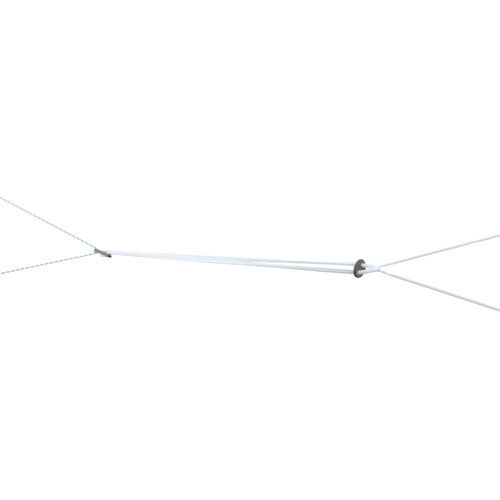
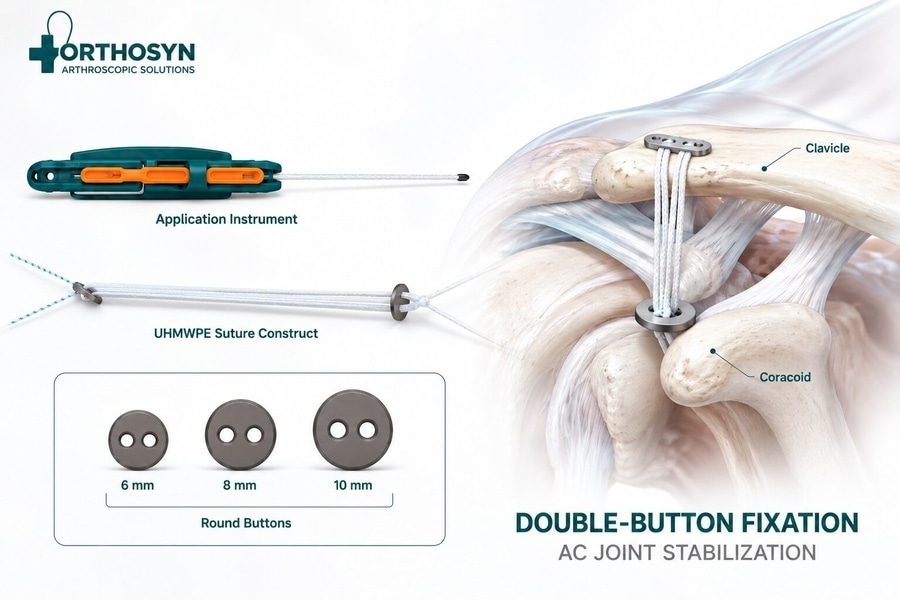
Double-button fixation is a cortical fixation technique in which two buttons are connected by high-strength suture material.
In AC joint stabilization, one button can be positioned on the clavicular cortex while the other is positioned beneath the coracoid.
The construct creates a connection between these two bony structures.
A simplified representation is:
Clavicle
↓ Upper Cortical Button
↓ High-Strength Suture Construct
↓ Coracoid
↓ Lower Cortical Button
After the AC/CC relationship is reduced, tension is applied to the connecting construct.
The buttons distribute the fixation forces against the cortical bone surfaces and help maintain the reduction.
Why Is the Coracoclavicular Relationship Important?
In many unstable AC joint injuries, the problem is not limited to the small AC articulation itself.
Disruption of the coracoclavicular ligaments can allow abnormal separation between the clavicle and the coracoid/scapular complex.
Therefore, one important objective of stabilization is to restore an appropriate coracoclavicular distance and relationship.
Conceptually:
CC Ligament Disruption → Loss of Clavicle-Coracoid Stability → Reduction → CC Fixation → Stabilization
Double-button systems are designed around this principle.
How Does a Double-Button Construct Stabilize the AC Joint?
The system works by creating a suspensory connection between the clavicle and coracoid.
Instead of a screw directly compressing the two bones together, the fixation is created through a connected cortical-button construct.
The principle is:
Cortical Button + High-Strength Suture + Cortical Button = Suspensory Fixation Construct
When properly positioned and tensioned, the construct helps maintain the reduced relationship between the clavicle and the coracoid.
This provides mechanical stabilization while biological healing or ligament reconstruction progresses.
How Is Double-Button Fixation Performed?
The exact surgical technique varies according to the system, injury pattern, acute or chronic presentation, and surgeon preference.
A general sequence may include:
Assessment → Reduction → Tunnel Preparation → Suture/Button Passage → Coracoid Button Deployment → Clavicular Button Positioning → Tensioning → Stability Assessment
Each stage affects the final fixation construct.
Step 1: Assessment of the AC Joint Injury
Before fixation, the surgeon evaluates the injury pattern.
This can include assessment of:
- AC joint displacement
- Coracoclavicular distance
- Horizontal and vertical instability
- Ligament injury
- Bone quality
- Chronicity
- Associated shoulder injuries
The surgical strategy should address the actual instability pattern rather than simply the radiographic appearance of the clavicle.
Step 2: Reduction of the AC Joint
The clavicle and scapular complex are brought toward an appropriate anatomical relationship.
This is the reduction stage.
The objective is not simply to pull the clavicle downward.
The surgeon must consider the relationship of the clavicle, acromion, coracoid, and scapula.
Once an appropriate reduction is achieved, the fixation system can be tensioned to maintain it.
Therefore:
Accurate Reduction + Stable Fixation = Foundation of AC Joint Stabilization
A fixation device cannot fully compensate for an inadequate reduction.
Step 3: Preparing the Bone Tunnel
A bone tunnel is prepared to allow passage of the fixation construct.
Depending on the surgical technique and system design, drilling may involve the clavicle and coracoid.
Tunnel positioning is important because the fixation forces are transferred through these bone structures.
Factors that may influence tunnel preparation include:
- Tunnel diameter
- Clavicular position
- Coracoid position
- Bone stock
- Drill trajectory
- Distance from surrounding cortical margins
- Implant dimensions
Preserving adequate bone around the tunnel is important for maintaining structural integrity.
Why Does Tunnel Diameter Matter?
Every drilled tunnel removes some bone.
Therefore, tunnel diameter is relevant when considering bone preservation.
The general principle is:
Smaller Required Tunnel → Less Bone Removed
However, smaller is not automatically better in every clinical situation.
The tunnel must still be appropriate for the implant, surgical technique, anatomy, and required fixation construct.
Why Is Tunnel Positioning Important?
Correct tunnel positioning helps create an appropriate direction of fixation between the clavicle and coracoid.
Poor positioning can potentially influence:
- Reduction
- Construct alignment
- Cortical support
- Bone stresses
- Button seating
- Fixation mechanics
The coracoid is also a relatively small anatomical structure, making accurate drilling particularly important.
The objective is not simply to create a hole between two bones.
The objective is to create a tunnel that supports the intended fixation while preserving surrounding bone.
Step 4: Passing the Fixation Construct
After tunnel preparation, the suture-button construct is passed through the prepared pathway.
Depending on the device design, this may involve a passing mechanism, guidewire, dedicated instrument, or an integrated delivery system.
The lower button must pass through the tunnel before being positioned beneath the coracoid cortex.
This stage requires controlled implant passage and confirmation of appropriate positioning.
Step 5: Deploying the Coracoid Button
Once the lower button has passed through the tunnel, it is positioned so that it rests against the inferior cortex of the coracoid.
This is a critical step.
The button should provide cortical support rather than remaining incorrectly positioned within the tunnel.
Conceptually:
Button Passage → Button Deployment → Cortical Seating
Correct seating allows the cortical surface to participate in load distribution.
Step 6: Positioning the Clavicular Button
The second button is positioned on the superior surface of the clavicle.
The construct therefore creates fixation between:
Superior Clavicular Cortex ↔ Suture Construct ↔ Inferior Coracoid Cortex
The two buttons function as cortical fixation points.
The connecting suture material transfers forces between them.
Step 7: Tensioning the Construct
Once the buttons are correctly positioned and the AC/CC relationship has been reduced, the suture construct is tensioned.
Tensioning brings the two cortical fixation points into a stable relationship.
However, the goal is not simply to apply maximum tension.
Excessive tension can potentially over-reduce the joint or create undesirable forces.
The objective is:
Appropriate Reduction → Controlled Tension → Stable Fixation
The final construct should therefore be evaluated together with the anatomical reduction.
Step 8: Final Stability Assessment
After fixation, the surgeon evaluates the construct.
Assessment may include:
- AC joint alignment
- Coracoclavicular relationship
- Button position
- Suture tension
- Stability
- Bone integrity
- Fluoroscopic or direct visualization when appropriate
The fixation should maintain the intended reduction without obvious implant malposition.
What Is Suspensory Fixation?
Double-button systems are commonly described as suspensory fixation systems.
In suspensory fixation, the construct is supported by cortical surfaces rather than relying exclusively on an implant positioned within cancellous bone.
The concept is:
Cortical Surface → Button → Suture Construct → Button → Cortical Surface
The connecting suture remains under tension between the two fixation points.
This principle is also used in other orthopedic fixation procedures, although implant geometry and surgical technique vary according to anatomy and indication.
What Is the Role of High-Strength Suture?
The suture component connects the two cortical buttons.
It therefore forms an important part of the mechanical fixation construct.
High-strength orthopedic sutures are designed to tolerate mechanical loading while maintaining the relationship between the fixation points.
However, the suture does not itself biologically reconstruct the coracoclavicular ligaments.
Instead:
Double-Button Construct → Mechanical Stability
Ligament Healing/Reconstruction → Biological Stability Over Time
This distinction is important when understanding the role of the implant.
Does Double-Button Fixation Reconstruct the CC Ligaments?
Not by itself.
A double-button system provides mechanical fixation between the clavicle and coracoid.
Depending on the injury and surgical strategy, this fixation may be used:
- To support healing of injured ligaments
- Together with ligament reconstruction
- Together with biological graft augmentation
- As part of a broader AC/CC stabilization procedure
Therefore:
Double-Button Fixation ≠ Biological Ligament
The implant provides mechanical stabilization while the biological structures heal or are reconstructed.
Acute vs Chronic AC Joint Injuries
The biological environment differs between acute and chronic AC joint injuries.
Acute Injury
In an acute injury, disrupted ligamentous structures may still have biological healing potential.
A stabilization construct may therefore be used to maintain reduction while healing occurs.
Chronic Injury
In chronic instability, the original ligaments may have reduced healing potential.
Depending on the clinical situation, reconstruction with graft tissue or additional biological augmentation may be considered.
For this reason, the same implant concept does not necessarily mean that the same surgical strategy is appropriate for every AC joint injury.
Is One Double-Button Construct Always Enough?
Not necessarily.
The number and configuration of fixation constructs depend on:
- Injury pattern
- Degree of instability
- Acute or chronic injury
- Bone anatomy
- Surgical technique
- Reconstruction strategy
- Implant design
- Surgeon preference
Some techniques may use a single coracoclavicular tunnel and one double-button construct, while others may use different or additional fixation configurations.
There is no universal configuration for every patient.
What About Horizontal AC Joint Instability?
Coracoclavicular fixation primarily addresses the relationship between the clavicle and coracoid and is particularly relevant to vertical stability.
However, AC joint instability can also have a horizontal component.
The AC capsule and AC ligaments contribute to horizontal stability.
Therefore, depending on the injury pattern, isolated CC fixation may not address every component of instability.
Additional AC stabilization or soft-tissue reconstruction may be considered in selected cases.
This reinforces an important principle:
AC Joint Stabilization ≠ Only Coracoclavicular Distance
Both vertical and horizontal stability may need to be evaluated.
Why Is Bone Preservation Important?
The clavicle and especially the coracoid must maintain sufficient bone around the fixation tunnels.
Excessive removal of bone or inappropriate tunnel positioning can affect structural integrity.
Therefore, surgeons must consider:
- Implant diameter
- Tunnel diameter
- Bone dimensions
- Tunnel location
- Number of tunnels
- Bone quality
- Distance between tunnels when multiple tunnels are used
The objective is to achieve adequate fixation while minimizing unnecessary bone removal.
What Are the Potential Advantages of Double-Button Fixation?
Depending on the technique and clinical situation, double-button fixation can offer several practical characteristics:
- Cortical fixation
- Suspensory stabilization
- Relatively compact implant geometry
- No large rigid implant crossing the AC joint in many techniques
- Ability to maintain clavicle-coracoid reduction
- Compatibility with minimally invasive or arthroscopically assisted approaches
- Possibility of combining fixation with biological ligament reconstruction
These characteristics should not be interpreted as proof that double-button fixation is universally superior to every alternative technique.
What Are the Technical Challenges?
Successful fixation depends on more than the implant itself.
Technical considerations include:
- Accurate reduction
- Correct tunnel position
- Safe coracoid drilling
- Appropriate button deployment
- Secure cortical seating
- Controlled tensioning
- Bone quality
- Avoiding excessive tunnel enlargement
- Addressing horizontal instability when necessary
- Appropriate postoperative protection
Implant selection and surgical technique must therefore be considered together.
Double-Button Fixation vs Hook Plate
A hook plate and a double-button system stabilize AC joint injuries using fundamentally different mechanical strategies.
Parameter Double-Button Fixation Hook Plate
Fixation concept Suspensory cortical fixation Rigid plate-based fixation
Main relationship addressed Clavicle-coracoid stabilization AC region stabilization
Implant position Buttons and suture construct Plate along clavicle with hook under acromion
Bone tunnel Typically required Different fixation principle
Implant profile Relatively compact Larger metallic construct
Implant removal Depends on system and clinical situation Removal may be planned depending on technique/system
Biological reconstruction Can be combined with graft/ligament reconstruction Can also be combined with additional procedures
Neither technique should be considered universally appropriate for every AC joint injury.
Double-Button Fixation vs Coracoclavicular Screw Fixation
Coracoclavicular screw fixation mechanically connects the clavicle and coracoid using a screw.
Double-button fixation instead uses cortical buttons connected by high-strength suture.
The mechanical concepts therefore differ:
CC Screw → Rigid Screw-Based Connection
Double Button → Suspensory Suture-Button Connection
The appropriate method depends on the injury, anatomy, surgeon preference, implant system, and overall reconstruction strategy.
Can Double-Button Fixation Be Used Arthroscopically?
Some double-button techniques can be performed using arthroscopically assisted or minimally invasive approaches.
Arthroscopy may allow visualization of the coracoid region and simultaneous assessment of associated intra-articular shoulder pathology.
However, the exact approach depends on the fixation system and surgical technique.
Open, mini-open, arthroscopic-assisted, and combined approaches may all be used in AC joint stabilization.
What Happens After Double-Button AC Joint Stabilization?
Mechanical fixation is only the beginning of the recovery process.
The repaired or reconstructed biological structures require time to heal.
Postoperative rehabilitation may regulate:
- Sling use
- Shoulder motion
- Range of motion
- Loading
- Strengthening
- Overhead activity
- Return to work
- Return to sport
The exact rehabilitation protocol depends on the injury, fixation technique, associated procedures, tissue reconstruction, and surgeon assessment.
Immediate mechanical fixation should not be confused with complete biological healing.
Can Double-Button Fixation Fail?
As with any orthopedic fixation construct, failure is possible.
Potential problems may include:
- Loss of reduction
- Suture or construct failure
- Button migration or malposition
- Inadequate cortical seating
- Tunnel enlargement
- Bone-related complications
- Coracoid or clavicular fracture
- Persistent instability
- Failure of biological healing
- Recurrent trauma
Careful surgical planning, tunnel positioning, reduction, fixation and postoperative management are therefore important.
What Should Be Considered When Selecting a Double-Button System?
Several characteristics may be relevant when evaluating a fixation system:
Parameter Why It Matters
Button dimensions Influence cortical contact and implant profile
Button geometry Affects seating against cortical bone
Tunnel requirement Relevant to bone preservation
Suture material Part of the mechanical fixation construct
Delivery mechanism Influences surgical workflow
Passing technique Determines how the construct is introduced
Tensioning method Important for controlled reduction
Available sizes Allows adaptation to anatomy and technique
Applicable indication Defines intended clinical use
The complete fixation system should be evaluated rather than focusing on a single implant characteristic.
Orthosyn Double-Button Fixation System
Orthosyn Medikal includes double-button fixation systems within its arthroscopy and ligament fixation portfolio.
The Orthosyn double-button concept includes a 12 mm flat button combined with a round cortical button, with round button options of 6 mm, 8 mm, and 10 mm depending on the selected configuration.
A with-handle system is designed to facilitate implantation without requiring a separate passing pin. For this configuration, a 3.8–4.2 mm drill pathway can be used according to the applicable technique and product instructions.
Orthosyn also has a traditional passing-pin configuration using a 12 mm flat button and 10 mm round button.
In AC joint stabilization, the double-button concept can be used to create a suspensory fixation construct between the clavicle and coracoid where the specific product indication, patient anatomy, injury characteristics, and surgical technique are appropriate.
As with any AC joint reconstruction system, implant selection should be based on the applicable instructions for use, bone anatomy, tunnel strategy, required fixation configuration, and professional surgical assessment.
Conclusion
Double-button fixation in AC joint stabilization works by creating a suspensory cortical fixation construct between the clavicle and the coracoid.
The overall principle can be summarized as:
AC Joint Instability → Anatomical Reduction → Clavicle-Coracoid Tunnel Preparation → Double-Button Passage → Cortical Button Seating → Controlled Tensioning → Stabilization
One button provides cortical support at the clavicle, while the second button provides fixation at the coracoid. High-strength suture material connects the two fixation points and helps maintain the reduced coracoclavicular relationship.
The implant does not replace the biological function of the AC and CC ligaments. Instead, it provides mechanical stabilization while ligament healing or reconstruction develops over time.
Successful AC joint stabilization therefore depends not only on the fixation device but also on accurate reduction, appropriate tunnel positioning, bone preservation, secure cortical button seating, controlled tensioning, assessment of vertical and horizontal instability, and an appropriate biological reconstruction strategy when required.
Orthosyn Medikal’s Double-Button Fixation System provides a cortical suspensory fixation option within the Orthosyn arthroscopy portfolio for AC joint stabilization and other applicable ligament fixation procedures, where the specific product indication, anatomy and surgical assessment are appropriate.