

#Product Trends
How Is the Calcaneofibular Ligament Repaired? | Orthosyn
Understand calcaneofibular ligament (CFL) injuries, surgical repair techniques, suture anchor fixation, and the role of ligament reconstruction in restoring lateral ankle stability.
The calcaneofibular ligament (CFL) is an important stabilizing structure on the lateral side of the ankle. It connects the fibula to the calcaneus and contributes to ankle and subtalar joint stability.
CFL injuries commonly occur alongside anterior talofibular ligament (ATFL) injuries following severe ankle sprains. When chronic lateral ankle instability persists despite appropriate conservative treatment, surgical repair or reconstruction may be considered.
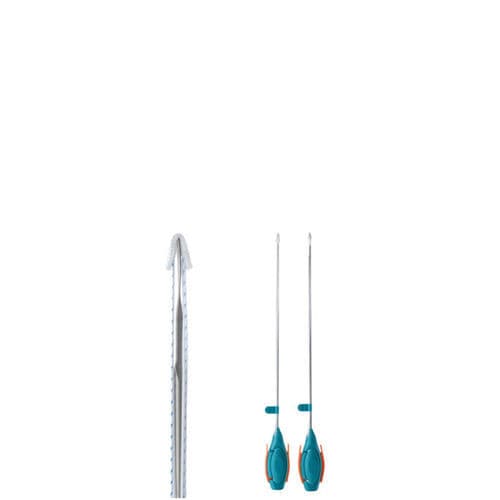
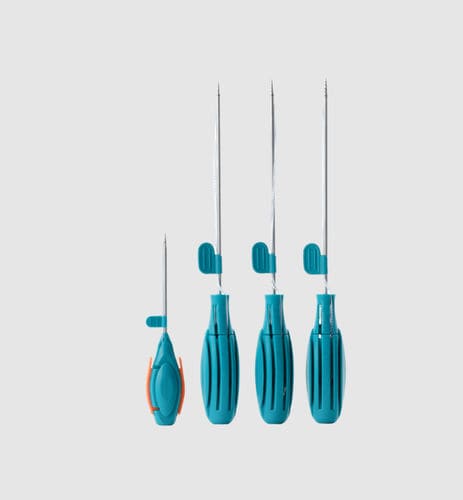
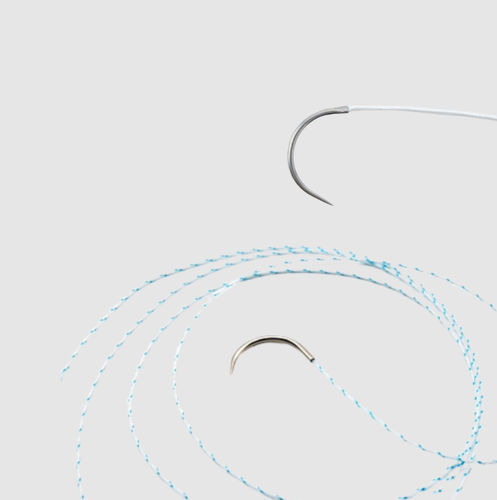
Orthosyn Medikal offers suture anchor systems used in orthopedic soft tissue fixation procedures. Depending on their specific indications, suitable suture anchors may be considered for ligament fixation techniques.
What Is the Calcaneofibular Ligament?
The calcaneofibular ligament is one of the three principal ligaments of the lateral ankle ligament complex, together with:
- Anterior Talofibular Ligament (ATFL): Connects the fibula to the talus and helps resist excessive anterior translation and inversion.
- Calcaneofibular Ligament (CFL): Connects the fibula to the calcaneus and contributes to ankle and subtalar stability.
- Posterior Talofibular Ligament (PTFL): Connects the fibula to the talus posteriorly and contributes to lateral ankle stability.
The CFL is particularly important in resisting excessive inversion, especially when the ankle is in a neutral or dorsiflexed position.
Damage to this ligament can contribute to mechanical instability and recurrent ankle sprains.
How Does a Calcaneofibular Ligament Injury Occur?
CFL injuries most commonly result from inversion trauma, when the foot twists inward beyond its normal range of motion.
The ATFL is usually injured first, while more severe injuries may also involve the CFL.
Common symptoms include:
- Pain and swelling around the lateral ankle
- Tenderness near the lateral malleolus
- Recurrent ankle sprains
- A sensation of ankle instability
- Difficulty during sports or activities involving rapid directional changes
Clinical examination and imaging, when indicated, help determine the extent of ligament damage and associated injuries.
When Is Calcaneofibular Ligament Repair Necessary?
Most acute lateral ankle ligament injuries can be managed without surgery through rehabilitation, progressive strengthening, and functional support.
Surgical treatment may be considered when patients experience persistent mechanical instability despite adequate conservative management.
Common indications include:
- Chronic lateral ankle instability
- Recurrent ankle sprains
- Persistent functional limitations
- Combined ATFL and CFL insufficiency
- Ligament damage suitable for anatomical repair
The decision to perform ligament repair or reconstruction depends on tissue quality, injury characteristics, patient activity level, and clinical findings.
How Is the Calcaneofibular Ligament Repaired?
CFL repair is commonly performed as part of a lateral ankle ligament stabilization procedure, often alongside ATFL repair.
Anatomical repair techniques aim to restore the ligament's attachment and improve lateral ankle stability.
coastsport.com.au
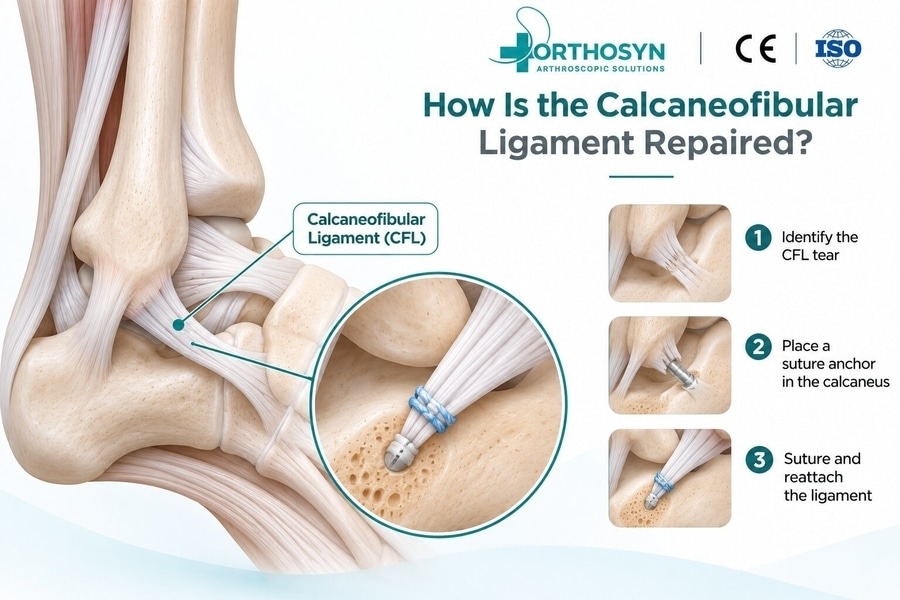
Illustrative lateral ankle anatomy showing the relationship between the fibula, calcaneus, and lateral ligament complex.
1. Surgical Exposure and Ligament Assessment
The surgeon accesses the lateral ankle through an open or minimally invasive approach, depending on the selected technique.
The ATFL, CFL, and surrounding structures are evaluated to identify damaged tissue and determine whether direct repair is feasible.
2. Preparation of the Ligament Attachment
The damaged ligament and its anatomical attachment site are assessed.
When necessary, the attachment area is prepared to facilitate fixation and healing.
The surgical objective is to restore the ligament as close as possible to its anatomical position.
3. Suture Anchor Placement
In selected repair techniques, a suture anchor may be inserted into the fibula near the anatomical attachment of the CFL.
The anchor provides a fixation point for sutures used to secure the ligament tissue.
Anchor selection depends on bone quality, ligament condition, anatomical requirements, and the device's approved indications.
4. Ligament Reattachment and Tensioning
Sutures are passed through the remaining ligament tissue and secured to the fixation point.
The surgeon adjusts ligament tension while maintaining appropriate ankle and subtalar joint positioning.
Correct tensioning is important because excessive tightening may restrict movement, while insufficient tension may leave residual instability.
5. Stability Assessment and Closure
After fixation, the surgeon evaluates ankle stability and joint movement.
The surgical site is then closed, and postoperative protection and rehabilitation are planned according to the repair technique and tissue condition.
What Is the Modified Broström Procedure?
The Modified Broström procedure is a commonly used anatomical technique for treating chronic lateral ankle instability.
It generally involves repairing the ATFL and, when indicated, the CFL.
The procedure may include reinforcement of the repaired ligaments using local tissue, as in the Broström-Gould modification.
Suture anchors can be used to facilitate ligament reattachment to bone in selected surgical techniques.
However, not every Broström procedure requires identical fixation methods or separate CFL repair.
What Is the Difference Between CFL Repair and Reconstruction?
Although both procedures aim to restore lateral ankle stability, repair and reconstruction use different surgical approaches.
Characteristic CFL Repair CFL Reconstruction
Surgical principle Reattachment or tightening of existing ligament tissue Replacement or reinforcement using a graft
Tissue requirements Sufficient native ligament tissue May be selected when native tissue is inadequate
Fixation methods Sutures, suture anchors, or other techniques Graft fixation using anchors, screws, or other devices
Common application Repairable ligament insufficiency Poor tissue quality, revision surgery, or selected complex instability
The choice depends on the condition of the native ligament and the patient's clinical requirements.
How Are Suture Anchors Used in CFL Repair?
Suture anchors are orthopedic fixation devices designed to attach soft tissue to bone.
In selected CFL repair techniques, an anchor can provide a stable point for sutures that secure ligament tissue near its anatomical attachment.
Different anchor designs may be used depending on surgical requirements.
Orthosyn Medikal offers several suture anchor configurations, including soft suture anchors, PEEK anchors, and titanium suture anchors.
Potential considerations when selecting an anchor include:
- Anchor diameter and design
- Available bone volume and quality
- Suture configuration
- Fixation technique
- Anatomical location
- Device-specific indications and instructions for use
The suitability of an Orthosyn anchor for CFL repair must be confirmed against its specific indications and surgical instructions.
What Factors Influence the Success of CFL Repair?
Several factors can affect the mechanical stability and biological healing of a repaired calcaneofibular ligament.
These include:
Ligament tissue quality: Adequate native tissue is important for successful direct repair.
Anatomical positioning: Restoring the ligament near its original attachment helps maintain appropriate joint mechanics.
Fixation stability: The fixation construct must withstand the forces encountered during the initial healing period.
Ligament tension: Appropriate tensioning helps balance stability with physiological joint movement.
Rehabilitation: Postoperative protection, progressive loading, strengthening, and proprioceptive training contribute to functional recovery.
Clinical outcomes also depend on associated injuries, patient characteristics, and adherence to rehabilitation protocols.
Conclusion
Calcaneofibular ligament repair is a surgical approach used to address selected cases of lateral ankle instability, particularly when the CFL is injured alongside the ATFL.
Anatomical repair techniques, including the modified Broström procedure, aim to restore ligament attachment and improve mechanical stability.
Suture anchors may be used to secure ligament tissue to bone, while ligament reconstruction may be considered when native tissue is insufficient.
Orthosyn Medikal's suture anchor portfolio provides soft tissue fixation options for orthopedic surgery. Appropriate device selection, anatomical repair, and postoperative rehabilitation remain essential considerations in lateral ankle ligament stabilization.
 鄂公网安备42018502009510号