#Product Trends
AI Morphology and Immunofluorescence on a Single Benchtop Platform
Seamaty VM2: Beyond the CBC
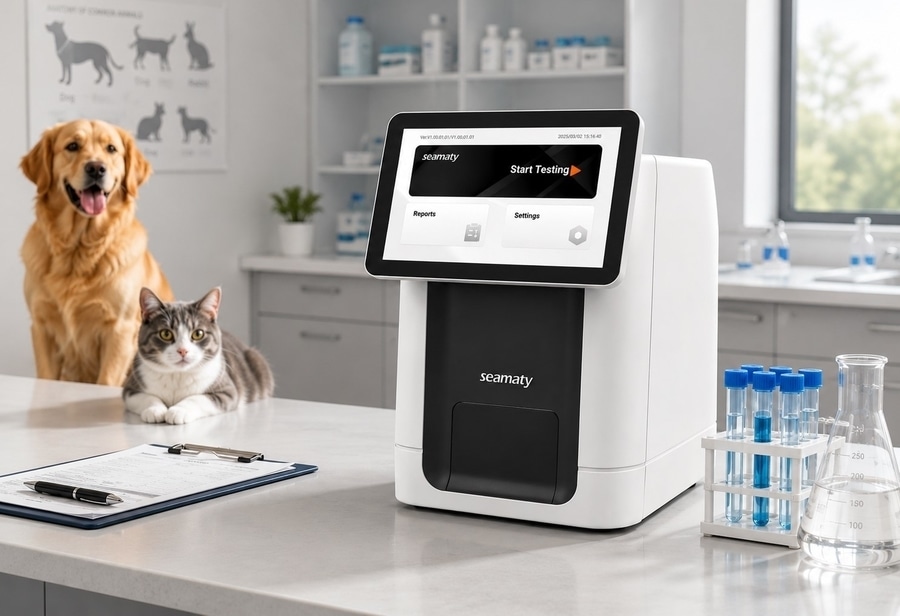
In veterinary in-clinic diagnostics, the hematology analyzer has long occupied a narrow lane: it counts cells, generates a differential, and stops there. Morphology review, when performed at all, means a separate manual slide scan or an external send-out. Immunoassays for inflammation, endocrine, or cardiac markers live on a different instrument — or in a reference laboratory. The Seamaty VM2 challenges that segmentation directly. It is a compact, reagent-free hematology platform with AI-assisted morphological evaluation and an integrated immunofluorescence module, built to consolidate diagnostic depth at the point of care.
1、Hematology with visual and algorithmic confirmation
The VM2 reports a 43-parameter CBC — 20 white-cell, 16 red-cell, and 7 platelet parameters — from 100 µL of whole blood, with a 20 µL trace mode for small or fragile patients. The leukocyte differential covers seven populations. But the analytical distinction lies in what happens alongside the count: the system captures high-resolution digital images of white cells, red cells, and platelets during each run and applies AI algorithms trained on veterinary-specific datasets to pre-classify cellular events and flag abnormal morphology. Flags include spherocytes, ghost RBCs, acanthocytes, stomatocytes, and platelet clumps, giving the clinician a visual gallery linked to the numeric result rather than a stand-alone flag with no morphological context. For sick-visit triage or pre-surgical screening, this means a morphology-supported CBC can be reviewed before the patient leaves the clinic, without a separate manual microscopy workflow.
2、Immunofluorescence extends the platform beyond cell counting
The built-in immunofluorescence module moves the VM2 from a hematology instrument into a multi-panel diagnostic hub. The current assay menu spans inflammation and pancreatic markers (c-CRP, f-SAA, cPL, fPL), renal function (SDMA), endocrine and reproductive hormones (TT4, TSH, cortisol, progesterone), cardiac markers (canine and feline NT-proBNP), and infectious-disease screening including parvovirus, distemper, heartworm, FeLV/FIV, and Giardia. Immunofluorescence turnaround is approximately 4–10 minutes depending on the assay, while the CBC plus morphology workflow runs in about 9 minutes. Validated species include dogs, cats, and 10+ exotic species — a breadth that matters for practices seeing rabbits, ferrets, or avian patients alongside canine and feline cases.
3、Workflow design that removes friction
The operational logic is deliberately lean. The hematology mode requires no liquid reagents, eliminating external reagent bottles, fluidic lines, and the maintenance burden that accompanies them. The interface is a 9-inch Android multi-touch screen, and reports print automatically via a built-in thermal printer. Results are accessible through browser or mobile via cloud connectivity, with LIS integration over WiFi or Ethernet and secure backup; onboard storage holds up to 500,000 patient records. The footprint is 275 × 235 × 289 mm at 8.3 kg, quiet enough for a benchtop in a treatment area or a mobile diagnostic unit.
4、What the VM2 changes for the clinic
The practical shift is not simply instrument consolidation. It is diagnostic sequence compression. A same-visit CBC with AI-assisted morphology flagging can be paired with an in-clinic cPL or fPL when pancreatitis is on the differential, a c-CRP or f-SAA to characterize an inflammatory response, or a TT4 when thyroid disease is suspected — without dispatching samples or waiting for a second analyzer to become available. For independent small-animal practices seeking reference-lab depth without a multi-instrument footprint or a reagent-volume commitment, the VM2 presents a coherent benchtop answer: hematology, morphology, and immunofluorescence in one workflow, on one screen, at the point of care.