#Industry News
The Installation of the Multifunctional High-Altitude Simulation System at the Client’s Site Has Been Successfully Completed
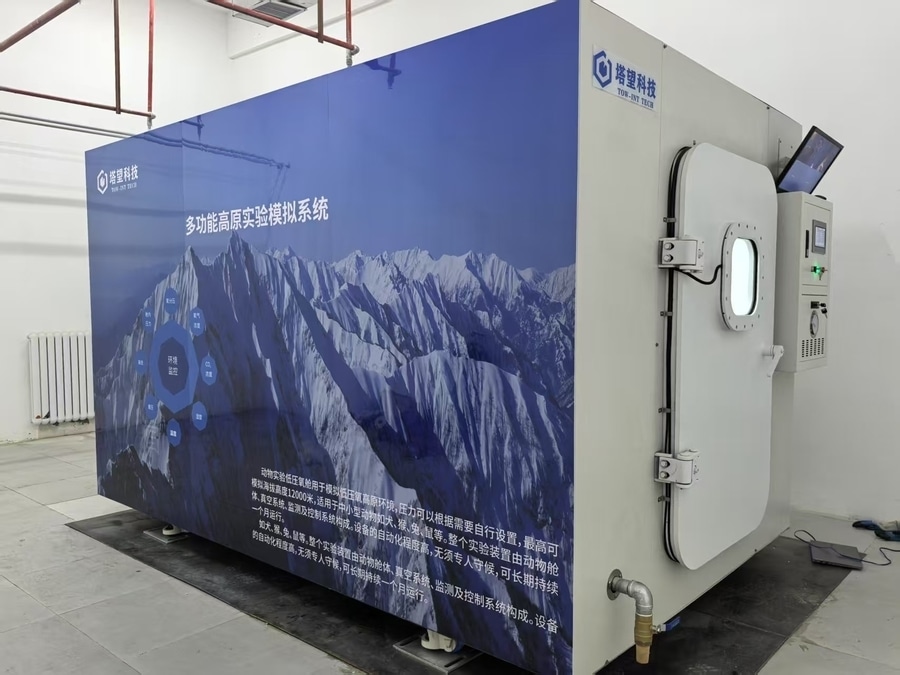
High-Altitude Simulation System Installed at the Client’s Site
In the fields of high-altitude medicine, biology, and related scientific research, simulating authentic plateau conditions is vital. The low-pressure, hypoxic characteristics of high-altitude environments significantly affect the physiological functions of both humans and animals, making it a long-standing focus in medicine, sports science, and military research. To achieve greater precision in replicating such environments, the Multifunctional High-Altitude Simulation System was developed.
Tow-Int Tech’s advanced simulation system acts as a "mobile plateau," creating a controlled platform for both **animal hypobaric hypoxia experiments** and **human low-pressure hypoxic training**, accelerating scientific breakthroughs.
Deployed at Renowned National High-Altitude Research Centers
1. Animal Hypobaric Hypoxia Experiments: A Window into Life's Adaptive Mechanisms
(1) Research Foundation
High-altitude hypoxia induces a wide range of physiological and pathological changes in animals. Simulated low-pressure hypoxic environments allow researchers to investigate adaptive mechanisms in:
Cardiovascular system (e.g., myocardial remodeling, pulmonary hypertension)
Respiratory system (e.g., altered breathing patterns, lung injury repair)
Nervous system (e.g., neurotransmitter shifts, cognitive impacts)
This provides vital theoretical support for the prevention and treatment of altitude illnesses, as well as for studies on the evolutionary adaptation of wildlife to high altitudes. Seminal works such as Fundamentals and Clinical Practice of High-Altitude Medicine provide a theoretical foundation for such experimental designs.
Key Research Objectives:
Investigating the pathogenesis of altitude illnesses
Testing protective effects of drugs or interventions against hypoxic injury
Exploring animal adaptation mechanisms in extreme environments
(2) System Advantages
The chamber accurately simulates low-pressure and hypoxic conditions corresponding to altitudes up to 12,000 meters, creating a stable and controllable plateau habita for test subjects. It supports multiple species including mice, rats, rabbits, and rhesus monkeys, meeting diverse experimental needs.
Equipped with an intelligent control system, it automatically adjusts pressure and oxygen concentration without requiring constant human supervision. A **comprehensive environmental monitoring system** tracks parameters like temperature, humidity, and gas concentration in real time, ensuring stability and reliable data throughout the experiment.
2. Human Hypobaric Hypoxia Training: Overcoming Altitude Adaptation Barriers
(1) Research Foundation
Following the principles of “live high–train low,” hypobaric hypoxia training stimulates physiological adaptations in humans, such as:
Increased red blood cell production
Enhanced oxygen utilization efficiency
Strengthened cardiovascular function
According to Exercise Physiology, well-designed hypoxic training can boost endurance, enhance acclimatization, and improve performance while offering potential therapeutic value for high-altitude illness.
Research Applications:
Simulating various altitude scenarios to optimize training programs
Developing and evaluating prevention/treatment for Acute Mountain Sickness (AMS)
Testing novel oxygen delivery equipment or anti-hypoxia medications
(2) System Advantages
The chamber features a container-style structure, providing ample space for human experimentation. It recreates hypobaric hypoxic environments for safe, controlled endurance training and pre-acclimatization.
From an operational perspective, experimenters can easily set parameters via smart terminals, with the system autonomously executing commands. Monitoring systems continuously track vital signs (e.g., heart rate, SpO₂) and environmental parameters, offering real-time alerts for safety.
Whether it’s for general population acclimatization, athlete performance enhancement, or high-altitude rehabilitation research, the chamber provides full-scenario adaptability, bridging science and real-world application.
System Advantages: A Versatile Partner on the Road to Scientific Discovery
True-to-Life Environmental Simulation
Precisely replicates high-altitude conditions, including regional specifics like the Qinghai-Tibet Plateau or Andes Mountains
Fully adjustable oxygen concentration and air pressure
Controlled temperature and humidity, ensuring experimental stability
Premium Experimental Conditions
Spacious design supports group housing for animals and movement for humans
Soundproof and vibration-damping structure minimizes external interference
Dedicated experimental benches and animal housing zones support long-term studies
Simplified Operations
Automated system streamlines the workflow, reducing labor and time costs
One-click altitude simulation mode switching
Remote monitoring and adjustment enhance safety and convenience
Comprehensive Monitoring and Detection
Real-time tracking of O₂, CO₂, temperature, humidity, and more
Integrated physiological monitoring systems for SpO₂, heart rate, EEG, etc.
Synchronized data recording and analysis to ensure data accuracy and safety
Flexible Compatibility
One system serves both animal and human experiments, reducing investment costs
Modular design allows for quick reconfiguration to suit diverse research needs
Ethical and safety compliance ensures welfare for both animals and human participants
This system offers invaluable support for cutting-edge research in:
✅ Development of novel altitude illness treatments
✅ Optimization of altitude training protocols for athletes
✅ Human adaptability studies under extreme environments
✅ Aerospace low-pressure hypoxia tolerance testing
Tow-Int Tech: Dedicated to Preclinical Animal Research
Specializing in controlled hypobaric hypoxia systems for laboratory animals, our platform is designed for both **acute** (e.g., high-altitude pulmonary/cerebral edema, altitude heart disease) and **chronic** (e.g., polycythemia, cardiovascular conditions) high-altitude disease modeling.