#Industry News
【New Product Release】Large Animal Energy Metabolism System
Large Animal Energy Metabolism System for Swine, Cattle Research
Energy metabolism is a fundamental characteristic of animal life and a central theme in animal nutrition research. Precise measurement of animal energy metabolism enables researchers to gain deep insights into energy requirements, energy utilization efficiency, and nutrient metabolism patterns. This provides a critical scientific basis for developing scientific feeding strategies, implementing precision nutrition, and ensuring effective health management.
I. The Scientific Significance of Energy Metabolism Measurement
Energy metabolism research plays an indispensable role in animal science. Respiratory calorimetry, recognized as the "gold standard" for measuring animal energy metabolism, accurately calculates an animal's heat production by measuring its oxygen consumption and carbon dioxide production over a specific period, based on the principles of the respiratory quotient and calorific value. This method not only allows for non-invasive, continuous, and precise measurement but also facilitates integrated studies by combining with other monitoring indicators, offering a powerful tool for unraveling the principles of animal energy metabolism.
As animal nutrition research progresses, energy metabolism studies are evolving: expanding from the whole-body level to tissues, cells, and even the molecular level; shifting from static observations to dynamic investigations; and developing from single-parameter analysis to integrated multi-omics approaches. These trends demand more from measurement technologies, requiring systems that are more precise, efficient, and automated.
II. Basic Principles of Respiratory Calorimetry
Indirect calorimetry determines total heat production by measuring an animal's oxygen consumption and carbon dioxide production over time, using these values to estimate the amount and type of metabolic substrates oxidized.
Host: Shenzhen Institute of Advanced Technology, Chinese Academy of Sciences
Chemical reactions adhere to the Law of Definite Proportions, meaning reactants and products are consumed and formed in fixed ratios. For example, oxidizing 1 mole of glucose requires 6 moles of O₂, producing 6 moles of CO₂ and 6 moles of H₂O, while releasing a specific amount of heat (ΔH). The reaction is: C₆H₁₂O₆ + 6O₂ → 6CO₂ + 6H₂O + ΔH. This proportional relationship remains constant regardless of intermediate steps or conditions. This same law applies to the oxidation of nutrients for energy within the body. The fundamental principle of indirect calorimetry leverages this definitive relationship. By measuring O₂ consumed and CO₂ produced, the amounts of carbohydrates, fats, and proteins oxidized within a certain period can be determined, allowing for the calculation of total heat released by the organism during that time.
III. System Components
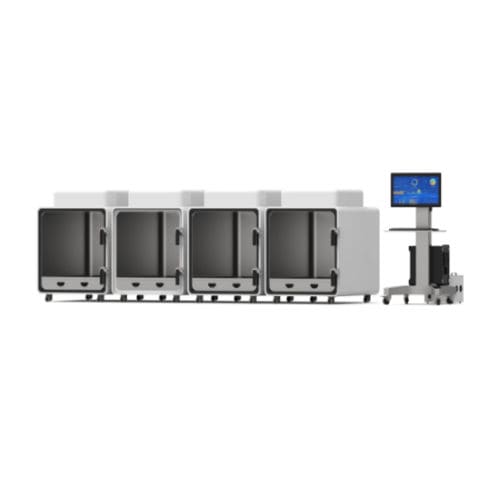
Shanghai TOW Technology's newly launched Large Animal Energy Metabolism System represents a comprehensive innovation and upgrade over traditional respiratory calorimetry techniques. It is specifically designed to meet the physiological characteristics and research needs of economically important animals such as pigs, cattle, sheep, and poultry.
TOW Tech offers various metabolic chamber models tailored to different experimental subjects and research objectives.
(1) Gas Sampling and Processing Subsystem
The system features a multi-channel sequential sampling design, enabling simultaneous monitoring of gas exchange from multiple individual animals. The gas sampling unit is equipped with high-quality particulate filters and desiccants to ensure the purity of the sampled gas.
(2) Airflow Control and Monitoring Subsystem
This subsystem incorporates precision mass flow controllers and pressure-temperature compensation devices to accurately control and monitor the gas flow rate entering the respiration chambers, achieving a flow control accuracy of ±0.2% of the full scale.
Addressing the challenge of large chamber volumes for big animals, the system employs a unique flow field optimization design. This ensures uniform gas mixing within the chamber, prevents dead spots, and guarantees the representativeness of the sampled gas.
(3) Data Acquisition and Processing Subsystem
An IoT-based intelligent data acquisition system collects, stores, and processes data from various sensors in real-time. Using specialized algorithms, it automatically calculates key parameters like heat production, respiratory quotient, and energy metabolic rate.
The system software is modular, featuring real-time monitoring, data visualization, anomaly alerts, and report generation functionalities. It supports remote access and operation, significantly enhancing experimental efficiency.
(4) Animal and Environmental Monitoring Subsystem
Beyond core gas exchange measurement, the system integrates modules for monitoring animal behavior and environmental parameters. Video tracking technology automatically records behaviors such as feeding, drinking, standing, and lying. Combined with synchronized monitoring of environmental temperature, humidity, wind speed, and light intensity, it provides comprehensive contextual data for energy metabolism studies.
IV. Technical Highlights
CollaborationPrecision Measurement Technology: Utilizes innovative technologies like temperature-humidity compensation algorithms, real-time baseline correction, and dynamic gas concentration equilibrium models, significantly enhancing measurement accuracy and stability. Overall system error is less than 2%, meeting the most stringent research requirements.
Multi-Animal Parallel Monitoring: An innovative multi-channel sequential sampling design, coupled with fast-response sensors and intelligent airflow control, enables parallel monitoring of up to 16 respiration chambers, drastically increasing experimental throughput.
Long-Term Stability: Key sensors are industrial-grade and feature automatic calibration functions, ensuring stable operation for months, suitable for long-term metabolic trials.
Intelligent Data Processing: A machine learning-based data quality control module automatically identifies and filters out anomalous data points, ensuring reliability. An intelligent early warning system monitors equipment status in real-time, providing alerts for potential issues.
Modular Design: The system's modular architecture allows users to flexibly configure measurement parameters and add functional modules based on research needs. This includes integrating ancillary equipment for monitoring feed intake, body temperature, and activity, enabling multi-dimensional integrated studies of energy metabolism.
V. Application Prospects & Research Directions
Precision Nutrition Research: Determine the energy requirements of animals across different breeds, physiological stages, and production goals. Establish accurate nutritional requirement models to provide a scientific basis for precision feeding.
Feed Nutritional Value Assessment: Accurately determine the energy digestibility, metabolizability, and net energy value of various feed ingredients. Develop more precise feed energy valuation systems.
Genetic Breeding Research: Compare energy utilization efficiency among animals with different genetic backgrounds. Identify superior germplasm that utilizes feed resources efficiently for breeding new varieties with high feed efficiency.
Environmental Physiology Research: Investigate the effects of environmental factors like temperature, humidity, and air quality on animal energy metabolism. Provide a theoretical basis for optimizing rearing environments and mitigating heat stress.
Shanghai TOW Technology is committed to providing the most advanced technological equipment and solutions for animal science research. The new Large Animal Energy Metabolism System embodies years of technical accumulation and innovation in the field of animal metabolic measurement. It breaks through the technical bottlenecks of traditional methods, achieving comprehensive improvements in measurement precision, throughput, and stability. We anticipate this system will become a powerful tool for researchers, aiding the advancement of animal energy metabolism research to new heights and contributing to the quality and efficiency improvements in China's animal husbandry sector.
Looking ahead, TOW Tech will continue adhering to the philosophy of "Technology Led, Innovation Driven," closely tracking cutting-edge research needs, and continually launching more high-quality scientific instruments. We aim to work alongside researchers to jointly promote progress and development in animal science.
To learn more about the technical details and application cases of our Large Animal Energy Metabolism System, please feel free to contact our technical team. We will provide professional technical consultation and customized solutions based on your specific research requirements.