#Product Trends
Core Value and Application of Vascular Calcification Models in Balloon R&D and Testing
Core Value and Application of Vascular Calcification Models in Balloon R&D and Testing
In the field of coronary intervention, vascular calcification has long been one of the most intractable challenges for interventional cardiologists. With the continuous innovation of interventional devices, including cutting balloons, scoring balloons, high-pressure balloons, intravascular lithotripsy (IVL) balloons, and spine balloons, medical device manufacturers are focusing heavily on verifying the safety, efficacy, and reliability of these devices for calcified lesion treatment. As a high-precision in vitro testing tool, the vascular calcification model provides solid scientific basis and reliable technical support for the iterative optimization and clinical verification of various balloon catheters, playing an irreplaceable role in the entire R&D lifecycle.
1. Core Value of Vascular Calcification Models
1.1 High-fidelity Restoration of Clinical Pathological Environments
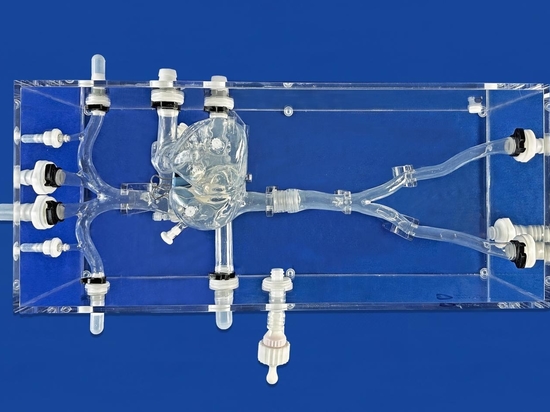
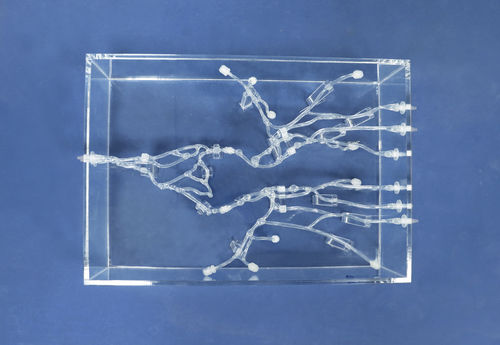
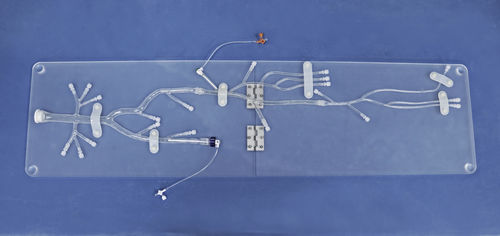
Our vascular calcification models are reconstructed and optimized based on authentic human CT and MRI data, adopting independently developed 3D printing technology and patented silicone materials. The 1:1 anatomical structure and inner diameter design perfectly restore the morphological characteristics of human blood vessels. Customizable calcified plaques with adjustable hardness, thickness, and morphology are embedded in transparent vascular models, accurately simulating mild, moderate, and severe calcification, as well as diverse lesion types including punctate, granular, annular, popcorn-shaped, and eccentric calcification distributed in the intima, media, and adventitia. This highly simulated pathological environment enables truly clinical-oriented performance testing for balloon devices.
1.2 Reduction of R&D Risks, Costs and Approval Cycles
The model effectively avoids the high costs and ethical risks of repeated animal experiments by completing preliminary device screening and performance verification in vitro. Defective designs can be eliminated at the early R&D stage, greatly reducing the failure risk of subsequent clinical trials. Moreover, standardized and objective test data obtained from vascular calcification models can be submitted to regulatory authorities such as NMPA and FDA as key evidence for product safety and effectiveness, significantly accelerating regulatory review and market approval procedures.
2. Practical Applications in Balloon Device Testing
The model supports comprehensive multi-dimensional performance testing for interventional balloons. It evaluates the trackability, deliverability, and flexibility of unexpanded balloons when passing through tortuous, stenotic, and rigid calcified vascular segments. It also verifies the dilation capacity of high-pressure balloons, including the cutting efficiency of cutting/scoring balloons on calcified rings and the plaque fragmentation effect of IVL balloons. In addition, it can detect extreme risks such as balloon rupture, coating peeling, and device fracture, helping confirm burst pressure and structural limits to ensure clinical safety.
Furthermore, the transparent model structure allows intuitive observation of the interaction between balloons and calcified plaques. It assists manufacturers in optimizing material selection, structural design, and pressure parameter setting, and supports in-depth research on plaque fragmentation mechanisms. It also enables horizontal comparison of different balloon technologies, providing data support for product innovation and market positioning.
3. Main Types and Advantages of Trandomed Vascular Calcification Models
As a leading domestic developer of vascular medial calcification models, Trandomed boasts mature material formulas and production processes. Our mainstream products include intimal and medial calcification models. The intimal calcification model adopts high-transparent soft silicone with embedded bionic calcified tissue, featuring adjustable hardness (20–50 Shore A), physiological compliance (2–1
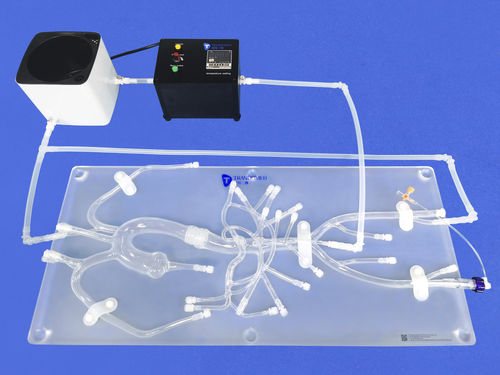
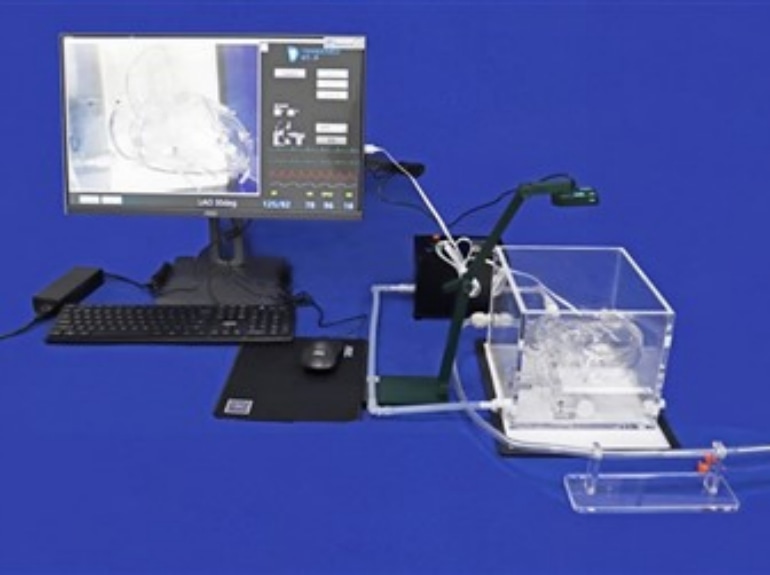
The self-developed medial calcification model features a dual-layer silicone structure, with calcified tissue accurately embedded between the intima and adventitia. The dual-hardness design perfectly restores real anatomical characteristics, and the transparent structure enables real-time observation of balloon dilation and plaque fracture. Combined with the Trandomed Simuheart pulsatile simulation system, the models can replicate real human hemodynamic conditions, achieving more accurate and comprehensive in vitro simulation. We also provide professional data certification and third-party testing assistance to fully support enterprises in efficient balloon R&D and regulatory declaration.