#Industry News
How to Boost Reproducibility in Airway Research & Clinical Training
How to Boost Reproducibility in Airway Research & Clinical Training
Poor experimental reproducibility has long plagued airway management research, respiratory device testing, and clinical skill training. Traditional airway training models suffer from oversimplified anatomical details, inconsistent mechanical feedback, and unrealistic surface texture. These flaws create significant data variability, making it hard to validate endoscopic navigation algorithms, test interventional device performance, and standardize clinical operation training outcomes.
In airway research, minor differences in airway resistance, mucosal lubricity, and structural morphology can lead to entirely different experimental results. Cadaver specimens and animal airway models, though biologically authentic, are limited by individual physiological differences, high batch-to-batch variability, ethical constraints, and short service life. Such instability severely hinders the reliability and repeatability of preclinical tests and algorithm verification, becoming a core bottleneck restricting the progress of respiratory medical research.
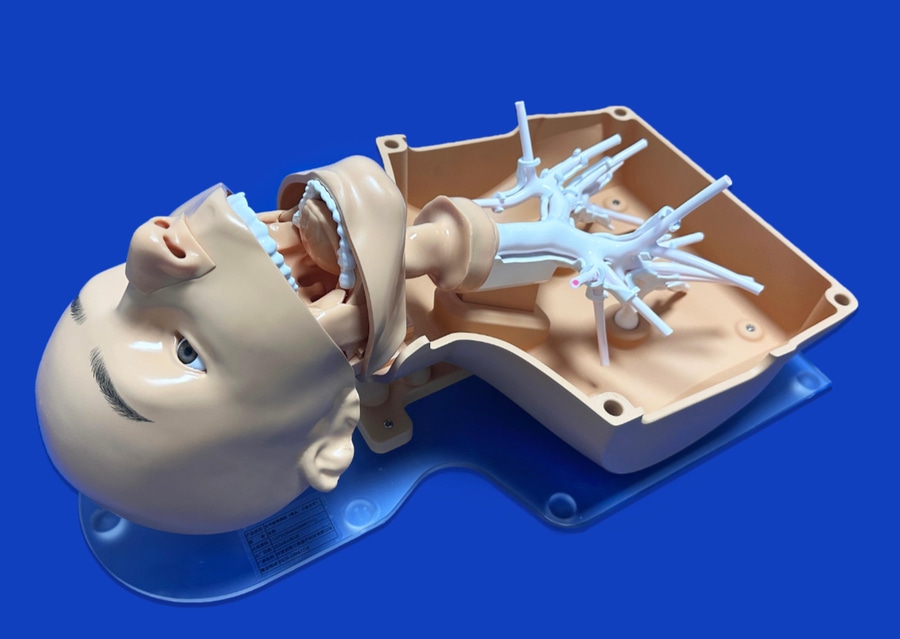
High-fidelity anatomical physical models have emerged as a gold-standard solution to address reproducibility challenges in airway research and training. To eliminate experimental deviation caused by model defects, Trando 3D launches the Classic Adult Bronchoscopy Model, tailored for standardized airway experimental research and high-precision clinical training.
This model features strictly precise anatomical restoration, fully reconstructed based on standard adult CT/MRI data with a 1:1 proportional ratio. It completely replicates the full airway structure from the nasal and oral cavity, pharynx, epiglottis, and vocal cords to the main bronchi and multi-level lobar bronchial branches, retaining fine anatomical details that traditional models ignore. This accurate structure ensures consistent spatial pathways for every bronchoscopy operation and device test, laying a solid foundation for unified experimental benchmarks.
Adopting exclusive biomorphic polymer materials, the model perfectly simulates the wetness, lubricity, elasticity and real mechanical feedback of human airway mucosa. It reproduces authentic tissue resistance during endoscopic advancement, torsion and intervention, perfectly matching the tactile feeling of real clinical bronchoscopy operations. Whether for diagnostic or therapeutic bronchoscopy trials, device passability testing, or endoscopic image algorithm recognition training, it delivers stable, realistic and highly consistent experimental feedback.
Beyond data stability, the standardized industrial manufacturing of this model eliminates individual differences in biological specimens, supporting long-term repeated experiments and cross-group comparative studies. It also complies with the international 3R ethical principles of animal experiments, effectively reducing reliance on animal and cadaver resources.
Ideal for respiratory and anesthesiology clinical skill training centers, bronchoscopic navigation algorithm validation, and respiratory interventional device testing, this high-fidelity airway model standardizes experimental conditions, unifies evaluation criteria, and fundamentally improves the reproducibility, credibility and clinical translational value of airway-related research.