#Product Trends
Coronary Intervention Training Model: A High-Fidelity Solution Beyond Physicians Alone
Coronary Intervention Training Model: A High-Fidelity Solution Beyond Physicians Alone
1. Why Coronary Intervention Simulation Matters
Coronary intervention is one of the most critical techniques in the treatment of coronary artery disease. It is highly precise, technically demanding, and allows very little margin for error. In real clinical environments, beginners struggle to gain hands-on experience, new devices are difficult to validate under realistic conditions, and standardized teaching remains a major challenge.
Against this background, a high-fidelity coronary intervention training model is no longer an optional educational tool—it has become essential infrastructure for hospitals, device companies, and research institutions. By closely replicating real anatomical structures and procedural conditions, it bridges the gap between theoretical knowledge and clinical practice, enabling safer, faster, and more consistent skill development.
2. Four Core Values of the Coronary Intervention Training Model
1. Realistic Anatomy Based on Clinical Data
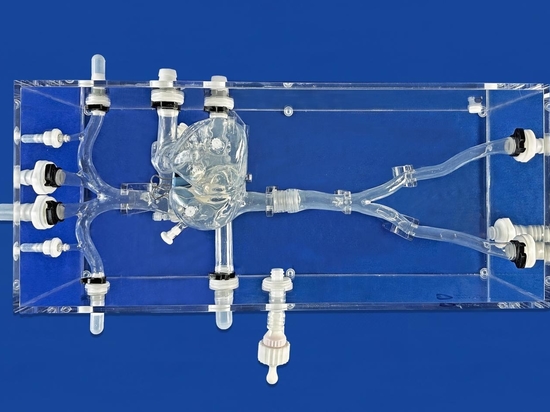
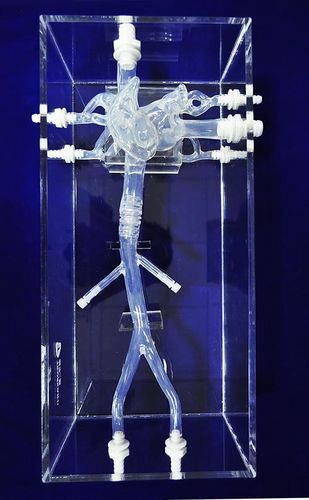
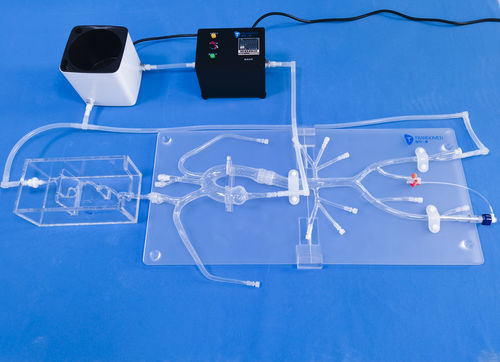
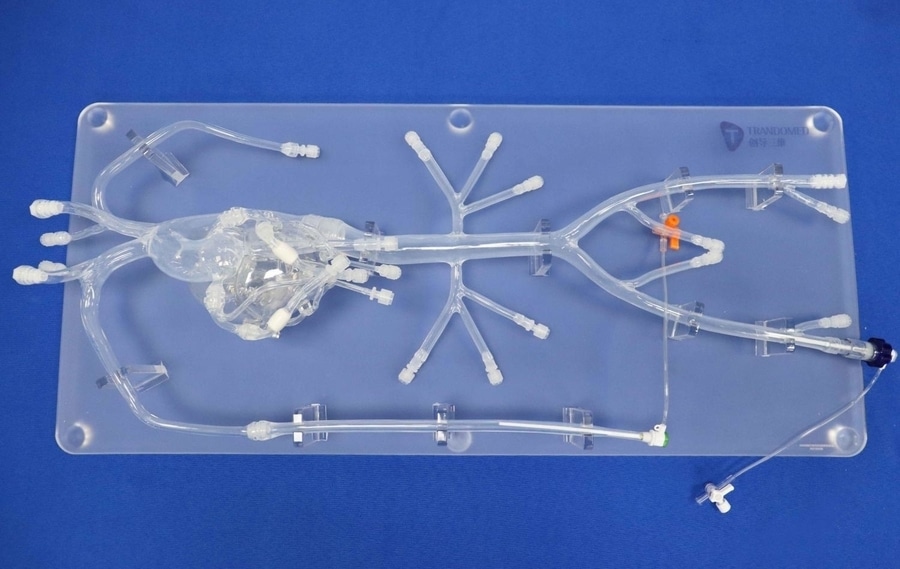
The model is reconstructed using real human CT coronary imaging data, accurately simulating the aorta, femoral artery, radial artery, and complete coronary circulation system. This ensures that trainees operate within a structure that closely mirrors true human anatomy, improving spatial understanding and procedural confidence.
2. Highly Realistic Haptic Feedback
Built with advanced biomimetic vascular materials, the model replicates the friction, elasticity, and resistance of real human vessels. When combined with optional pulsatile flow simulation, users experience realistic wire advancement, balloon inflation, and stent deployment sensations that closely match actual catheterization procedures in the cath lab.
3. Modular Lesion Design for Full Scenario Coverage
The system adopts a modular structure, allowing interchangeable pathological segments such as stenosis, bifurcation lesions, tortuous vessels, and chronic total occlusions (CTO). A single platform can therefore simulate a wide range of complex coronary cases, supporting repeated practice under different clinical scenarios without needing multiple models.
4. Full Compatibility with Interventional Devices
The model is compatible with mainstream coronary interventional devices including guidewires, catheters, balloons, stents, and rotational atherectomy systems. It can be used not only for training but also for device performance testing, R&D validation, and procedural optimization, making it a versatile tool across the entire product lifecycle.
3. Key User Groups and Application Scenarios
Hospital and Clinical Training Departments
For cardiology residents and junior physicians, the model provides a zero-risk environment for repeated practice of vascular access, wire manipulation, lesion crossing, and stent deployment. This significantly shortens the learning curve and reduces dependence on live patient procedures.
For senior physicians and department heads, it enables standardized teaching and unified procedural protocols. Complex cases can be pre-simulated before surgery, and post-operative review can be conducted in a controlled training environment, improving overall procedural success rates.
For catheterization lab teams, the platform supports rehearsal of new techniques and procedures before clinical implementation, reducing intraoperative uncertainty and enhancing patient safety.
Medical Device Companies
For R&D engineers, the model provides a realistic platform for early-stage device testing, including deliverability, trackability, and deployment behavior of new stents and catheters. This helps identify design issues early, reducing development cycles and rework costs.
For clinical application specialists and training teams, it serves as a powerful demonstration tool for hospital education, distributor training, and product promotion, significantly improving market adoption efficiency.
For regulatory and validation teams, the model supports preclinical simulation testing and documentation, improving the credibility of submission data and accelerating regulatory approval processes.
Academic and Research Institutions
For medical schools and universities, it transforms traditional anatomy teaching into hands-on procedural training, allowing students to understand coronary intervention from an early stage through real操作 rather than passive observation.
4. Advancing Safe and Standardized Coronary Training
Advancement in coronary intervention has always relied on repeated, risk-free practice. The Trandomed coronary intervention training model brings together anatomy realism, tactile fidelity, modular pathology, and full device compatibility into one integrated platform.
By shifting risk away from patients and into a controlled simulation environment, it enables physicians, engineers, educators, and students to refine their skills before entering the clinical setting. This not only improves individual competency but also supports broader standardization across hospitals and institutions.
Ultimately, Trandomed’s training system is not just a simulation device—it is a foundational tool for safer procedures, better-trained professionals, and more reliable cardiovascular innovation.